


Freshwater is essential for drinking, food production, sanitation, agriculture, and healthy ecosystems. Yet growing demand, pollution, drought, and changing weather patterns are putting increasing pressure on freshwater supplies around the world.
So, how can we do water conservation in everyday life?
It doesn’t have to be complicated. Simple habits such as fixing leaks, taking shorter showers, turning off the faucet while brushing your teeth, collecting rainwater, and finding safe ways to reuse water can significantly reduce water waste.
Conserving water also has benefits beyond saving water at home. Using less water can lower utility bills, reduce the energy needed to pump and treat water, and leave more freshwater available for rivers, wetlands, wildlife, agriculture, and communities.
In this guide, we’ll look at practical water conservation tips and easy ways to conserve water at home, outdoors, at work, and in your community.
Why Is Water Conservation Important?
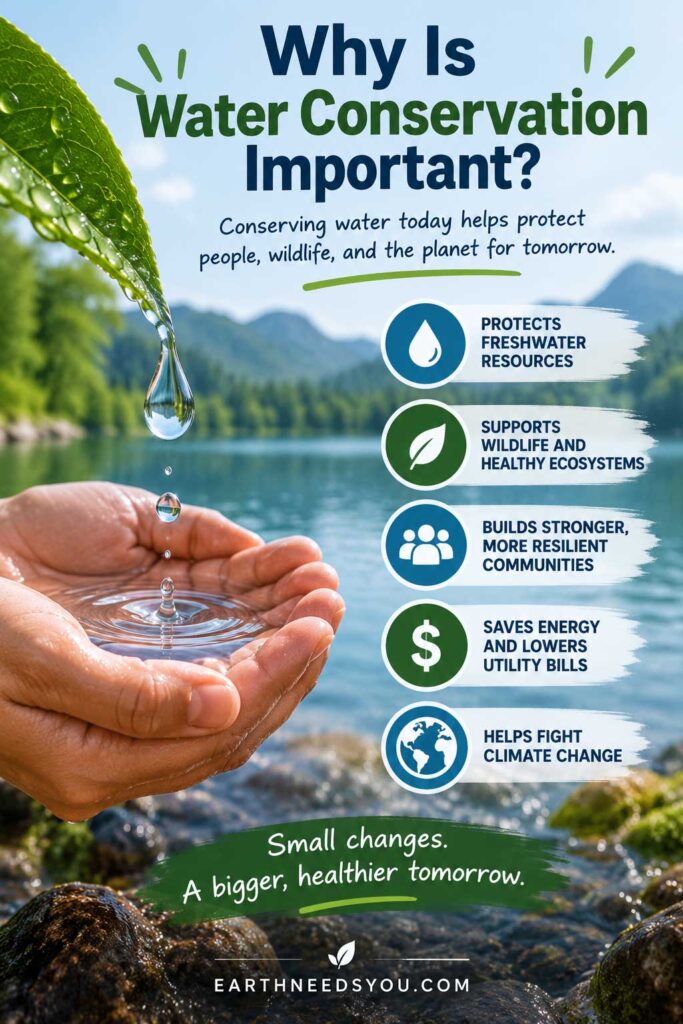
Water conservation matters because freshwater is limited, yet we depend on it every day for drinking, cooking, sanitation, farming, industry, and energy production. Rivers, lakes, wetlands, and groundwater also support wildlife and entire ecosystems.
The U.S. Environmental Protection Agency’s WaterSense program provides guidance on using water more efficiently in homes and businesses.
As demand for water grows and many regions face drought and changing rainfall patterns, using the water we already have more efficiently becomes increasingly important. Water conservation also works alongside broader water preservation techniques that help protect freshwater sources from depletion and pollution.
Protects Freshwater Supplies
Conserving water reduces pressure on rivers, reservoirs, lakes, and underground aquifers. This is especially important in areas where groundwater is being withdrawn faster than it can naturally recharge.
Using less water can also help communities maintain more reliable supplies during droughts and other periods when water becomes scarce.
Protects Rivers, Wetlands, and Wildlife
Conserving water isn’t only about maintaining supplies for people. Rivers, streams, lakes, and wetlands also provide essential habitat for fish, birds, amphibians, insects, and plants.
When too much water is withdrawn, water levels can fall and habitats can deteriorate. Better water conservation helps reduce that pressure and supports healthier freshwater ecosystems.
Saves Energy and Money
Water doesn’t simply appear when we turn on a faucet. It must often be pumped, treated, transported, and sometimes heated, all of which require energy.
Using less water can therefore reduce both water and energy consumption. At home, simple changes such as repairing leaks, taking shorter showers, and using efficient fixtures can also lower utility bills.
Supports Agriculture and More Resilient Communities
Agriculture depends heavily on reliable freshwater supplies, making efficient water use particularly important for food production. Better irrigation, healthier soils, and other water-saving farming practices can help farmers produce food while reducing pressure on freshwater resources.
Conservation also helps communities prepare for drought and periods of unusually high demand. Water management is also closely connected with land degradation, particularly in dry regions where restoring vegetation and soil can help prevent or reverse desertification. The less water that is unnecessarily wasted today, the more flexibility communities have when supplies become strained.
Did You Know? Even a small household leak can waste a surprising amount of water over time. Checking faucets, toilets, pipes, and outdoor connections regularly is one of the easiest ways to reduce water waste.
Water Conservation Benefits at a Glance
| Benefit | How It Helps |
|---|---|
| Protects freshwater | Reduces pressure on rivers, lakes, reservoirs, and aquifers |
| Saves money | Can reduce household water and energy bills |
| Conserves energy | Less water needs to be pumped, treated, and heated |
| Supports wildlife | Helps protect freshwater habitats |
| Supports agriculture | Encourages more efficient use of irrigation water |
| Prepares for drought | Helps communities manage limited supplies |
| Protects future supplies | Reduces unnecessary demand on freshwater resources |
Ultimately, water conservation isn’t about avoiding water use altogether. It’s about using water more efficiently and wasting less of it so that freshwater remains available for people, agriculture, wildlife, and ecosystems.
25 Practical Ways to Conserve Water Every Day
You don’t need to completely change your lifestyle to use less water. Some of the best water conservation methods are simple habits you can practice every day.
Here are 25 realistic ways to conserve water at home and outdoors.
1. Turn Off the Tap While Brushing Your Teeth
There’s no reason to leave the water running while you brush. Wet your toothbrush, turn off the faucet, and turn it back on when you’re ready to rinse. It’s a tiny change that quickly becomes a habit.
2. Fix Leaking Faucets and Pipes
Don’t ignore that slow drip in the kitchen or bathroom. Check faucets, toilets, outdoor spigots, and visible plumbing periodically. Fixing leaks is one of the easiest ways to reduce water waste without changing how you use water.
According to the EPA’s Fix a Leak program, household leaks collectively waste nearly one trillion gallons of water annually in the United States.
3. Take Shorter Showers
You don’t need to rush through every shower, but cutting a few unnecessary minutes can reduce both water use and the energy needed to heat it.
4. Install a Water-Efficient Showerhead
If you have an older showerhead, consider replacing it with a water-efficient model. Modern fixtures are designed to reduce flow without making your shower feel like a trickle.
5. Upgrade an Older Toilet
Older toilets can use considerably more water per flush than modern efficient models. If you’re already renovating a bathroom or replacing a toilet, water efficiency is worth considering.
6. Run Full Loads of Laundry
Whenever possible, wait until you have a full load before starting the washing machine. If you need to wash a smaller load, use the appropriate load or water-level setting if your machine provides one.
7. Fill the Dishwasher Before Running It
The same principle applies in the kitchen. Rather than running several partially filled cycles, wait until the dishwasher has a full load.
8. Collect Rainwater
A rain barrel can capture water from your roof for later use in the garden. Depending on local rules and conditions, collected rainwater can be useful for flowers, trees, shrubs, and other outdoor needs.
9. Water Plants in the Morning
Early morning is generally a good time to water because temperatures are cooler and less water is lost to evaporation than during the hottest part of the day.
10. Grow Plants Suited to Your Climate
Choose native and climate-appropriate plants when possible. Once established, plants adapted to local conditions may need less supplemental irrigation than species poorly suited to the area.
11. Add Mulch Around Plants
A layer of mulch around trees, shrubs, and garden plants can slow evaporation and help the soil retain moisture longer. As a bonus, mulch can also suppress weeds.
12. Water Deeply Instead of Constantly
Frequent shallow watering isn’t always the best approach. For many established landscape plants, slower and deeper watering encourages roots to grow farther into the soil. The right schedule depends on the plant, soil, weather, and local climate.
13. Sweep Patios and Driveways
A hose isn’t necessary every time you clean a driveway, patio, or sidewalk. For loose dirt, leaves, and debris, grab a broom instead.
14. Don’t Leave the Hose Running While Washing Your Car
If you wash your vehicle at home, use a bucket for most of the cleaning and a hose with a shut-off nozzle for rinsing. Another option is a commercial car wash that recycles some of its water.
15. Install Faucet Aerators
Faucet aerators mix air into the water stream and can reduce flow while still providing enough water for everyday activities such as washing your hands.
They’re inexpensive and are among the easiest water saving ideas to implement at home.
16. Keep Cold Drinking Water in the Refrigerator
If you regularly let the faucet run while waiting for cold water, keep a pitcher in the refrigerator instead. You’ll have cold water ready without sending perfectly usable water down the drain.
17. Give Some Household Water a Second Use
Some relatively clean household water can be reused rather than immediately discarded. For example, water used to rinse fruits and vegetables can sometimes be collected and used on suitable plants.
Be sensible about what you reuse, particularly if the water contains salt, cleaning products, grease, or other contaminants.
For more ideas, see our guide to 10 practical ways to reuse water around the home and garden.
18. Cover Your Swimming Pool
Pools continuously lose water through evaporation. A properly fitted pool cover can reduce that loss and may also help keep debris out of the water.
19. Pay Attention to Your Water Bill
A sudden increase in water consumption can be a warning sign that something has changed. If your habits haven’t changed but your usage has, check for leaking toilets, faucets, irrigation lines, and other possible problems.
20. Use Smarter Irrigation
Automatic irrigation systems can waste water when they run during rain or continue watering regardless of soil conditions.
Weather-based or soil-moisture controls can help irrigation systems respond to actual conditions rather than following the same schedule every day.
21. Teach Children to Save Water
Water conservation for families works best when everyone participates. Teach children to turn faucets off completely, avoid playing with running water unnecessarily, and tell an adult when they notice a leak.
22. Choose Water-Efficient Appliances
When your washing machine or dishwasher eventually needs replacing, compare water consumption as well as price, capacity, and energy efficiency. ENERGY STAR provides efficiency information that can help you compare dishwashers when it’s time for a replacement.
There’s usually no reason to replace a perfectly good appliance solely to save water, but efficiency is worth considering when it’s already time for a new one.
23. Don’t Automatically Water the Lawn
Don’t water the lawn just because the sprinkler is scheduled to run. Check the weather and soil conditions first, and follow any local watering guidance or restrictions.
Skipping unnecessary watering is one of the simplest ways to save water at home during the warmer months.
24. Report Major Public Water Leaks
Water conservation isn’t limited to your property. If you see a broken water main, damaged hydrant, or another significant public leak, report it to the appropriate local utility or authority.
25. Make Water Conservation a Habit
The most effective water conservation tips are the ones you actually continue using.
You don’t have to adopt all 25 ideas tomorrow. Start with the easiest changes—fix a leak, shorten a shower, stop running half-empty loads, or adjust your irrigation schedule. Once those become normal habits, look for another place where you can save water.
Small Changes Can Make a Real Difference
Learning how to save water isn’t about eliminating normal water use. It’s about noticing where water is being wasted and finding practical ways to use only what you need.
A few changes may seem insignificant on their own, but repeated every day across an entire household, they can add up to meaningful water savings over time.
How to Save Water at Home
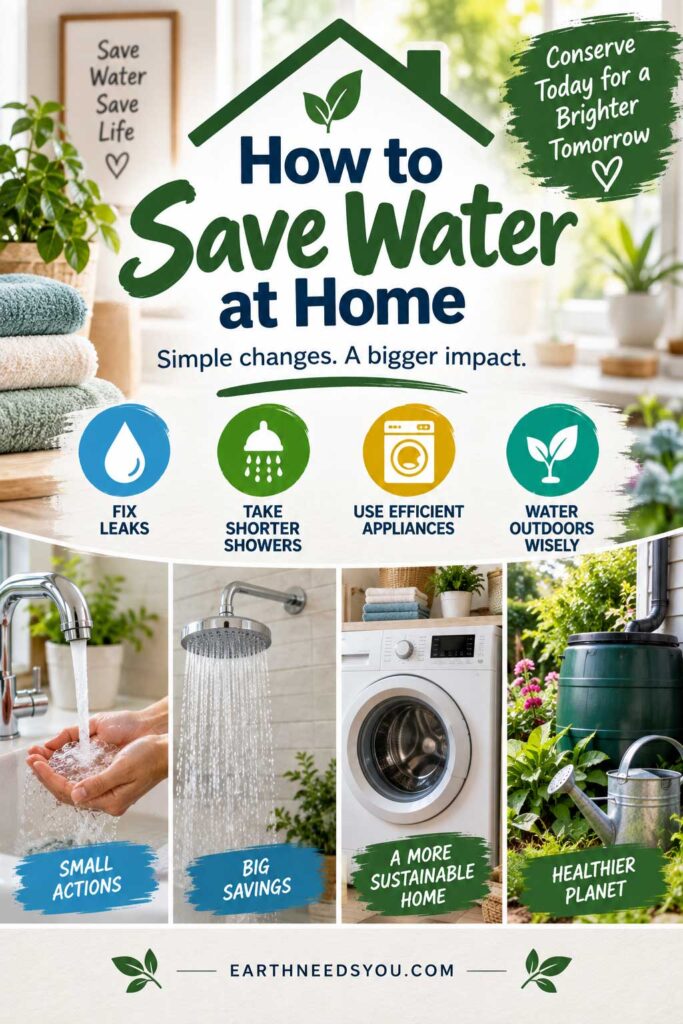
Many of the water-saving ideas above become easier to put into practice when you look at your home room by room. The bathroom, kitchen, laundry room, and yard are good places to start.
In the Bathroom
Focus first on leaks and unnecessary running water. Repair dripping faucets and leaking toilets, turn off the tap while brushing your teeth or shaving, and consider water-efficient showerheads and toilets when fixtures need replacing.
Shorter showers can also make a noticeable difference, especially in households where several people shower every day.
In the Kitchen and Laundry Room
Try to get the most out of every dishwasher and washing-machine cycle by running full loads whenever practical.
You can also keep cold drinking water in the refrigerator rather than waiting for the faucet to run cold. When washing fruits and vegetables, consider collecting the rinse water for plants when appropriate.
When it’s time to replace a dishwasher or washing machine, compare water efficiency along with energy use, capacity, and price.
In the Garden and Yard
Outdoor water use can climb quickly during hot, dry weather. Water plants when conditions are cooler, add mulch to help the soil retain moisture, and consider drip irrigation for garden beds.
Similar ideas can also help protect soil in dry areas. Here are 5 ways individuals can help stop desertification.
Choosing plants suited to your local climate can reduce the amount of supplemental watering they need once established. It’s also worth checking whether your lawn actually needs water before automatically turning on the sprinkler.
Rainwater can provide another useful source of water for gardens where collection is permitted.
Watch for Hidden Water Waste
Not every water problem is obvious. A leaking toilet, underground irrigation leak, or damaged pipe may continue wasting water without attracting much attention.
Keep an eye on your water bills and investigate unexpected increases in consumption. Smart leak detectors and water-monitoring devices can also help identify problems earlier.
Make Water Conservation Part of Your Routine
The goal of household water conservation isn’t to make everyday life inconvenient. It’s simply to stop using water when it isn’t providing any benefit.
Fix leaks when you notice them, don’t leave water running unnecessarily, use appliances efficiently, and pay attention to outdoor watering. Once these habits become routine, saving water at home requires very little extra effort.
Water Conservation at School, Work, and in Your Community

Saving water isn’t only something we can do at home. Schools, workplaces, businesses, farms, and local governments use large amounts of water too, which means improvements in these places can have an impact across an entire community.
Water Conservation at School
Schools use water in restrooms, cafeterias, drinking fountains, sports facilities, gardens, and landscaping. Fixing leaks quickly and installing water-efficient fixtures are practical places to start.
Schools can also turn conservation into a learning opportunity. Students can help identify dripping faucets, learn how much water everyday activities require, or participate in a garden that demonstrates rainwater collection and efficient irrigation.
Simple projects like these can help students understand where their water comes from and how everyday choices affect how much they use.
Saving Water at Work
The best approach for a workplace depends on the type of business. An office building, restaurant, hotel, factory, and landscaping company will all use water differently.
For a typical office, improvements might include efficient restroom fixtures, fixing leaks quickly, monitoring unusual changes in water use, and reducing unnecessary landscape irrigation.
For businesses that use large amounts of water for manufacturing, cleaning, cooling, or food preparation, tracking where that water goes can reveal opportunities to reduce waste or reuse water within certain processes.
What Communities Can Do
Some water loss happens before water ever reaches a home or business. Aging pipes and other infrastructure problems can waste treated drinking water, making maintenance and leak detection an important part of community conservation.
Local governments and utilities can also encourage conservation through water-efficient landscaping programs, rain barrel initiatives, public education, and incentives for certain efficiency upgrades.
Protecting rivers, wetlands, lakes, and groundwater from pollution is equally important. Better waste management matters too, which is one reason recycling is important for the environment beyond simply keeping materials out of landfills. Conservation and water quality go hand in hand: protecting the amount of freshwater available matters most when those water sources are also kept clean and healthy.
Water Conservation in Agriculture
Agriculture accounts for roughly 70% of global freshwater withdrawals, according to the Food and Agriculture Organization of the United Nations, making better agricultural water management especially important.
There isn’t one irrigation method that’s right for every farm. Depending on the crop, soil, climate, and available water supply, farmers may use drip irrigation, soil-moisture monitoring, improved irrigation scheduling, rainwater storage, or other techniques to reduce unnecessary losses.
Healthy soil can help as well. Soil with good structure and organic matter generally holds water better, potentially allowing crops to make better use of rainfall and irrigation.
Consumers have a role here too. Reducing food waste means fewer resources—including the water used to grow, process, and transport food—are spent producing food that is ultimately thrown away.
Individual habits matter, but some water problems require action beyond a single household.
Schools can teach better habits, businesses can improve efficiency, farmers can refine irrigation, utilities can repair infrastructure, and communities can protect the rivers and groundwater they depend on.
When those efforts happen together, water conservation becomes more than simply turning off a faucet. It becomes part of how a community manages and protects its freshwater resources for the long term.
Frequently Asked Questions About Water Conservation
What is water conservation?
Water conservation means using water efficiently and avoiding unnecessary waste. It includes everyday habits such as turning off running faucets and fixing leaks, as well as larger improvements such as efficient irrigation, appliances, plumbing fixtures, and water management systems.
What are the easiest ways to conserve water?
Start with the things you do every day. Turn off the faucet while brushing your teeth, fix leaks, take shorter showers, run full loads of laundry and dishes, and avoid watering lawns or gardens when they don’t need it. These simple water conservation tips don’t require major lifestyle changes.
How can I reduce water waste at home?
Look for water that’s being used without providing a real benefit. A dripping faucet, leaking toilet, unnecessarily long shower, half-empty washing machine, or sprinkler running after rain are all examples of avoidable water use.
Monitoring your water bill can also help you notice unusual changes that may indicate a hidden leak.
How does conserving water help the environment?
Using water more efficiently can reduce pressure on rivers, lakes, reservoirs, and groundwater supplies. It can also reduce some of the energy required to pump, treat, distribute, and heat water.
Leaving more water available in natural systems can also benefit wetlands, rivers, and the wildlife that depends on them.
Can water conservation lower my bills?
Yes. Using less water can lower your water bill where charges are based on consumption. Reducing hot-water use can also lower energy costs because less water needs to be heated.
The amount you save will depend on local utility rates, household size, your current water use, and the changes you make.
What is the difference between water conservation and water preservation?
The terms are closely related but have slightly different meanings.
Water conservation generally focuses on using water efficiently and reducing unnecessary consumption. Water preservation is a broader idea that can include protecting rivers, lakes, wetlands, groundwater, and other water resources from pollution, depletion, and environmental damage.
Both approaches ultimately support the same goal: keeping clean freshwater available for people and ecosystems over the long term.
Final Thoughts: Making Water Conservation Part of Everyday Life
Water conservation doesn’t have to mean major sacrifices. Often, it starts with noticing where water is being wasted and making a few practical changes.
Fixing leaks, turning off unnecessary running water, using appliances efficiently, improving outdoor watering, and choosing water-efficient fixtures can all help reduce water waste at home.
The same idea applies beyond the household. Long-term water preservation also depends on protecting the natural sources that supply our water. Schools, businesses, farms, utilities, and communities can all find ways to use freshwater more efficiently and protect the rivers, lakes, wetlands, and groundwater they depend on.
You don’t need to adopt every water-saving idea at once. Start with the changes that make sense for your home and daily routine. Over time, those habits can make water conservation something you do naturally rather than something you have to think about.
Keep Exploring Water & Environmental Solutions
Want to keep making practical changes? Explore these EarthNeedsYou guides on protecting water, reducing waste, and caring for natural resources:
- 10 Ways to Reuse Water — Simple ways to give water a second use around your home and garden.
- Water Preservation Techniques — Explore practical methods for protecting freshwater and reducing unnecessary water use.
- How Can We Prevent or Reverse Desertification? — Learn how water management, healthier soils, vegetation, and restoration can help degraded land recover.
- 5 Ways You Can Help Stop Desertification — Everyday actions individuals can take to support healthier soil, water, and ecosystems.
- Why Recycling Is Important for the Environment — See how recycling can conserve resources, reduce waste, and lessen environmental pressure.



0 Comments