

Trees are one of nature’s most effective tools for removing carbon dioxide from the atmosphere. As they grow, they absorb CO₂ through photosynthesis and use that carbon to build their trunks, branches, roots, and leaves while releasing oxygen back into the atmosphere.
But not every tree stores the same amount of carbon.
Large, long-lived trees can accumulate substantial amounts over their lifetimes, while fast-growing species may capture CO₂ more quickly during their early years. Where a tree grows matters too. Climate, soil, water availability, overall health, and lifespan can all influence how much carbon it ultimately stores.
So, which trees are particularly good at storing carbon?
In this guide, we’ll explore 10 carbon-storing trees, including oaks, pines, tulip trees, maples, sweetgum, and eucalyptus. We’ll look at what makes each one valuable for carbon storage, how large it can grow, and what you should know before planting one.
What Is Carbon Sequestration?
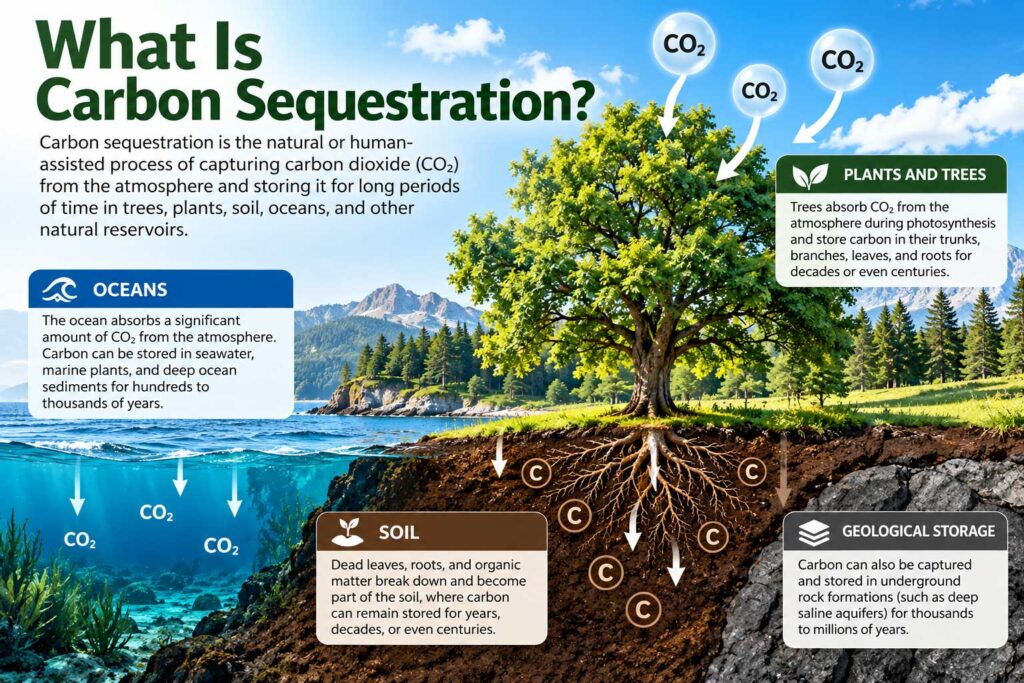
Carbon sequestration is the process of capturing carbon dioxide from the atmosphere and storing that carbon for a period of time.
Trees do this naturally through photosynthesis. As a tree grows, it takes in CO₂ and uses the carbon to build new leaves, branches, trunks, and roots. Some carbon also makes its way into the soil through roots, fallen leaves, and other organic matter. Other approaches to long-term soil carbon storage, including biochar, are also being studied and used in agriculture and land management.
Trees aren’t the only place that carbon ends up. Forests also store carbon in living vegetation, dead wood, leaf litter, roots, and soil.
This is one reason protecting mature forests is so important. Planting new trees can help capture additional CO₂ over time, but keeping established forests intact protects the large amounts of carbon they already store.
What Makes a Tree Good at Storing Carbon?
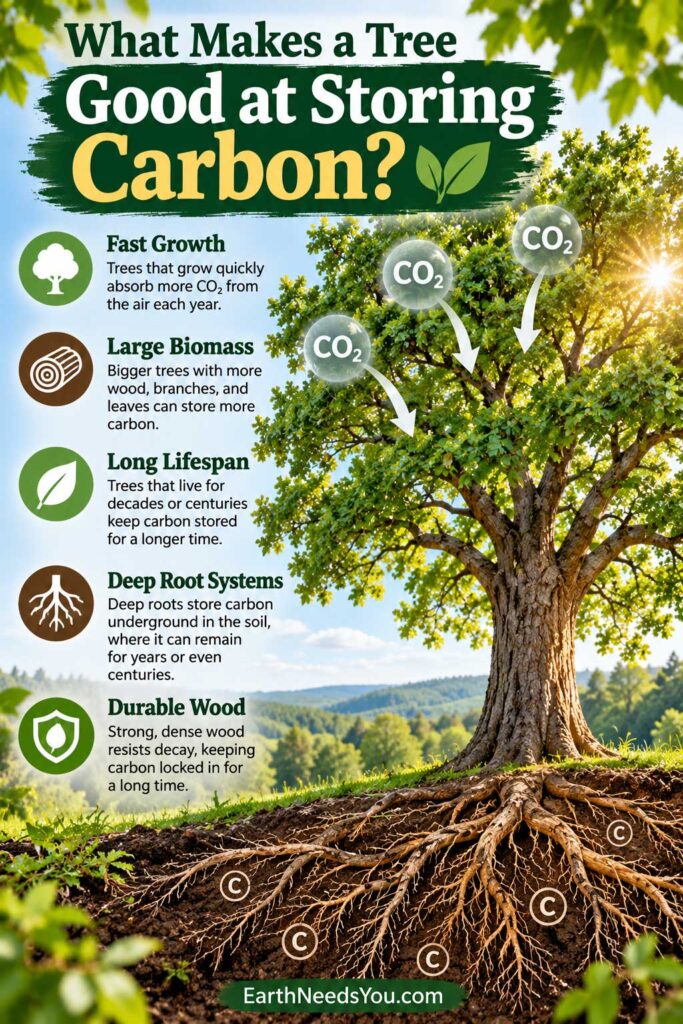
There isn’t one tree species that will always capture and store the most carbon. How much a tree stores depends on a combination of its size, growth rate, wood density, lifespan, and the conditions where it grows.
Large trees have an obvious advantage because they can accumulate enormous amounts of woody biomass over time. Fast-growing species can also absorb CO₂ quickly while adding new trunks, branches, and roots, although fast growth doesn’t automatically mean greater carbon storage over an entire lifetime.
Wood density plays a role as well. Two trees can be roughly the same size yet contain different amounts of carbon because their wood density and structure differ.
Then there’s longevity. Some trees can survive for hundreds of years, continuing to accumulate carbon as they grow. Keeping those trees healthy and standing also helps keep much of that carbon stored rather than returning it to the atmosphere through decomposition or burning.
But species is only part of the equation. Soil, rainfall, temperature, available space, pests, disease, and competition from surrounding plants can all affect how well a tree grows.
That’s why the right tree in the right place is usually more valuable than simply choosing a species because it appears on a list of fast-growing or high-carbon trees.
How Much CO₂ Can a Tree Absorb?
You may have seen claims that a particular tree absorbs a specific number of pounds of carbon dioxide every year. In reality, it isn’t that simple.
There is no single CO₂ absorption rate that applies to every oak, pine, maple, or eucalyptus. Even two trees of the same species can store very different amounts of carbon.
A tree’s carbon uptake changes as it grows and depends on factors such as its age, size, health, climate, soil, water availability, and growing conditions. The EPA likewise notes that tree carbon sequestration depends on growth rate, species, age, location, and other conditions. A young sapling, for example, won’t absorb the same amount of CO₂ as a large, established tree.
Scientists can estimate how much carbon a tree stores by looking at its size, species, and biomass. That’s more useful than assigning one annual CO₂ figure to every tree of a particular species.
For homeowners and communities, the takeaway is straightforward: choose trees suited to the local environment, give them enough room to reach maturity, keep them healthy, and protect existing large trees whenever possible.
A tree that survives and continues growing for decades can ultimately be far more valuable for carbon storage than a poorly suited tree that grows quickly but dies young.
A Real-World Example
The carbon stored by trees becomes much easier to appreciate when we look at an entire urban forest.
A U.S. Forest Service analysis estimated that Des Moines, Iowa, has about 2.5 million live trees storing roughly 466,000 tons of carbon, equivalent to about 1.7 million tons of CO₂. Those trees were also estimated to remove approximately 44,000 tons of CO₂ per year.
The numbers won’t be the same in every city or forest. Tree size, species, density, age, climate, and growing conditions all affect carbon storage. But the example shows how millions of individual trees can collectively become a substantial carbon reservoir. Forests are a natural form of carbon capture, while engineered approaches such as carbon capture technology attempt to capture CO₂ from industrial and energy sources.
10 Carbon-Storing Trees Worth Knowing
The trees below aren’t ranked from best to worst. Each has characteristics that can make it valuable for capturing and storing carbon when grown in suitable conditions.
Of course, carbon storage isn’t the only consideration when planting a tree. Climate, available space, water needs, native range, potential invasiveness, and effects on the surrounding ecosystem should all be considered.
With that in mind, here are 10 carbon-storing trees worth knowing.
1. Pine Trees
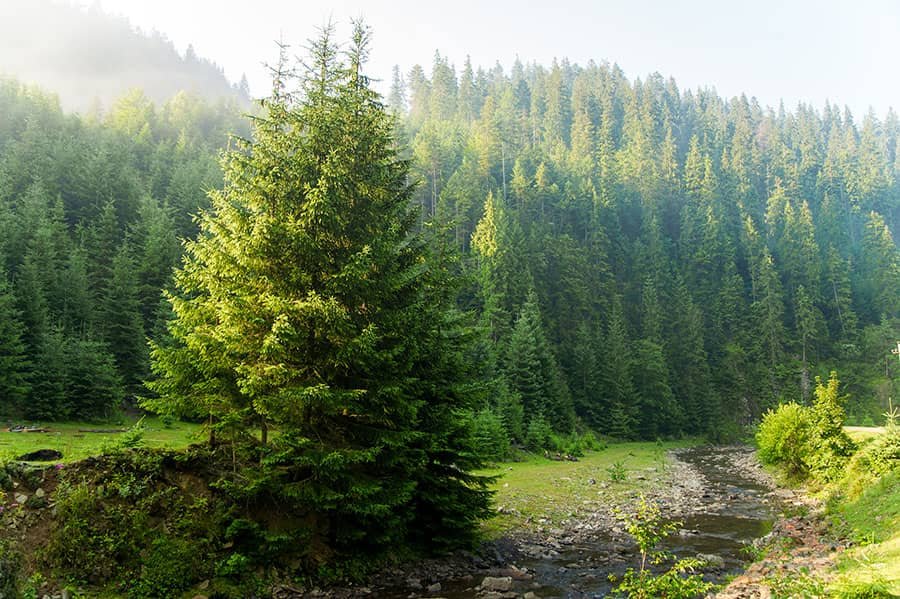
Pines are among the most widespread conifers in the world, with more than 100 species in the genus Pinus. They are found naturally across much of the Northern Hemisphere, from cold northern forests to warmer mountainous and coastal regions.
Their value for carbon storage comes from a combination of growth, size, and longevity. As pine trees grow, carbon becomes stored throughout their trunks, branches, and roots. In a forest, additional carbon can accumulate in dead wood, fallen needles, and soil.
Some pine species grow relatively quickly, while others can live for hundreds of years. Certain species can survive for far longer under the right conditions. This means the carbon-storage potential of a pine can vary enormously depending on the species and where it grows.
Why Pines Can Be Good Carbon-Storing Trees
Pines can develop substantial woody biomass and are often capable of growing on sites where other large trees may struggle. Their evergreen needles also allow many species to photosynthesize during periods when nearby deciduous trees have no leaves, although actual carbon uptake still varies with temperature, moisture, and other conditions.
Large-scale pine forests can hold significant amounts of carbon, but the trees are only part of that storage. Forest soils, roots, dead wood, and organic matter also contribute to the ecosystem’s total carbon stock.
Choosing the Right Pine
There is no single growing recommendation that applies to every pine. Depending on the species, pines can tolerate conditions ranging from cold climates and poor soils to relatively dry environments.
Choosing a pine native or well adapted to your region is important. Some species need considerable space as they mature, and planting a large pine too close to buildings, utility lines, or other infrastructure can create problems later.
Pines can also be affected by drought, wildfire, insects, and diseases. These risks vary considerably by species and location.
For long-term carbon storage, the goal isn’t simply to plant the fastest-growing pine available. A healthy species suited to the local environment and capable of remaining in place for many decades is usually the better choice.
2. Tulip Tree (Yellow Poplar)
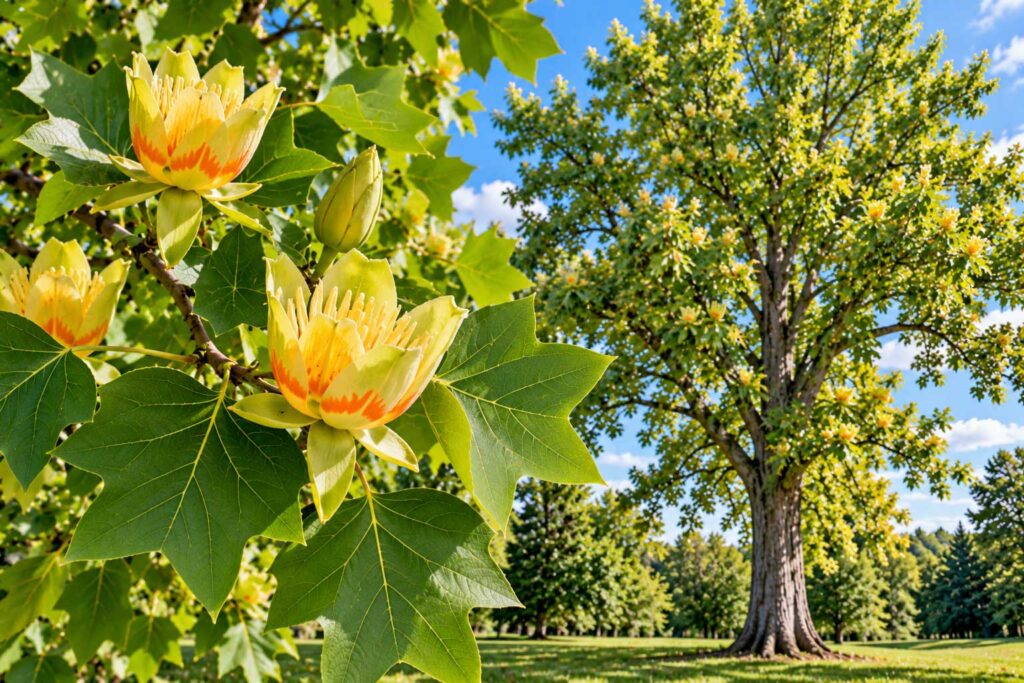
The tulip tree (Liriodendron tulipifera), also called yellow poplar or tulip poplar, is a large deciduous tree native to eastern North America. Despite its common name, it isn’t a true poplar. It belongs to the magnolia family.
Tulip trees are notable for their combination of rapid growth and impressive mature size. Under favorable conditions, they can grow into very large trees, developing tall, straight trunks and substantial amounts of woody biomass.
Why Tulip Trees Can Be Good Carbon-Storing Trees
Tulip trees can add significant biomass as they mature, storing carbon in their trunks, branches, and extensive root systems.
Their relatively fast growth is another advantage. Young and middle-aged trees can add substantial new wood when growing under favorable conditions, although the actual amount of CO₂ captured varies from tree to tree.
Tulip trees can also live for many decades, and some individuals survive for centuries. That gives healthy trees plenty of time to continue accumulating carbon as they increase in size.
Beyond carbon storage, their flowers provide nectar for pollinators, while their seeds can provide food for birds and other wildlife.
Rather than assigning every tulip tree a fixed number of pounds of CO₂ per year, it is more useful to think about its lifetime potential. A healthy tree with enough room to reach a large size can accumulate substantial woody biomass over many decades.
For properties within its suitable growing range, a tulip tree can be a strong choice when the goal is to establish a large, long-lived shade tree that also stores carbon.
Where Tulip Trees Work Best
Tulip trees perform best where they have plenty of room to grow. They generally prefer moist, well-drained soil and good sunlight, and their eventual height makes them better suited to spacious yards, parks, and larger landscapes than small planting areas.
Their mature size also means they shouldn’t be planted directly beneath power lines or too close to buildings.
As with any tree planted for carbon storage, long-term survival matters. Choosing an appropriate location where a tulip tree can remain healthy and undisturbed for decades is more important than simply choosing it because it grows quickly.
3. Oak Trees

Oak trees belong to the genus Quercus, a large group containing hundreds of species found across much of the Northern Hemisphere and beyond. Depending on the species, an oak may grow into a massive shade tree or remain relatively small.
For carbon storage, the large tree-forming species are especially interesting. Many oaks grow for centuries and develop thick trunks, extensive branches, and large root systems. All of that living biomass contains stored carbon.
Oaks don’t always grow as quickly as some of the other trees on this list, but carbon storage isn’t simply a race to grow the fastest. Their ability to become large and remain part of a landscape for generations can make them valuable long-term carbon stores.
Why Oaks Can Be Good Carbon-Storing Trees
One of the biggest advantages of oaks is their combination of size, wood density, and longevity. As an oak adds new wood each year, more carbon becomes incorporated into its trunk, branches, and roots.
Large, mature oaks can contain far more biomass than young trees, which is another reason preserving existing trees is important alongside planting new ones.
Oaks can also provide considerable ecological value. Their acorns feed birds and mammals, while their leaves, bark, branches, and cavities can provide food and habitat for numerous insects and other wildlife.
Because there are so many oak species, it’s often possible to select one adapted to the climate and soil conditions of a particular region.
Oaks are a good example of why protecting the trees we already have matters.
They may take time to reach their full size, but a healthy oak can continue accumulating woody biomass for many decades and potentially centuries. Removing a large established oak and replacing it with a small sapling doesn’t immediately replace the carbon stored in the mature tree.
If you have space for one, planting a locally appropriate oak—and allowing it to remain in the landscape for the long term—can provide both carbon storage and valuable wildlife habitat.
Give Oaks Room to Grow
Growing requirements vary considerably among oak species. Some tolerate relatively dry soils, while others perform better in moist conditions. Mature size can also range dramatically.
Before planting, choose a species suited to your region rather than selecting an oak based only on appearance or growth speed. Native species can be particularly valuable where supporting local biodiversity is also a priority.
Give large-growing oaks plenty of room for their canopy and roots to develop. With the right location and proper care during establishment, an oak planted today could remain part of the landscape for generations.
4. Silver Maple
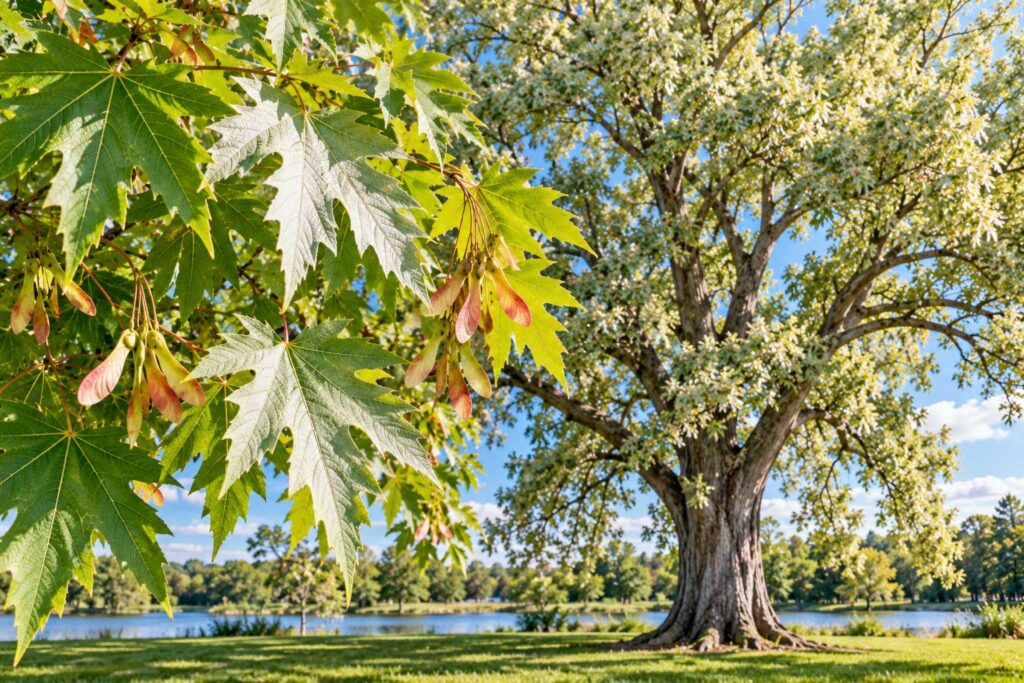
Silver maple (Acer saccharinum) is a fast-growing deciduous tree native to eastern and central North America. It is commonly associated with riverbanks, floodplains, and other moist areas, although it has also been widely planted as a shade tree.
Its rapid growth and ability to become a large tree make silver maple interesting from a carbon-storage perspective. When conditions are favorable, it can add substantial amounts of woody biomass over a relatively short period compared with many slower-growing trees.
That fast growth, however, comes with trade-offs.
Why Silver Maples Can Be Good Carbon-Storing Trees
Silver maples can grow quickly and develop broad crowns, large trunks, and extensive root systems. As that biomass increases, carbon captured through photosynthesis becomes incorporated into the growing tree.
Their relatively rapid early growth can make them useful where establishing tree cover quickly is desirable.
Silver maples also have ecological value within their native range. Their flowers provide an early-season food source for pollinators, while their seeds and other parts of the tree are used by birds and wildlife.
But carbon storage shouldn’t be evaluated by growth rate alone. A tree’s long-term survival and suitability for the planting location are just as important.
A silver maple with enough room to mature can develop considerable biomass. Planting one in the wrong location, however, can lead to conflicts with pavement, structures, or utilities and may result in the tree being removed long before it reaches its full potential.
For carbon storage, a well-placed tree that remains standing for decades is far more useful than one that grows quickly but has to be removed prematurely.
Where Silver Maple Makes Sense
Silver maples generally perform well in moist soils and tolerate periodic flooding, although established trees can adapt to a range of conditions.
They need plenty of space. Their roots can spread aggressively near the surface and may interfere with sidewalks, driveways, drainage systems, and other infrastructure when planted too close.
The wood is also relatively weak compared with some slower-growing hardwoods, making branches more susceptible to breakage during storms.
For these reasons, silver maple can be a useful large tree in an appropriate landscape, but it isn’t necessarily the best choice for small yards or locations close to buildings and paved areas.
5. Horse Chestnut
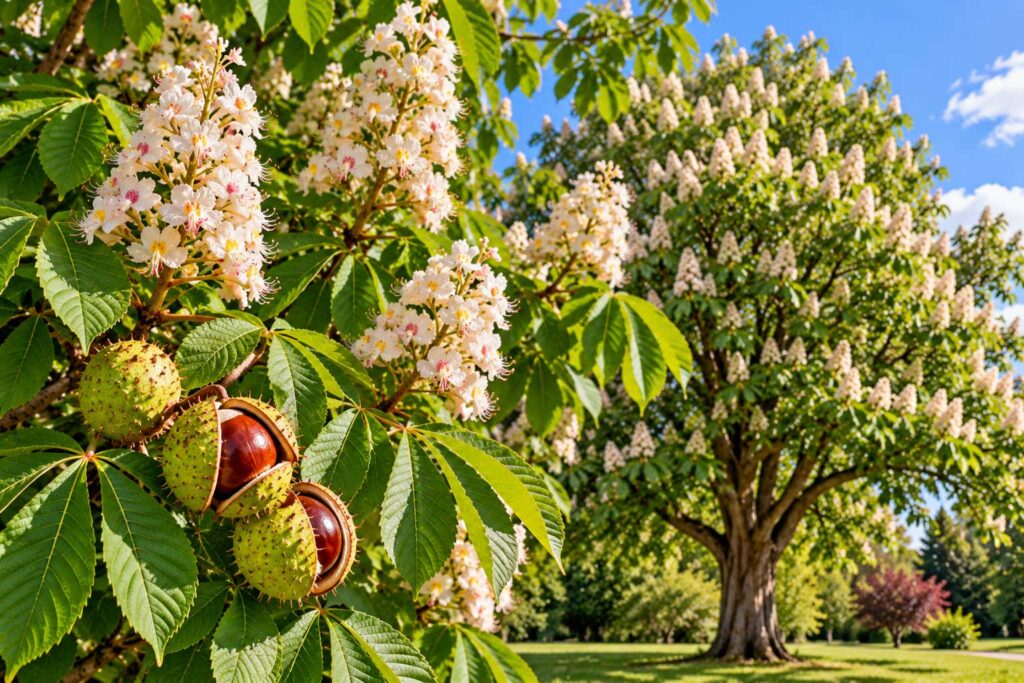
Horse chestnut (Aesculus hippocastanum) is a large deciduous tree native to parts of southeastern Europe. It has been planted widely elsewhere, particularly in parks, large gardens, streets, and avenues, where mature trees are easily recognized by their broad crowns and showy clusters of flowers.
Unlike some of the fastest-growing trees on this list, horse chestnut’s carbon-storage value comes largely from its ability to develop substantial woody biomass and survive for a long time when conditions are favorable.
Why Horse Chestnuts Can Be Good Carbon-Storing Trees
Horse chestnuts can grow into large trees and may live for several centuries. As they mature, increasing amounts of carbon become stored in their trunks, branches, and roots.
Their flowers are another benefit, providing nectar and pollen for bees and other insects during the flowering season.
However, the carbon-storage potential of any horse chestnut depends heavily on tree health. Disease, pests, drought, and unsuitable planting conditions can shorten its lifespan and reduce the amount of time it remains a functioning carbon store.
Horse chestnut shows why longevity can be just as important as rapid growth when considering carbon-storing trees.
A healthy tree that becomes large and remains in place for generations can gradually build a substantial amount of woody biomass. Its long-term value therefore depends less on achieving an exceptionally high annual growth rate and more on reaching maturity and remaining healthy.
Where horse chestnut is well suited to local conditions, giving it enough room to develop its full canopy and root system can help maximize that long-term potential.
Before Planting a Horse Chestnut
Horse chestnuts need enough space to accommodate their mature size, making them better suited to parks, large gardens, campuses, and other spacious landscapes than small yards.
Tree health is an important consideration. Horse chestnuts can be affected by several pests and diseases, and their suitability varies by region.
Their large seeds, commonly called conkers, should also not be confused with edible sweet chestnuts. Raw horse chestnut seeds are not safe to eat.
Before planting one specifically for carbon storage, consider whether the species is appropriate for your climate and whether a locally native tree could provide similar carbon-storage benefits while offering greater value to the surrounding ecosystem.
6. London Plane Tree
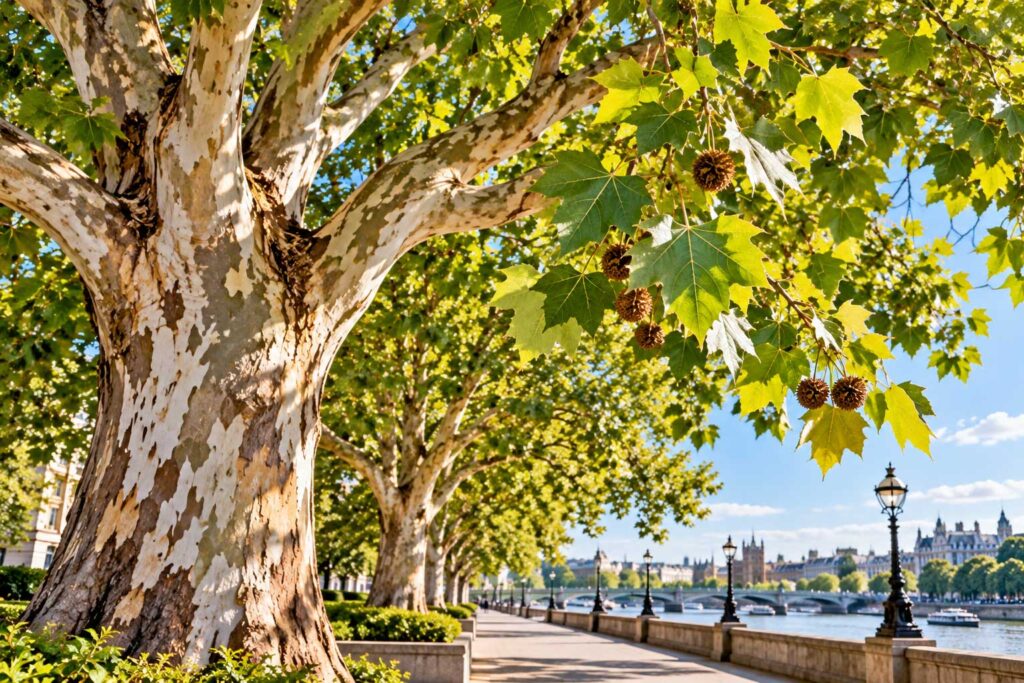
The London plane (Platanus × acerifolia) is a large deciduous tree widely planted along streets and in parks and other urban landscapes. It is generally considered a hybrid involving the American sycamore and Oriental plane.
One reason the London plane has become such a familiar city tree is its ability to tolerate conditions that can be difficult for many other large species, including compacted soil and urban pollution.
For carbon storage, its biggest advantage is simple: London planes can get huge.
Why London Plane Trees Can Be Good Carbon-Storing Trees
London plane trees can develop massive trunks, broad crowns, and substantial branch systems. As the tree grows and adds woody biomass, it stores carbon captured from the atmosphere.
Its tolerance of urban environments can also be an advantage. A species capable of surviving and reaching a large size along suitable streets, in parks, and in other developed areas may provide long-term carbon storage where more sensitive trees struggle.
Large urban trees offer benefits beyond carbon storage. Their canopies provide shade and can help reduce heat around streets, sidewalks, buildings, and other paved surfaces.
A tree doesn’t contribute much to long-term carbon storage if it dies shortly after planting. London planes have become common in cities partly because they can survive conditions that are challenging for many other large trees.
When given enough soil volume and space to reach maturity, a London plane can continue accumulating woody biomass for decades.
Where London Plane Trees Work Best
Size is both an advantage and a limitation. London plane trees need considerable room for their roots and crowns, so they aren’t appropriate for every street, yard, or urban planting site.
They can also be affected by diseases such as anthracnose and canker stain, with risks varying by location.
Because the London plane is a hybrid rather than a locally native species in many places where it is planted, communities planning new trees should also consider suitable native alternatives. A diverse mix of well-adapted species can provide carbon storage while reducing dependence on a single type of urban tree.
7. American Sweetgum
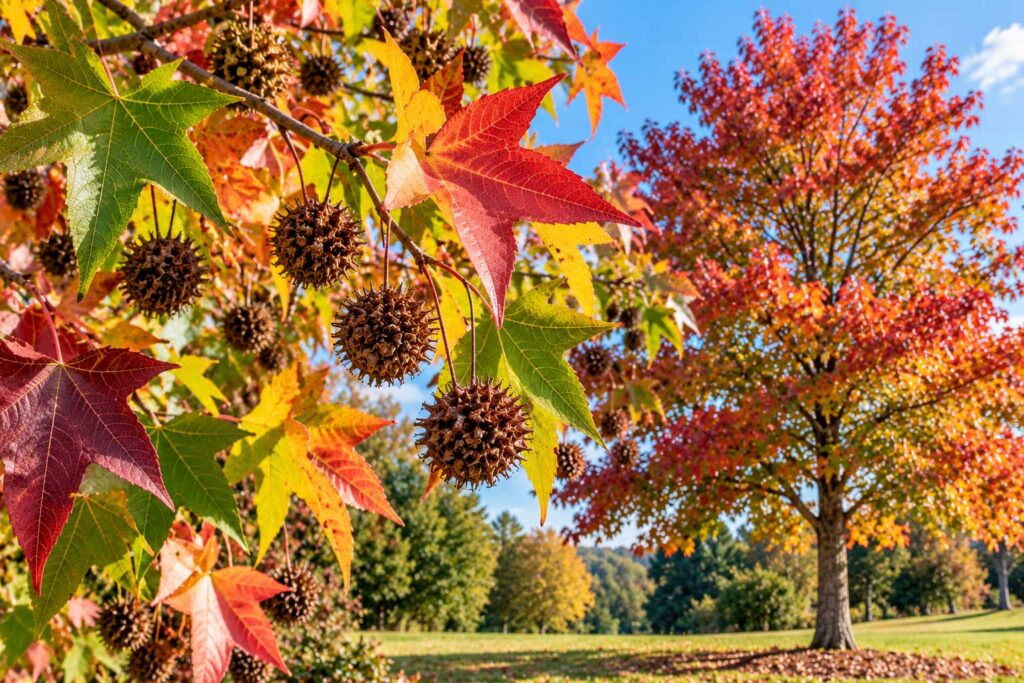
American sweetgum (Liquidambar styraciflua) is a large deciduous tree native to the southeastern and south-central United States, with its natural range extending into Mexico and Central America. It is easily recognized by its star-shaped leaves and round, spiky fruits.
Sweetgum grows relatively quickly when young and can eventually become a tall, substantial tree. In forests and spacious landscapes, mature trees can reach impressive sizes, giving them good potential for long-term carbon storage.
Why American Sweetgum Can Be a Good Carbon-Storing Tree
Sweetgum combines several characteristics that are useful for carbon storage: relatively rapid growth, a large mature size, and the ability to remain in the landscape for many decades.
As the trunk, branches, and roots expand, more carbon becomes incorporated into the tree’s biomass. Fallen leaves, roots, and other organic material can also contribute carbon to the surrounding soil.
Within its native range, sweetgum provides additional ecological benefits. Its seeds are eaten by birds and small mammals, while the tree can provide shelter and habitat for wildlife.
That combination of growth rate and mature size can lead to substantial carbon storage over several decades.
Is Sweetgum Right for Your Yard?
Sweetgum performs best when given sufficient sunlight and generally favors moist, well-drained soils, although it can tolerate a range of growing conditions once established.
Its mature size means it needs plenty of room above and below ground. It should be positioned where its roots and expanding canopy are unlikely to conflict with buildings or infrastructure.
The tree’s hard, spiky fruits can also be a nuisance on sidewalks, lawns, driveways, and other heavily used areas.
For that reason, American sweetgum is often better suited to larger properties, naturalized areas, parks, and restoration projects than small landscapes where fallen fruits could become a recurring problem.
8. Red Mulberry
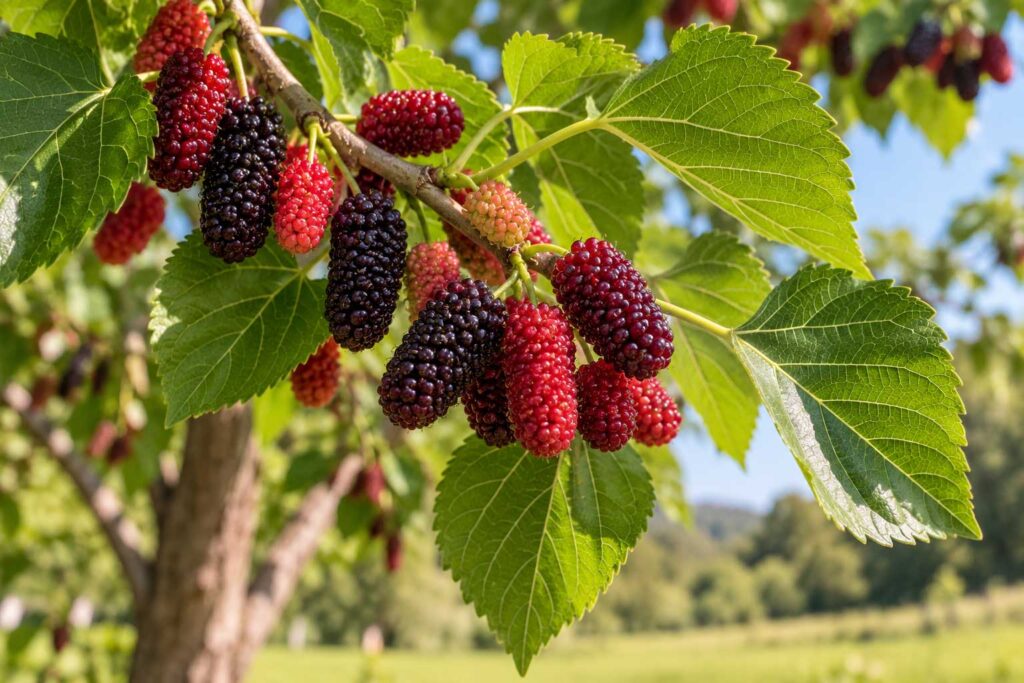
Red mulberry (Morus rubra) is a deciduous tree native to eastern and central North America. It is generally smaller than massive trees such as oaks, tulip trees, and London planes, but it can still contribute to carbon storage while providing valuable food and habitat for wildlife.
Mature red mulberries typically develop spreading crowns and substantial trunks when given enough space. As the tree grows, carbon becomes stored throughout its wood and root system.
Its value, however, extends well beyond carbon.
Why Red Mulberry Can Be a Useful Carbon-Storing Tree
Red mulberry accumulates carbon as it adds woody biomass, just like other trees. Where it really stands out, however, is its ecological value.
Its sweet fruits provide food for numerous birds and mammals, while its foliage supports insects and other wildlife. Within its native range, that combination makes red mulberry particularly useful where biodiversity matters alongside carbon storage.
Red mulberry is a good reminder that the tree storing the most carbon isn’t automatically the best tree for every landscape.
A large oak may eventually contain more woody biomass, but not every property has enough space for a massive canopy tree. A healthy red mulberry planted in an appropriate location can store carbon for decades while simultaneously providing food and habitat for wildlife.
For smaller landscapes within its native range, those combined benefits can make red mulberry worth considering.
Where Red Mulberry Works Best
Red mulberry generally prefers fertile, moist, well-drained soil but can tolerate a range of conditions once established.
Give the tree enough room for its spreading crown, and consider where falling fruit will land. Ripe mulberries can stain patios, sidewalks, vehicles, and other surfaces, so planting directly beside heavily used paved areas may not be ideal.
It is also important to distinguish native red mulberry from white mulberry (Morus alba), a non-native species introduced to North America. The two can hybridize, which has contributed to concerns about the conservation of native red mulberry populations in some areas.
Where red mulberry is native and appropriate for the site, planting the native species can combine carbon storage with meaningful benefits for local wildlife.
9. Dogwood Trees
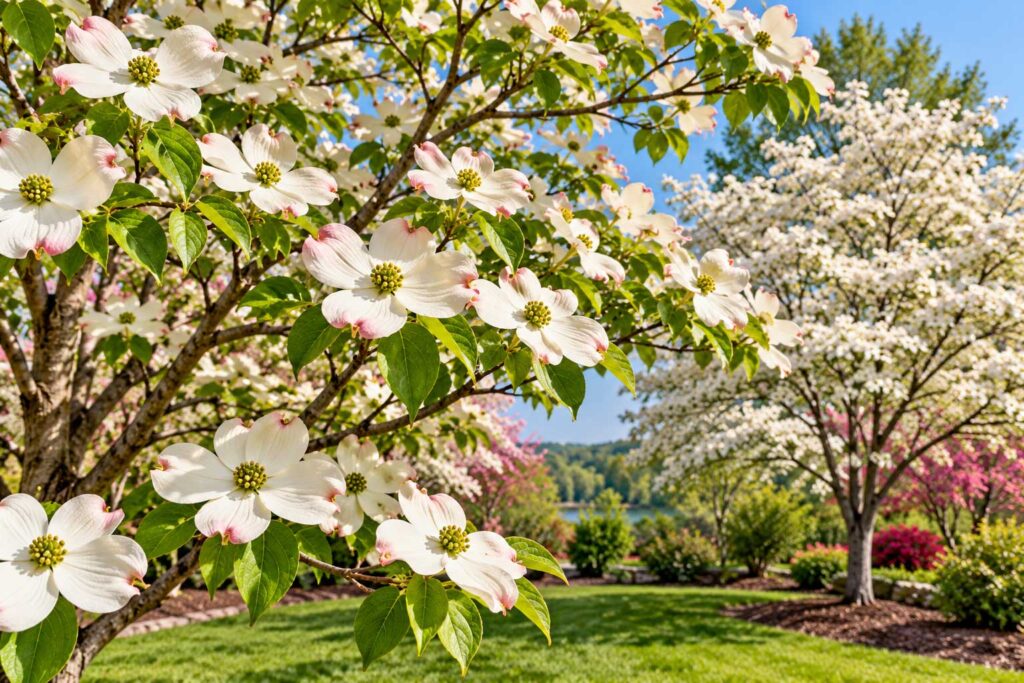
Dogwoods belong to the genus Cornus, a diverse group of trees and shrubs found across temperate regions of the Northern Hemisphere and elsewhere. One of the best-known North American species is flowering dogwood (Cornus florida), a small deciduous tree valued for its spring display and wildlife benefits.
Dogwoods don’t reach the enormous size of oaks, pines, or tulip trees, so they generally won’t store as much carbon as a massive canopy tree. However, that doesn’t make them unimportant.
Their smaller size allows them to grow in landscapes where there simply isn’t room for a 70- or 100-foot tree.
Why Dogwoods Can Be Useful Carbon-Storing Trees
Like all woody trees, dogwoods capture CO₂ as they grow and store carbon in their trunks, branches, and roots.
Their greatest advantage is the combination of modest carbon storage with other ecological benefits. Native dogwoods can provide flowers for pollinators, fruits for birds and other wildlife, and additional structure within woodland edges and layered landscapes.
Smaller trees also have a place in a carbon-conscious landscape. A yard can combine large canopy trees with smaller native species rather than relying on a single type of tree.
A dogwood won’t typically accumulate as much woody biomass as a mature oak or tulip tree, but it can still capture carbon while supporting wildlife and fitting into spaces where a much larger tree would be impractical.
If you have room for a large canopy tree, that may offer greater long-term carbon-storage potential. If space is limited, an appropriately selected dogwood can still be a valuable part of a diverse landscape.
Choosing the Right Dogwood
Growing requirements depend on the species. Flowering dogwood, for example, generally performs well in moist, well-drained soil and can grow in partial shade, reflecting its natural occurrence in and around eastern North American forests.
Choosing a dogwood native to your region can increase its ecological value and improve the chances that it is suited to local growing conditions.
Dogwoods can also be affected by pests, drought, and diseases, so good site selection matters. Avoid treating them as miniature versions of large shade trees; give them the light, soil conditions, and space appropriate for the particular species you choose.
10. Eucalyptus Trees

Eucalyptus is a large group containing hundreds of species of trees and shrubs, most of which are native to Australia. They range enormously in size, from relatively small plants to some of the tallest flowering trees on Earth.
Many eucalyptus species are known for rapid growth, which is one reason they are frequently discussed in connection with carbon sequestration. Under suitable conditions, fast-growing eucalyptus trees can add woody biomass quickly and capture substantial amounts of CO₂ as they develop.
Why Eucalyptus Can Be Good at Storing Carbon
The main carbon-storage advantage of many eucalyptus species is their rapid accumulation of biomass.
Some species grow quickly and eventually become very large trees. As new wood, branches, and roots develop, carbon captured through photosynthesis becomes incorporated into that biomass.
Eucalyptus trees are also important components of their native ecosystems. In Australia, different species provide habitat and food for a wide range of wildlife, including insects, birds, and mammals.
However, the genus is extremely diverse. Growth rates, mature sizes, lifespans, water requirements, and carbon-storage potential vary considerably among species.
Eucalyptus is a good reminder that fast growth isn’t the whole story.
Fast growth can allow certain eucalyptus species to accumulate carbon relatively quickly, but growth rate alone doesn’t determine whether planting one is environmentally beneficial.
A eucalyptus planted in an appropriate ecosystem and allowed to mature can store considerable carbon. Planting the wrong species in an unsuitable environment can create ecological problems and undermine those benefits.
The best carbon-storing tree is ultimately one that can grow successfully, remain healthy, and stay in the landscape for decades without damaging the surrounding ecosystem.
Think Before Planting Eucalyptus
Eucalyptus should be selected especially carefully outside its native range.
Some species have been planted extensively around the world for timber, pulp, windbreaks, and ornamental purposes. Depending on the species and location, concerns can include high water demand, wildfire behavior, cold sensitivity, and the potential to spread beyond planted areas.
That doesn’t mean all eucalyptus trees behave the same way. With hundreds of species, their environmental characteristics vary widely.
Before planting eucalyptus, check whether the particular species is appropriate for your climate and whether it is considered invasive or otherwise problematic in your region. Tree selection is equally important in land-restoration projects, particularly when communities are trying to prevent or reverse desertification. Where suitable native trees are available, they may provide carbon storage while offering stronger benefits for local biodiversity.
Comparing the 10 Carbon-Storing Trees
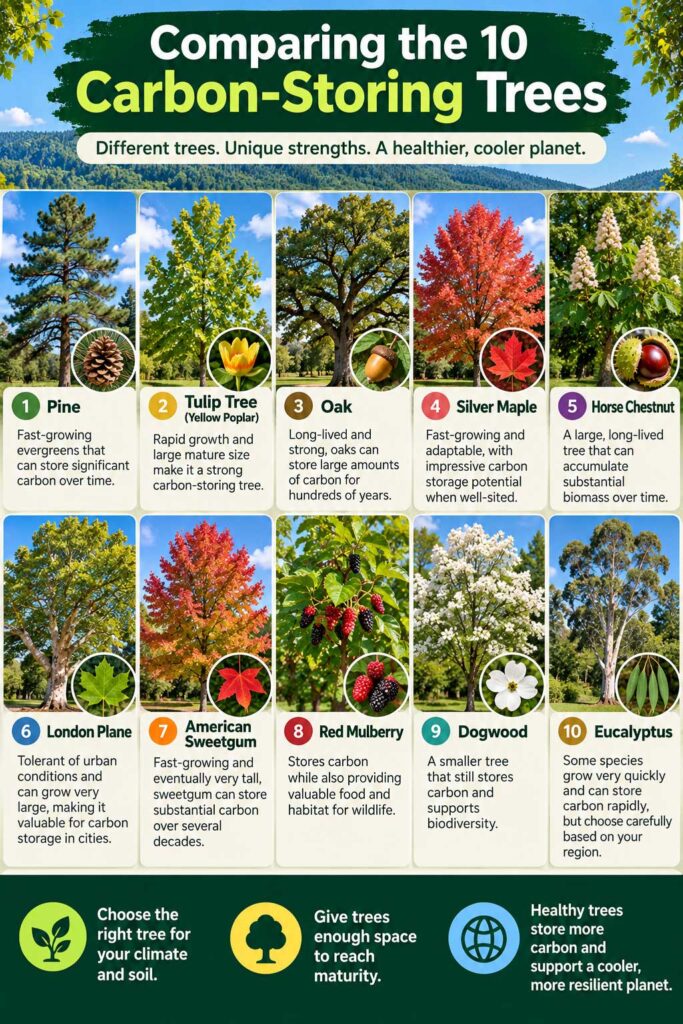
There isn’t a single tree that will be the best choice in every location. Some species stand out for rapid growth, while others have the advantage of dense wood, large mature size, or exceptional longevity.
Here’s a quick comparison of the trees covered above.
| Tree | Growth Rate | Mature Size | Longevity | Why It Stands Out | Important Consideration |
|---|---|---|---|---|---|
| Pine | Varies by species | Medium to very large | Often long-lived | Long-term woody biomass | Choose a locally suitable species |
| Tulip Tree | Fast | Very large | Long-lived | Fast growth combined with large size | Needs considerable growing space |
| Oak | Slow to moderate | Large to very large | Very long-lived | Large size, dense wood, and longevity | Give roots and canopy room to develop |
| Silver Maple | Fast | Large | Moderate | Rapid biomass accumulation | Weak wood and aggressive roots can be issues |
| Horse Chestnut | Moderate | Large | Long-lived | Large woody biomass over a long lifespan | Pest and disease pressures vary by region |
| London Plane | Moderate to fast | Very large | Long-lived | Large size and urban tolerance | Needs substantial soil and canopy space |
| American Sweetgum | Moderate to fast | Large | Long-lived | Good combination of growth and mature size | Spiky fruits can be messy |
| Red Mulberry | Moderate | Small to medium | Moderate to long-lived | Carbon storage plus wildlife value | Fruit can stain paved surfaces |
| Dogwood | Slow to moderate | Small | Moderate | Useful in smaller, diverse landscapes | Stores less carbon than large canopy trees |
| Eucalyptus | Often fast | Varies widely | Varies by species | Rapid biomass accumulation in suitable conditions | Some species may be unsuitable outside their native range |
These comparisons are general rather than fixed measurements. Growth rate, mature size, and longevity can vary considerably among individual species and growing locations.
More importantly, carbon-storage potential should never be the only factor used to choose a tree. A species that thrives in your climate, supports the surrounding ecosystem, and remains healthy for decades can ultimately be more valuable than a theoretically faster-growing tree planted in the wrong place.
Which Tree Stores the Most Carbon?
It’s tempting to pick one species and call it the best carbon-storing tree, but there isn’t a universal winner.
Large, mature trees generally hold far more carbon than small trees because they contain more woody biomass. This gives massive, long-lived trees such as oaks and tulip trees considerable long-term potential. Fast-growing trees, including some eucalyptus and maple species, may accumulate biomass more rapidly during certain stages of their lives.
The answer also changes depending on whether you’re comparing individual trees, an acre of forest, annual carbon uptake, or carbon stored over an entire lifetime.
For homeowners, a more useful question is: Which large, long-lived tree is best suited to my property and local ecosystem?
A tree that survives for 100 years has decades to accumulate carbon. A poorly chosen tree that dies or has to be removed after 10 years does not.
That’s why local suitability, mature size, tree health, and longevity should all be considered alongside growth rate when choosing trees for carbon storage.
Does Planting Trees Really Help Fight Climate Change?
Yes, planting and protecting trees can help address climate change, but trees are only one part of the solution.
As trees grow, they remove CO₂ from the atmosphere and store carbon in their wood, roots, and surrounding soils. Restoring forests can also provide benefits that go far beyond carbon storage, including wildlife habitat, healthier watersheds, erosion control, shade, and improved biodiversity.
But planting trees doesn’t cancel out unlimited greenhouse gas emissions.
Carbon stored in forests can also return to the atmosphere. Wildfires, logging, land clearing, disease, drought, and decomposition can all release some of that stored carbon again. Newly planted trees also need years or decades to accumulate the amount of carbon held by mature forests.
That’s why protecting existing forests is especially important. Large, established trees already contain substantial amounts of carbon that took decades or even centuries to accumulate.
Tree planting works best as part of a broader climate strategy that includes reducing fossil-fuel use, improving energy efficiency, expanding cleaner energy sources, protecting ecosystems, and restoring degraded land. Engineered solutions are also being developed alongside natural ones, including CO₂ capture technology in India and projects elsewhere around the world.
Planting More Trees Isn’t Always Better
Successful tree planting is about more than putting as many seedlings into the ground as possible.
Planting inappropriate species can create problems with water use, wildfire risk, invasive species, or local biodiversity. Trees planted in unsuitable environments may also die before they have time to store significant amounts of carbon.
In some ecosystems, planting trees may not even be the right restoration strategy. Natural grasslands, wetlands, peatlands, and other non-forest ecosystems have their own ecological value and can store significant amounts of carbon without being converted into forests.
Tree restoration makes the most sense where forests naturally belong, while existing grasslands, wetlands, peatlands, and other ecosystems deserve protection in their own right.
When new trees are planted, selecting diverse species suited to the local climate and giving them the care needed to reach maturity can make their environmental benefits last much longer.
How to Choose a Carbon-Storing Tree for Your Property
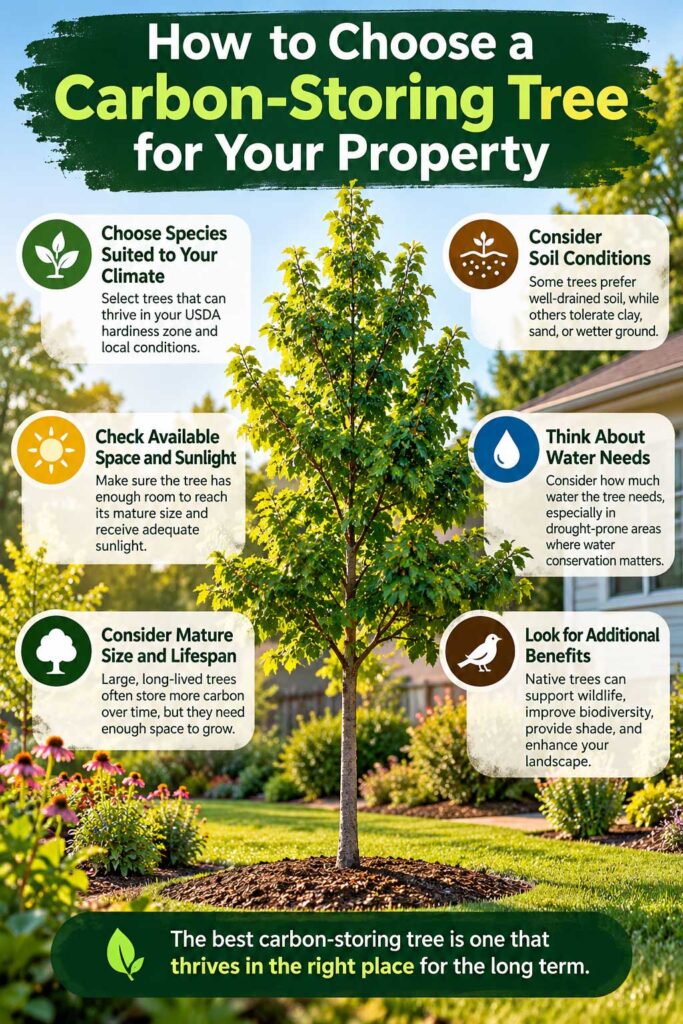
If you want to plant a tree for carbon storage, don’t simply choose the fastest-growing species you can find. The best choice is usually a tree that fits your climate, soil, available space, and surrounding ecosystem—and has a good chance of remaining healthy for decades.
Start with native or well-adapted species. Trees suited to local conditions are more likely to handle normal temperature ranges, rainfall patterns, and seasonal changes. Native trees can also provide food and habitat for local wildlife.
Think about mature size before planting. A tiny sapling may eventually become a 70-foot tree with a wide canopy and extensive root system. Check for buildings, sidewalks, underground utilities, septic systems, and overhead power lines before deciding where it should go.
Available sunlight and soil conditions matter too. Some trees tolerate wet ground, drought, shade, or poor soil better than others. Water requirements deserve attention too, especially in drought-prone areas where water conservation is already a priority. Matching the species to the site gives it a much better chance of reaching maturity.
It’s also worth considering diversity. Planting several appropriate species rather than relying heavily on one type of tree can make a landscape more resilient to pests, diseases, and changing environmental conditions.
And don’t overlook trees that are already there. If your property has a healthy mature tree, protecting it may provide a more immediate carbon benefit than removing it and starting again with a sapling.
Before You Plant
Ask yourself a few simple questions: Is this tree suited to my climate? Is it native or considered invasive in my area? How large will it become? Does it have enough room for its roots and canopy? Can I provide enough water while it becomes established?
Frequently Asked Questions About Carbon-Storing Trees
Which Tree Absorbs the Most CO₂?
There isn’t one universal winner. Large size, fast growth, longevity, wood density, climate, and growing conditions all affect carbon uptake, so the best-performing species varies by location.
Do Older Trees Store More Carbon?
Large, mature trees generally contain much more stored carbon than young trees because they have accumulated far more woody biomass over their lifetimes.
Age alone doesn’t determine carbon storage, however. Tree size, species, health, and growing conditions all matter. A healthy mature tree with a large trunk, branches, and root system can represent decades of accumulated carbon.
Do Pine Trees Absorb CO₂?
Yes. Pine trees absorb carbon dioxide through photosynthesis and use the carbon to build new needles, branches, trunks, and roots.
Many pine species can grow into large, long-lived trees, giving them considerable potential for long-term carbon storage. The amount captured by an individual pine varies according to its species, size, age, health, and environment.
How Much Carbon Can One Tree Store?
There is no single number that applies to every tree. A small young tree contains far less carbon than a large mature tree, and even similarly sized trees can differ because of their species and wood characteristics.
Scientists can estimate tree carbon storage using measurements such as trunk diameter, height, species, and biomass. For this reason, fixed claims that every tree of a particular species absorbs exactly the same amount of CO₂ each year should be treated cautiously.
Are Fast-Growing Trees Better for Carbon Storage?
Not necessarily. Fast-growing trees can accumulate biomass quickly, which can increase carbon uptake during periods of rapid growth. But growth speed is only part of the picture.
Mature size, lifespan, wood characteristics, survival, and local suitability also matter. A slower-growing tree that becomes very large and survives for centuries may ultimately store substantial amounts of carbon.
Is It Better to Plant New Trees or Protect Existing Trees?
Both are valuable, but protecting healthy existing forests and mature trees is especially important because they already contain carbon accumulated over many years.
New trees take time to grow and build biomass. Planting trees can increase future carbon storage and restore degraded forests, while protecting established trees helps prevent existing carbon stocks from being lost.
Is Planting Trees Enough to Stop Climate Change?
No. Trees can remove CO₂ from the atmosphere and provide many other environmental benefits, but tree planting cannot replace reducing greenhouse gas emissions.
Forests can also lose stored carbon through wildfire, land clearing, drought, disease, and other disturbances. Protecting and restoring forests works best alongside reducing fossil-fuel emissions, improving energy efficiency, and developing cleaner energy systems.
What Is the Best Carbon-Storing Tree to Plant at Home?
The best choice depends on where you live and how much space you have. Look for a native or well-adapted species that can become relatively large, live for many decades, and grow without interfering with buildings, utilities, or other infrastructure.
Local extension services, forestry agencies, botanical gardens, and native-plant organizations can help identify trees suited to your specific region.
Final Thoughts: The Best Carbon-Storing Tree Is One That Survives
There isn’t one tree that wins everywhere. Oaks offer size and longevity, tulip trees combine fast growth with impressive mature size, and some eucalyptus species can accumulate biomass remarkably quickly.
But the species on the label matters less if the tree is planted somewhere it can’t thrive.
For homeowners, the best approach is to choose trees suited to the local climate and soil, give them enough room to mature, and keep the healthy trees that are already growing whenever possible.
Planting new trees can help, but protecting mature trees and forests matters just as much. The real goal isn’t simply to plant more trees—it’s to keep the right trees growing for a very long time.
Explore More Climate & Carbon Solutions
Trees are only one part of the climate solution. Explore more ways ecosystems, technology, and everyday actions can help reduce emissions and protect the planet:
- CO₂ Capture Technology in India — Explore how carbon capture, utilization, and storage technologies are being developed to capture CO₂ from industrial sources.
- 10 Benefits of Using Biochar — Learn how biochar can support soil health while storing carbon for long periods.
- How Can We Prevent or Reverse Desertification? — Discover ways to restore degraded land, protect soil, conserve water, and rebuild vegetation.
- How Can We Do Water Conservation? — Explore practical ways to conserve freshwater and use water resources more efficiently.
- How Recycling and Reusing Reduce Pollution — Learn how keeping materials in use can reduce waste, resource extraction, and environmental pollution.



0 Comments