


Plastic has transformed modern life, but its convenience has also created one of the world’s most persistent environmental problems.
More than 500 million tonnes of plastic are used globally each year. Much of it becomes waste after a relatively short period, while millions of tonnes leak into rivers, lakes, oceans, soil, and other natural environments.
Plastic pollution is not limited to bottles and bags. It also includes abandoned fishing gear, synthetic clothing fibers, tire-wear particles, industrial plastic pellets, packaging waste, and microscopic fragments known as microplastics.
Plastic has now been detected in deep-ocean trenches, remote islands, wildlife, food, drinking water, air, and human tissues. At the same time, only a small percentage of global plastic waste is successfully recycled.
These 101 plastic pollution facts reveal the scale of the problem, how plastic affects oceans, wildlife, climate, and human exposure, and the solutions that could dramatically reduce future plastic waste.
Let’s start with how much plastic the world produces—and where all that material eventually goes.
Global Plastic Production and Waste Facts
1. The World Uses More Than 500 Million Tons of Plastic Each Year
Humanity now uses more than 500 million tons of plastic annually. Plastic is found in packaging, clothing, vehicles, electronics, construction, agriculture, healthcare, and countless household products.
The problem is not simply how much plastic we use, but how quickly a large share of it becomes waste. UNEP estimates that more than 500 million tonnes of plastic were consumed globally in 2024 alone.
The first group of plastic pollution facts looks at how much plastic the world produces, uses, and ultimately throws away.
2. Plastic Production Has Nearly Doubled Since 2000
Global plastic production increased from approximately 234 million tonnes in 2000 to 460 million tonnes in 2019.
That means annual production nearly doubled in less than two decades, placing growing pressure on waste collection, recycling, and disposal systems.
3. Plastic Use Could Nearly Triple by 2060
Without stronger policies, global plastic use could increase from 460 million tonnes in 2019 to about 1.32 billion tonnes by 2060.
Economic growth and rising populations are expected to be major drivers of this increase.
4. The World Generates Hundreds of Millions of Tonnes of Plastic Waste
Global plastic waste reached approximately 353 million tonnes in 2019, more than twice the 156 million tonnes generated in 2000.
Packaging, consumer products, textiles, construction materials, and transportation all contribute to this enormous waste stream.
5. Plastic Waste Could Exceed One Billion Tonnes a Year by 2060
Under current policies, annual plastic waste could increase from 353 million tonnes in 2019 to around 1.01 billion tonnes by 2060.
That would place even greater pressure on landfills, recycling facilities, municipal collection systems, rivers, coastlines, and communities without reliable waste infrastructure.
6. Nearly Two-Thirds of Plastic Waste Comes From Short-Lived Products
Almost two-thirds of global plastic waste comes from products with lifespans of less than five years.
Packaging accounts for about 40%, consumer products for 12%, and textiles for 11%, showing how strongly short-lived products contribute to the waste problem.
7. Packaging Is the Largest Source of Plastic Waste
Packaging accounts for approximately 40% of global plastic waste, making it the largest single category.
Its short lifespan is a major reason why packaging becomes waste so quickly, while films, coatings, adhesives, and multilayer materials can make some packages difficult to recycle.
8. Disposable Plastics Create an Enormous Waste Stream
Bags, wrappers, takeaway containers, cups, straws, and disposable cutlery may be used for only minutes before becoming waste.
Combined with other short-lived consumer products, disposable packaging plays a major role in the rapidly growing global plastic waste stream.
9. Billions of Tonnes of Plastic Have Already Become Waste
Researchers estimated that humanity produced approximately 8.3 billion tonnes of virgin plastic between 1950 and 2015.
By 2015, around 6.3 billion tonnes had already become plastic waste, illustrating how quickly plastic accumulated during the modern plastics era.
10. Most Historical Plastic Waste Was Never Recycled
Of the approximately 6.3 billion tonnes of plastic waste generated by 2015, researchers estimated that only 9% had been recycled and about 12% had been incinerated.
Roughly 79% had accumulated in landfills or the natural environment.
11. Plastic Often Fragments Instead of Fully Biodegrading
Most conventional plastics do not break down like food, paper, or untreated wood.
Sunlight, salt water, heat, waves, and friction can gradually break larger plastic products into smaller fragments, including microplastics. NOAA notes that these pieces may become extremely difficult to remove once dispersed. (noaa.gov)
Scientists are also investigating biological approaches to plastic degradation, including plastic-eating fungi.
12. Plastic Can Persist for Generations
How long plastic lasts depends on its polymer, thickness, additives, and surrounding environment.
Plastic exposed to sunlight and waves may fragment faster, while material buried in sediment, landfills, or deep water can persist for very long periods. (noaa.gov)
13. Landfills Store Plastic Rather Than Eliminate It
Sending plastic to a regulated landfill can prevent immediate litter and environmental leakage, but it does not make the material disappear.
In other words, a landfill can contain plastic safely, but it does not make the material go away. Much of it simply remains buried and unavailable for future use.
14. Open Burning Creates Additional Pollution
Plastic waste is openly burned in some communities where safe collection and disposal systems are limited.
Burning plastic can release fine particles, greenhouse gases, and hazardous chemicals into the air, creating risks for both the environment and nearby communities.
15. Poor Waste Management Is a Major Source of Plastic Leakage
Inadequate collection and disposal are major drivers of plastic entering the environment.
The OECD estimated that 22 million tonnes of plastic leaked into the environment in 2019, with mismanaged waste responsible for most macroplastic leakage. (oecd.org)
Ocean and Aquatic Plastic Pollution Facts
Some of the most alarming plastic pollution facts involve rivers, coastlines, and oceans, where discarded plastic can travel enormous distances and remain for decades.
16. Around 19–23 Million Tonnes of Plastic Enter Aquatic Ecosystems Annually
An estimated 19–23 million tonnes of plastic waste leak into aquatic ecosystems each year, including rivers, lakes, wetlands, and seas.
That enormous flow of waste continues adding to plastic already accumulated in freshwater and marine environments. (unep.org)
17. Not All River Plastic Immediately Reaches the Ocean
Plastic moving through rivers can become trapped along riverbanks, in vegetation, sediment, reservoirs, lakes, and floodplains.
Some debris may remain in freshwater systems for years or even decades before eventually moving downstream.
18. Rivers Store Enormous Amounts of Plastic
The OECD estimated that approximately 109 million tonnes of plastic had accumulated in rivers globally by 2019.
This means rivers are not simply pathways carrying plastic toward the ocean—they can also act as long-term reservoirs of pollution.
19. More Than 1,000 Rivers May Carry Most River Plastic Reaching the Ocean
Research highlighted by UNEP estimates that more than 1,000 rivers account for around 80% of riverine plastic emissions to the ocean.
Many of these are relatively small rivers located near densely populated urban areas and coastlines.
20. Most Ocean Plastic Is Not Simply Floating at the Surface
Visible floating debris represents only part of marine plastic pollution.
Plastic can wash ashore, sink into sediment, remain suspended in the water column, become trapped in coastal habitats, or break into smaller particles. OECD estimates suggest substantial quantities have already accumulated in both rivers and the ocean.
21. Plastic Makes Up at Least 85% of Marine Litter
Plastic is the dominant form of waste found in marine environments.
UNEP estimates that plastics account for at least 85% of total marine litter, making them the largest and most persistent component of marine waste. (unep.org)
22. Around 80% of Marine Pollution Comes From Land-Based Sources
UNEP estimates that around 80% of marine pollution originates from land-based sources, including plastic waste as well as other pollutants.
Poorly managed waste, stormwater, rivers, wastewater, industrial activity, and coastal development can carry pollutants—including plastic—from communities into marine environments. (unep.org)
23. Plastic Has Reached the Deepest Parts of the Ocean
Plastic pollution has been documented in the Mariana Trench, one of the deepest environments on Earth.
UNEP reports plastic contamination from remote islands and sea ice to the deepest ocean trenches, showing how far human waste has spread. (unep.org)
24. Plastic Accumulates on the Deep Seafloor
Not all ocean plastic remains near the surface.
Plastic can sink through the water column and accumulate in deep-sea sediment, trenches, canyons, and other seafloor environments that are extremely difficult to monitor or clean. (unep.org)
25. Garbage Patches Are Not Solid Islands
Ocean garbage patches are large areas where currents concentrate marine debris.
They contain fishing gear, larger fragments, and huge numbers of microplastics spread across the water rather than forming solid islands that people could walk on. (noaa.gov)
26. Lost Fishing Gear Is Especially Dangerous to Marine Wildlife
Lost or discarded fishing gear includes nets, lines, traps, pots, floats, and other equipment.
Because this gear is designed to catch animals, it can continue trapping and killing fish, turtles, seabirds, marine mammals, and other wildlife long after it has been lost. (noaa.gov)
Learn more about how plastic pollution affects marine life.
27. Ghost Gear Can Keep Fishing Without Fishermen
Abandoned, lost, or discarded fishing equipment is often called ghost gear.
It can continue trapping animals after fishermen lose control of it—a process known as ghost fishing. (noaa.gov)
28. Plastic Can Damage Coral Reefs and Seagrass Beds
Plastic debris and abandoned fishing gear can become tangled around coral, drag across reefs, or settle over sensitive marine habitats.
NOAA notes that derelict fishing gear can damage seafloor habitats including coral reefs and seagrass beds. (noaa.gov)
29. Ocean Currents Can Carry Plastic Far From Its Source
Marine debris does not necessarily stay near the place where it entered the water.
Winds and ocean currents can transport plastic across large distances and concentrate debris in ocean gyres, including remote areas far from populated coastlines. (noaa.gov)
30. Beach Cleanups Reveal Only Part of the Problem
Beach cleanups remove visible pollution and can protect local wildlife, but much of the plastic in marine environments remains out of sight.
Debris may be suspended below the surface, spread through the water column, resting on the seafloor, or broken into tiny microplastics. (noaa.gov)
Microplastic Pollution Facts

These plastic pollution facts become even harder to visualize when plastic breaks into microscopic particles that can spread through water, soil, air, and living organisms.
31. Microplastics Are Smaller Than Five Millimeters
Microplastics are plastic particles smaller than five millimeters in their longest dimension.
Some are manufactured at a small size, while others form when larger plastic products gradually break apart. (noaa.gov)
32. Nanoplastics Are Even Smaller Than Microplastics
Nanoplastics are extremely small plastic particles below the microplastic size range.
Definitions still vary between scientific organizations and studies, which is one reason nanoplastics remain especially difficult to detect, measure, and compare across research. (who.int)
33. Microplastics Are Found in Water, Soil, and Air
Microplastics have been detected throughout marine and freshwater environments, as well as in soil and airborne particles.
Their widespread presence means plastic pollution is no longer limited to visible litter on beaches or in waterways. (eea.europa.eu)
34. Larger Plastic Waste Becomes Microplastic Over Time
Bottles, bags, packaging, fishing gear, and other plastic products can fragment as they are exposed to sunlight, wind, water, and physical abrasion.
The original item may become difficult to recognize while its plastic remains as countless smaller fragments. (noaa.gov)
35. Synthetic Clothing Releases Plastic Fibers
Polyester, nylon, acrylic, and other synthetic textiles can shed tiny plastic fibers during manufacturing, wearing, washing, and disposal.
These microfibers can spread through wastewater, air, soil, rivers, and marine environments. (eea.europa.eu)
36. Washing Machines Can Release Microfibers
Washing synthetic clothing can release microscopic fibers into wastewater.
Treatment plants can capture a large proportion of them, but not all. Many captured particles also end up in sewage sludge, some of which may later be applied to agricultural land. (eea.europa.eu)
37. Vehicle Tires Release Particles as They Wear
Tires gradually shed particles through friction with road surfaces.
These tire and road-wear particles can accumulate along roads or be carried by wind and stormwater into soil, drains, rivers, lakes, and coastal waters. (OECD)
38. Paint and Coatings Can Release Microplastics
Paints and protective coatings used on buildings, roads, ships, vehicles, and industrial equipment often contain synthetic polymers.
As these surfaces weather, wear, or flake, they can release plastic-containing particles into surrounding environments.
39. Plastic Pellets Can Escape Before Products Are Even Manufactured
Small resin pellets are used as raw material to manufacture larger plastic products.
If pellets are spilled during production, handling, or transportation, they can enter drains, rivers, ports, beaches, and oceans before ever becoming finished consumer goods.
40. Microplastics Can Move Through Food Webs
Plankton, shellfish, worms, fish, and other organisms can ingest microplastic particles.
Predators may then be exposed when they consume these organisms, allowing plastic particles to move between different levels of aquatic food webs.
41. Microplastics Have Been Found in Drinking Water
Studies have detected microplastics in both tap water and bottled drinking water.
Reported concentrations vary considerably because researchers use different sampling methods, particle-size limits, and laboratory techniques. (who.int)
42. Microplastics Have Been Detected in Human Tissues and Organs
Studies have reported microplastics in several human tissues and organ systems, including the respiratory, digestive, cardiovascular, reproductive, and urinary systems.
Researchers are still determining how particles enter and move through the body and what these findings mean for long-term human health. (pmc.ncbi.nlm.nih.gov)
Plastic Recycling Facts
The following plastic pollution facts show why recycling remains important—but also why recycling alone cannot keep up with the amount of plastic waste being generated.
43. Only About 9% of Global Plastic Waste Is Successfully Recycled
In 2019, approximately 15% of plastic waste was collected for recycling, but processing losses reduced the successfully recycled share to about 9%.
Collection does not guarantee that material is ultimately turned into a new product. (oecd.org)
For the bigger picture, see why recycling is important.
44. A Recycling Symbol Does Not Guarantee Recyclability
The number inside the triangular symbol identifies the type of plastic resin.
It does not confirm that a local recycling program accepts the item or that a nearby facility can process it economically.
45. Plastic Is Not One Single Material
Plastic includes many different polymers, including PET, HDPE, PVC, LDPE, polypropylene, and polystyrene.
Because these materials have different properties and melting points, they generally need to be separated before recycling.
46. Multilayer Packaging Is Often Difficult to Recycle
Some wrappers, pouches, cups, and tubes combine plastic with paper, foil, adhesives, or several different polymers.
These bonded layers can be difficult to separate, which means many multilayer packages are not accepted by conventional recycling systems.
47. Food Contamination Can Reduce Recycling Quality
Grease, liquids, and leftover food can contaminate otherwise recyclable material.
Containers should generally be emptied and prepared according to local recycling instructions before being placed in a recycling bin.
48. Plastic Bags Can Damage Sorting Equipment
Flexible bags and films can become tangled around machinery at recycling facilities.
Many curbside programs therefore reject them, although some stores and specialist collection points accept clean plastic film separately.
49. Wish-Cycling Can Make Recycling Less Effective
We’ve probably all done it: put something questionable in the recycling bin and hope the facility can handle it. This habit is known as wish-cycling.
Non-recyclable products can contaminate loads, increase sorting costs, and sometimes damage processing equipment.
50. Many Plastics Cannot Be Recycled Indefinitely
Mechanical recycling exposes plastic to heat and physical processing, which can gradually reduce material quality.
Manufacturers may need to blend recycled resin with virgin plastic to maintain strength, appearance, safety, or performance.
51. Some Recycled Plastic Is Downcycled
Recycled plastic is not always turned back into the same product.
It may instead become carpet fibers, benches, insulation, construction materials, or plastic lumber, and some of these products may be difficult to recycle again later.
52. Virgin Plastic Can Sometimes Be Cheaper Than Recycled Plastic
When fossil-fuel feedstocks are inexpensive, newly produced plastic can cost less than recycled material.
That can weaken recycling markets unless recycled-content requirements, producer-responsibility programs, or other policies help create stable demand.
53. Exported Plastic Waste Is Not Automatically Recycled
Plastic sent to another country may be recycled responsibly, but export alone does not prove successful recycling.
Some shipments may be rejected, stored, burned, or poorly managed, which is why transparent tracking and enforcement are important.
54. Recycling Helps, but Reduction and Reuse Can Prevent More Waste
Recycling preserves some material value and can reduce demand for virgin plastic.
However, eliminating unnecessary products and expanding reuse can prevent waste before collection, sorting, and processing are needed.
Recycling works best alongside reduction and reuse; see how recycling and reusing reduce pollution.
Wildlife and Marine Life Plastic Pollution Facts
Some of the most disturbing plastic pollution facts involve wildlife, from animals swallowing plastic to becoming trapped in abandoned fishing gear.
55. Plastic Pollution Affects More Than 800 Marine and Coastal Species
UNEP reports that plastic pollution affects more than 800 marine and coastal species through ingestion, entanglement, habitat damage, and other harmful interactions.
Affected animals include fish, seabirds, sea turtles, seals, dolphins, whales, and many invertebrates. (UNEP)
56. Sea Turtles Can Mistake Plastic for Food
Sea turtles can mistake plastic bags and other floating debris for prey.
Swallowed plastic may block the digestive system, puncture internal tissue, or create a false feeling of fullness that reduces normal feeding.
57. Seabirds Can Feed Plastic to Their Chicks
Seabirds may mistake plastic fragments for natural prey and carry them back to their nests.
As a result, chicks can ingest plastic during important stages of growth and development.
58. Plastic Can Make Animals Feel Full Without Providing Nutrition
Plastic occupying space in an animal’s stomach can create a false sense of fullness.
This may reduce feeding and contribute to poor nutrition, weakness, or starvation. (NOAA)
59. Swallowed Plastic Can Cause Internal Injuries
Hard or sharp pieces of marine debris can damage the digestive tract after they are swallowed.
NOAA notes that ingested debris can block the stomach or puncture internal tissues, potentially causing severe injury or death. (NOAA)
60. Entanglement Can Prevent Animals From Swimming or Feeding
Fishing line, ropes, nets, packing bands, and other debris can wrap around marine animals.
Entangled wildlife may struggle to swim, breathe, or feed and can suffer deep wounds, infections, drowning, or starvation. (NOAA)
61. Plastic Loops Can Tighten as Animals Grow
Loops from packing bands, fishing line, bags, and other debris can become caught around wildlife.
If an animal continues growing while entangled, the material may cut into tissue, restrict movement, or cause increasingly serious injuries.
62. Whales Can Ingest Plastic and Other Marine Debris
Whales and other cetaceans can swallow fishing gear and marine debris while feeding.
Ingestion may cause injury, digestive blockage, or contribute to poor health and death in severe cases.
63. Filter Feeders Can Take In Microplastics
Mussels, oysters, some fish, and other filter-feeding organisms process large volumes of water while feeding.
Microplastics suspended in that water can be captured and ingested along with natural food particles. (NOAA)
64. Plastic Debris Can Smother Marine Habitats
Plastic sheets, bags, and lost fishing gear can settle over corals and other seafloor organisms.
This can reduce light, restrict water movement, damage living tissue, and alter sensitive habitats. UNEP identifies smothering and reduced light as documented impacts of plastic on coral reefs.
65. Lost Fishing Nets Can Damage Coral Reefs
Derelict fishing nets can drag across coral reefs, breaking or smothering living coral.
NOAA has documented lost nets becoming tangled within reef structures and causing repeated physical damage. (NOAA)
66. Floating Plastic Can Transport Species Across Oceans
Barnacles, algae, crabs, and other organisms can attach themselves to floating plastic.
Research has found coastal species surviving and reproducing on plastic debris thousands of kilometers from shore, showing that plastic can create new opportunities for long-distance rafting and species dispersal.
67. The Full Wildlife Impact Is Difficult to Measure
Scientists have documented impacts on hundreds of marine species, but many parts of the ocean remain poorly observed.
Animals harmed offshore may never be found, meaning recorded cases are unlikely to capture every interaction between wildlife and plastic debris. NOAA notes that there may be many more affected species that have not yet been identified.
Plastic pollution affects animals in many different ways, from entanglement and ingestion to habitat damage. Explore our complete guide to how plastic pollution affects marine life for a closer look at the risks facing ocean wildlife.
Single-Use Plastic and Packaging Facts
Many plastic pollution facts trace back to products designed to be used briefly, especially disposable packaging, bags, cups, wrappers, and containers.
68. Single-Use Plastics Are Often Used for Only Minutes
Straws, wrappers, bags, cups, and disposable cutlery may be useful for only a few minutes.
The material can then remain in landfills or the environment for far longer than the product was ever used.
Quick Fact: Up to one trillion plastic shopping bags may be produced worldwide each year. Although each bag uses relatively little material, their enormous volume creates a major single-use plastic waste stream.
69. Plastic Packaging Often Outlives the Product It Protects
A wrapper may protect food for days or weeks before being discarded.
The plastic itself can persist long after the product has been consumed.
70. Around 36% of Plastic Is Used for Packaging
Packaging is the largest generator of single-use plastic waste worldwide.
UNEP reports that around 36% of all plastic produced is used for packaging, much of which becomes waste shortly after purchase.
71. Small Sachets Are Difficult to Collect and Recycle
Single-portion sachets are widely used for shampoo, sauces, coffee, cleaning products, and cosmetics.
Many are made from complex layers of plastic, films, and sometimes aluminum, making them difficult and often uneconomical to recycle.
72. Disposable Cups May Contain Hidden Plastic
Many paper cups contain a thin plastic lining that helps prevent leaks.
Because the paper and plastic are bonded together, these cups may require specialized recycling rather than ordinary paper recycling.
73. Cigarette Filters Contain Plastic Fibers
Most cigarette filters are made largely from cellulose acetate, a plastic material.
When discarded, cigarette butts can release microplastic fibers along with heavy metals and other chemicals into beaches, streets, soil, and waterways.
74. Many Wet Wipes Contain Synthetic Plastic Fibers
Disposable wet wipes are not always made entirely from paper or natural fibers.
Products containing synthetic materials can contribute to plastic pollution, while flushing wipes can also create serious problems for sewer systems.
75. Some Dark Plastics Are Harder for Sorting Systems to Identify
Many recycling facilities use optical sorting technology to identify different plastic types.
Certain dark pigments, especially traditional carbon-black formulations, can make some plastic items harder for these systems to detect and sort correctly.
76. Lightweight Packaging Easily Escapes Waste Systems
Wrappers, bags, films, and foam can be blown from bins, trucks, and dumping sites.
Rainwater and flooding may then carry this lightweight waste into drains, rivers, lakes, and oceans.
77. Refillable Packaging Can Replace Repeated Single-Use Purchases
A durable bottle, cup, or container can avoid substantial packaging waste when it is returned and reused many times.
The greatest benefits come from systems with convenient collection, high return rates, efficient washing, and repeated reuse.
Plastic Pollution and Climate Change Facts
Plastic is also connected to fossil fuels and greenhouse gas emissions. These plastic pollution facts show why the issue extends beyond litter and waste management.
78. Most Conventional Plastic Is Made From Fossil Fuels
Most conventional plastics are produced from fossil-fuel feedstocks such as oil and natural gas.
These resources are extracted, refined, processed into petrochemicals, and converted into plastic resins before becoming finished products.
79. Plastic Creates Emissions Before It Becomes Waste
Greenhouse gases are released during fossil-fuel extraction, refining, petrochemical production, plastic manufacturing, and transportation.
A plastic product therefore carries a climate footprint before it is ever used or discarded.
80. The Plastic Lifecycle Generated About 1.8 Billion Tonnes of Emissions in 2019
The global plastic lifecycle generated approximately 1.8 billion tonnes of greenhouse gas emissions in 2019.
That represented about 3.4% of total global greenhouse gas emissions that year. (oecd.org)
81. Most Plastic-Related Emissions Come From Production
Around 90% of plastic lifecycle greenhouse gas emissions come from the production and conversion of fossil fuels into plastic materials and products.
Waste management accounts for a much smaller share of the total climate footprint. (oecd.org)
82. Plastic-Related Emissions Could More Than Double by 2060
Without stronger policies, annual greenhouse gas emissions from the plastics lifecycle could rise to approximately 4.3 billion tonnes by 2060.
Growing plastic use and production are expected to drive much of that increase. (oecd.org)
83. Incinerating Plastic Releases Fossil Carbon
When fossil-based plastic is burned, carbon stored in the material is released largely as carbon dioxide.
Incineration can also generate ash and other air pollutants, although the exact impacts depend on the technology and pollution controls used.
84. Open Plastic Burning Can Create Serious Air Pollution
Burning plastic in fields, barrels, streets, or uncontrolled dumps releases smoke directly into the surrounding environment.
Open burning can emit fine particles, black carbon, greenhouse gases, and hazardous chemicals that can affect both climate and local air quality.
85. Recycling Can Reduce Some Plastic-Related Emissions
Using recycled plastic can reduce demand for virgin fossil feedstocks and may require less energy than producing new plastic.
The climate benefit depends on collection efficiency, processing losses, energy sources, transport, and whether recycled material actually replaces virgin plastic.
86. Reducing Unnecessary Plastic Can Support Climate Goals
Using less unnecessary plastic can reduce demand for fossil feedstocks, manufacturing, transportation, and waste treatment.
Plastic reduction can therefore support both pollution prevention and climate mitigation.
Human Health and Plastic Exposure Facts
Human exposure is one of the fastest-growing areas of plastic research. These plastic pollution facts summarize what scientists know—and what remains uncertain.
87. People Can Inhale and Swallow Microplastics
Microplastics can enter the body through food, drinking water, and the air we breathe.
Indoor exposure may come from dust, synthetic textiles, furnishings, packaging, and other plastic-containing materials. WHO identifies ingestion and inhalation as important routes of human exposure. (WHO)
88. Microplastics Have Been Detected in Human Blood
Researchers have found microplastic and nanoplastic particles in human blood samples.
This provides evidence that some particles can move beyond the digestive or respiratory system and circulate within the body, although scientists are still studying how long they remain and where they ultimately accumulate.
89. Plastic Particles Have Been Found in Human Lungs
Microplastics have been detected in human lung tissue and respiratory samples.
Airborne fibers and fragments can be inhaled, but researchers still do not know the full health impact of everyday environmental exposure at typical concentrations.
90. Microplastics Have Been Detected in the Placenta
Researchers have reported microplastic particles in placental tissue.
The finding confirms that exposure can reach this important organ, but it does not by itself prove that microplastics cause pregnancy complications or other specific health problems.
91. Microplastics and Nanoplastics Have Been Found in Human Brain Tissue
Recent studies have detected microplastic and nanoplastic particles in human brain samples.
Researchers are now investigating how very small particles may cross biological barriers and whether their presence has long-term neurological effects, but causal health effects have not yet been established.
92. Finding Plastic in the Body Does Not Automatically Prove It Causes Disease
Detection confirms that humans are exposed to microplastics and that some particles can enter tissues.
However, current human evidence does not yet establish a clear causal relationship between microplastic exposure and specific chronic diseases.
93. Plastics Can Contain Many Chemical Additives
Plastic products may contain plasticizers, pigments, stabilizers, flame retardants, antioxidants, and other additives that provide specific properties.
Some of these chemicals can migrate out of plastic during production, use, recycling, weathering, or disposal, creating an additional exposure concern beyond the particles themselves.
94. Scientists Are Still Studying the Long-Term Health Effects
Laboratory and animal studies suggest that microplastics may contribute to processes such as inflammation, oxidative stress, and endocrine disruption.
Human studies have also reported associations with some biological markers and health outcomes, but methodological differences and limited long-term data mean researchers cannot yet determine the full risk from everyday exposure.
Plastic Pollution Solutions and Progress Facts
Not all plastic pollution facts are negative. Research shows that existing solutions could substantially reduce future pollution if they are implemented at scale.
95. Plastic Pollution Could Be Cut by About 80% by 2040
UNEP estimates that currently available technologies and major policy and market shifts could reduce global plastic pollution by approximately 80% by 2040.
The roadmap combines eliminating unnecessary plastics with expanded reuse, improved recycling, better alternatives, and stronger waste management. (UNEP)
96. Reuse Systems Could Reduce Plastic Pollution by About 30%
Refillable bottles, returnable containers, reusable cups, bulk dispensers, and packaging take-back systems can replace repeated single-use purchases.
UNEP estimates that scaling up reuse could reduce global plastic pollution by approximately 30% by 2040. (UNEP)
97. Deposit-Return Systems Can Increase Collection and Reduce Litter
Deposit-return systems add a refundable charge to beverage containers and return that money when the container is brought back.
OECD evidence shows that these systems can improve collection, reduce litter and material leakage, and support higher-quality reuse or recycling. (OECD)
Extended producer responsibility, or EPR, makes producers responsible for their products beyond the point of sale, including the post-consumer stage.
These systems can help finance collection and recycling while creating incentives for better product design and waste prevention. (OECD)
99. Better Product Design Can Prevent Plastic Waste
Products made from fewer compatible materials are often easier to reuse and recycle.
Reducing unnecessary layers, problematic additives, and permanently bonded components can improve recyclability and keep more material in circulation. (OECD)
100. Preventing Plastic Waste at the Source Is More Effective Than Relying on Cleanup
Once plastic becomes widely dispersed through rivers, oceans, soil, sediment, and wildlife habitats, recovery becomes increasingly difficult.
UNEP therefore emphasizes eliminating unnecessary and problematic plastics before relying on downstream waste management and cleanup.
101. Plastic Pollution Is Not an Unsolvable Problem
The scale of plastic pollution is enormous, but many of the solutions already exist.
Reducing unnecessary plastic, expanding reuse, improving recycling and collection, redesigning products, and strengthening producer responsibility could dramatically reduce future pollution if these measures are implemented together.
These solutions work best when they are implemented together. Our guide to whether plastic pollution can be stopped explores what it would take to reduce plastic pollution on a much larger scale.
Why Do Plastic Pollution Statistics Differ?
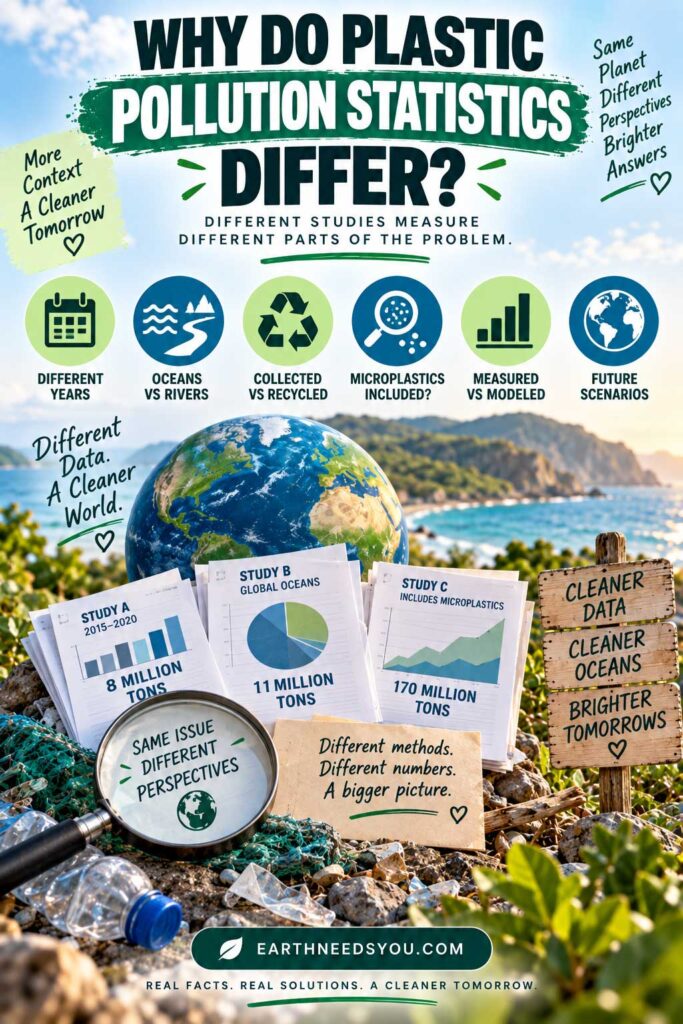
Plastic pollution statistics often vary because different reports measure different parts of the problem.
One study may estimate how much plastic reaches the ocean, while another includes pollution entering rivers, lakes, soil, and other environments. Recycling figures can also differ depending on whether they measure plastic collected for recycling or material that is actually processed into new products.
Differences may also result from:
- The year being studied
- Countries and industries included
- Whether microplastics are counted
- Different definitions of plastic waste
- Improvements in detection technology
- Measured data versus computer modeling
- Different assumptions used in future projections
For example, plastic entering a river does not necessarily reach the ocean immediately. It may become trapped in sediment, vegetation, reservoirs, or floodplains for years before moving farther downstream.
This is why estimates for river pollution, ocean leakage, and total environmental leakage can all be different without necessarily contradicting one another.
Future figures for 2040 or 2060 should also be understood as scenarios rather than guaranteed outcomes. They are based on assumptions about population growth, consumption, plastic production, government policies, recycling rates, and waste-management infrastructure.
When comparing plastic pollution facts and statistics, check what the number actually measures, which year it represents, and whether it refers to production, waste generation, recycling, environmental leakage, or accumulated pollution.
Despite differences between individual estimates, the broader picture is consistent: the world produces enormous amounts of plastic, recycling remains limited, and millions of tonnes of plastic continue leaking into natural environments every year.
What Can You Do to Reduce Plastic Pollution?
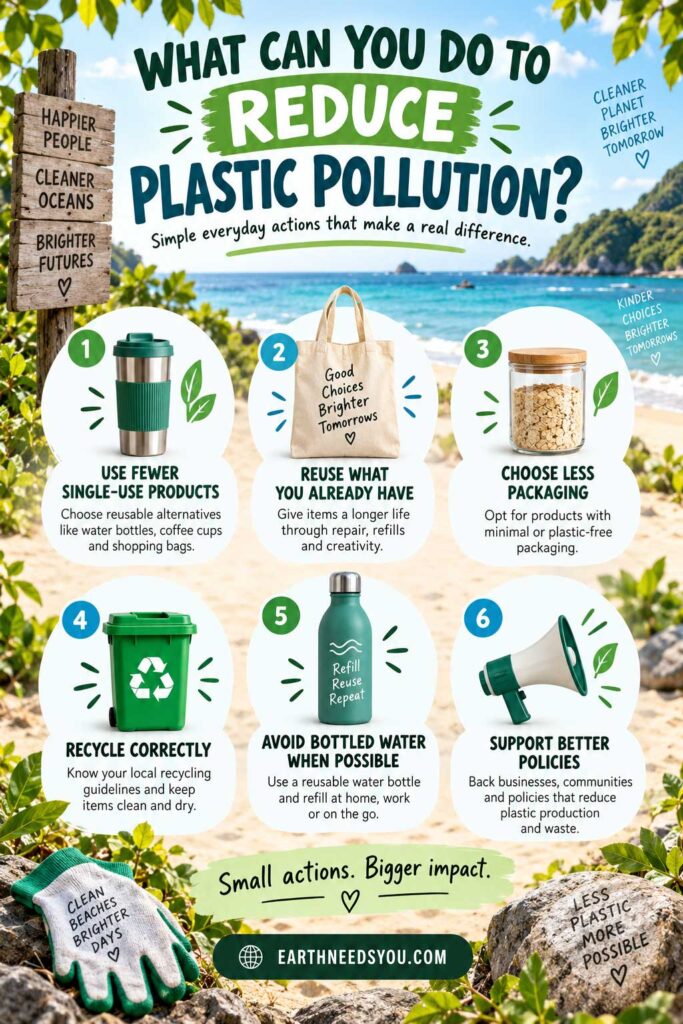
Plastic pollution requires action from governments, manufacturers, retailers, and waste-management systems. Individuals cannot solve the problem alone, but everyday choices can still reduce unnecessary waste and support better systems.
Use Fewer Single-Use Products
Start with plastic items you regularly use once and throw away, such as:
- Shopping bags
- Bottled water
- Disposable cups
- Straws
- Plastic cutlery
- Takeaway containers
Replacing frequently used disposable products with durable alternatives can prevent a significant amount of waste over time.
Reuse What You Already Have
Keep using existing bags, bottles, containers, and household products for as long as they remain safe and functional.
Buying a new product marketed as “eco-friendly” is not always better than making full use of something you already own.
Choose Products With Less Packaging
Packaging creates a large share of plastic waste.
When practical, choose unpackaged produce, refillable products, concentrated products, larger containers, and items without unnecessary layers of wrapping.
Recycle According to Local Rules
Check which plastic types your local recycling program actually accepts.
Empty containers, keep food and liquids out of recycling, and avoid adding uncertain items simply because they display a recycling symbol.
Learn more in our guide to understanding plastic recycling symbols.
Use a Reusable Bottle Where Tap Water Is Safe
Where safe drinking water is available, a reusable bottle can reduce repeated packaging waste.
The best reusable bottle is often the one you already own and continue using.
Buy Fewer Clothes and Keep Them Longer
Buying fewer, better-quality clothes can reduce both textile waste and microfiber pollution.
Washing synthetic clothing less frequently, using gentler cycles, and repairing garments can also help extend their useful life.
Maintain Your Vehicle Tires
Correct tire pressure, proper wheel alignment, smooth acceleration, and avoiding unnecessary driving can reduce tire wear.
These habits may also extend tire life and improve fuel efficiency.
Never Burn Plastic Waste
Open burning can release fine particles, greenhouse gases, and harmful chemicals into the air.
Use approved recycling, municipal collection, or disposal services instead.
Join Local Cleanups
Beach, river, park, and neighborhood cleanups can remove dangerous debris and help identify common sources of litter.
They are most effective when combined with efforts to prevent the same waste from returning.
Support Businesses That Reduce Waste
Choose companies that reduce packaging, provide refill options, sell durable products, use recycled materials, or offer repair and take-back programs.
Be cautious of vague claims such as “green,” “natural,” or “biodegradable” when no clear explanation is provided.
Support Effective Plastic Policies
Well-designed policies can reduce waste on a much larger scale than individual choices alone.
Examples include:
- Deposit-return systems
- Extended producer responsibility
- Reuse targets
- Better waste collection
- Recycled-content requirements
- Restrictions on unnecessary disposable plastics
Focus on Progress, Not Perfection
Completely avoiding plastic is unrealistic for most people.
A more practical goal is to reduce unnecessary consumption, reuse products consistently, recycle correctly, and support systems that make lower-waste choices easier for everyone.
Explore more practical ideas in 10 ways to reduce your plastic waste.
Frequently Asked Questions About Plastic Pollution
These frequently asked questions summarize some of the most important plastic pollution facts covered throughout this guide.
How Much Plastic Is Produced Every Year?
Global plastic use now exceeds 500 million tonnes annually. Without stronger policies, plastic use could nearly triple by 2060 compared with 2019 levels.
How Much Plastic Waste Is Generated Each Year?
The world generated approximately 353 million tonnes of plastic waste in 2019.
Under current trends, annual plastic waste could exceed one billion tonnes by 2060.
How Much Plastic Enters Aquatic Ecosystems Every Year?
An estimated 19–23 million tonnes of plastic waste enter aquatic ecosystems annually.
This includes plastic pollution reaching rivers, lakes, wetlands, coastal waters, and seas.
What Percentage of Plastic Is Recycled?
Around 15% of global plastic waste was collected for recycling in 2019, but processing losses meant only about 9% was successfully recycled.
Why Is Plastic Difficult to Recycle?
Plastic includes many different polymers, additives, colors, coatings, and material combinations.
Contamination, multilayer packaging, flexible films, limited processing capacity, and weak demand for recycled material can make recycling more difficult.
Does the Recycling Symbol Mean Plastic Is Recyclable?
No.
The number inside the recycling symbol identifies the type of plastic resin. It does not guarantee that your local recycling program accepts the product or that a nearby facility can process it.
How Long Does Plastic Take to Decompose?
There is no single decomposition time for all plastic.
Persistence depends on the polymer, thickness, additives, sunlight, temperature, moisture, oxygen, and surrounding environment.
Most conventional plastics gradually fragment into smaller pieces rather than biodegrading like food or untreated wood.
What Are Microplastics?
Microplastics are plastic particles smaller than five millimeters.
They can come from larger plastic waste breaking apart, synthetic clothing, vehicle tires, paint and coatings, industrial pellets, fishing equipment, and other sources.
Are Microplastics Harmful to Humans?
Microplastics have been detected in food, drinking water, air, and human tissues.
Scientists are still investigating how much people are exposed to, how particles move through the body, and whether long-term exposure contributes directly to specific diseases.
Where Does Most Ocean Plastic Come From?
A large share of marine plastic pollution originates on land.
Poor waste management, littering, stormwater, floods, rivers, wastewater, and coastal activities can carry plastic toward the sea. Fishing and aquaculture activities also contribute marine debris.
Is the Great Pacific Garbage Patch a Solid Island?
No.
The Great Pacific Garbage Patch is a broad region where ocean currents concentrate floating debris and microplastics. The waste is dispersed across a huge area rather than forming a solid island that people could walk on.
How Does Plastic Harm Wildlife?
Wildlife can swallow plastic, become entangled in fishing gear and other debris, or experience habitat damage.
Plastic pollution can contribute to digestive blockages, internal injuries, starvation, drowning, restricted movement, and damage to coral reefs and other habitats.
Is All Plastic Harmful?
No.
Plastic provides important benefits in medicine, food safety, construction, transportation, electronics, emergency response, and many other areas.
The greatest problems come from unnecessary disposable products, excessive packaging, poor product design, unsafe disposal, and plastic leaking into the environment.
Can Plastic Pollution Be Stopped?
Plastic pollution can be reduced dramatically through source reduction, reuse, better product design, reliable waste collection, effective recycling, producer responsibility, and stronger pollution controls.
Recycling alone is unlikely to solve the problem while plastic production and waste continue growing.
What Is the Best Way to Reduce Plastic Pollution?
The most effective approach prioritizes preventing waste before it is created:
- Eliminate unnecessary plastic
- Reduce material use
- Reuse and refill
- Repair and extend product life
- Recycle suitable materials
- Safely manage remaining waste
- Clean up existing pollution
Preventing plastic waste at its source is generally more effective than trying to recover it after it has dispersed through rivers, oceans, soil, and other environments.
The Biggest Lesson From These 101 Plastic Pollution Facts
These 101 plastic pollution facts show that plastic waste is far more than a litter problem.
Plastic pollution begins with fossil-fuel extraction and manufacturing, continues through short-lived products and packaging, and often ends in landfills, rivers, oceans, soil, air, or living organisms.
The scale is enormous. Global plastic use now exceeds half a billion tonnes annually, only a small share of plastic waste is successfully recycled, and millions of tonnes enter aquatic ecosystems every year.
Yet plastic pollution is not impossible to reduce.
The strongest solutions include:
- Eliminating unnecessary single-use products
- Expanding refill and reuse systems
- Designing products that last longer
- Making packaging easier to recycle
- Improving waste collection
- Preventing lost fishing gear and industrial pellet spills
- Holding producers responsible for packaging waste
- Supporting communities that lack safe waste infrastructure
Plastic also remains essential in medicine, food safety, construction, transportation, and many other areas. The goal should not be to remove every plastic product, but to reduce wasteful uses and manage necessary plastics far more responsibly.
Individual actions such as reusing containers, choosing less packaging, recycling correctly, and joining local cleanups can help. However, the greatest progress will come from coordinated action by governments, manufacturers, retailers, and consumers.
The most important lesson is simple: preventing plastic waste is easier than cleaning it up after it has spread through the environment.
Reducing unnecessary plastic today can protect wildlife, ecosystems, communities, and future generations for decades to come.



0 Comments