

Trees are natural carbon stores. As they grow, they absorb carbon dioxide (CO₂) from the atmosphere through photosynthesis and use that carbon to build trunks, branches, roots, and leaves. Some of that carbon can remain locked away for decades or even centuries.
But not all trees store carbon in the same way. Some grow incredibly fast, while others become enormous or live for thousands of years. Forest type matters too. Carbon isn’t stored only in the trunk of a tree—it can also accumulate in roots, dead wood, leaf litter, and surrounding soils.
So, which trees can store the most carbon?
From California’s gigantic sequoias to coastal mangroves and Africa’s ancient baobabs, trees have evolved very different ways to capture and hold carbon. Some grow incredibly fast. Others become enormous or survive for more than a thousand years.
There isn’t a universal ranking that says one tree species is always the “best” at storing carbon. Climate, age, growing conditions, forest density, soil, and land management can dramatically change the amount of carbon stored. Rather than treating this as a strict ranking, we’ll look at 10 trees and tree groups that show just how much carbon forests can hold when they’re given enough time to grow.
How Do Trees Store Carbon?

Trees remove carbon dioxide from the atmosphere through photosynthesis. Using sunlight, they convert CO₂ and water into the energy they need to grow. Much of the captured carbon becomes part of the tree itself, accumulating in its trunk, branches, roots, and leaves.
As a tree grows larger, more carbon becomes locked within its woody biomass. Some of that carbon can remain stored for decades or centuries, particularly in large, long-lived trees.
But the tree itself is only part of the story. Forest ecosystems can store carbon in several places:
- Trunks and branches – Large woody structures can hold carbon for many years.
- Roots – A substantial portion of a tree’s biomass exists below ground.
- Forest soils – Decomposing leaves, roots, and other organic material contribute carbon to the soil.
- Dead wood – Fallen trees and branches can continue holding carbon as they slowly decompose.
- Leaf litter – Leaves and other plant material gradually become part of the forest’s organic soil layer.
This is why determining which trees store the most carbon isn’t as simple as comparing growth rates. A fast-growing tree may absorb CO₂ rapidly, while a slower-growing tree that becomes enormous and lives for centuries may ultimately store far more carbon.
What Makes a Tree Especially Good at Storing Carbon?

So what allows some trees to become especially large carbon stores? Several factors matter:
Large mature size. Bigger trees generally contain more woody biomass, giving them the capacity to hold more carbon.
Long lifespan. Long-lived species can accumulate carbon over hundreds or even thousands of years.
Fast growth. Rapidly growing trees can capture carbon quickly as they build new wood, although growth rate alone doesn’t determine lifetime carbon storage.
Wood density. Dense wood can contain substantial biomass within a given volume.
Healthy surrounding ecosystems. Forest soils, roots, dead wood, and other vegetation can dramatically increase the total amount of carbon stored around a tree.
Location also matters. The same species may grow very differently depending on rainfall, temperature, soil, competition, disturbances, and forest management.
With that in mind, let’s look at 10 trees that store the most carbon and the different ways they build enormous carbon reserves across the world’s forests.
1. Giant Sequoia (Sequoiadendron giganteum)

Few trees demonstrate the scale of natural carbon storage better than the giant sequoia. Native to the western slopes of California’s Sierra Nevada, these enormous trees can live for thousands of years and develop some of the largest trunks found anywhere on Earth.
Giant sequoias store carbon primarily by turning atmospheric CO₂ into woody biomass as they grow. Their exceptional size is what makes them particularly impressive. A mature tree contains an enormous volume of wood, allowing it to hold carbon accumulated over centuries.
Why Giant Sequoias Store So Much Carbon
Their real advantage is time. A giant sequoia can spend centuries adding layer after layer of new wood.
Reaching old age doesn’t mean a giant sequoia stops growing. Large, healthy trees can continue adding new wood even after reaching extraordinary dimensions. Protecting an established giant matters not only because of the carbon it already stores, but also because it can keep accumulating more.
The surrounding forest matters too. Carbon is also present in roots, fallen wood, leaf litter, and forest soils, so the climate value of a sequoia grove extends beyond its largest trees.
How Big Can a Giant Sequoia Get?
Giant sequoias commonly reach heights of more than 250 feet, while exceptional specimens can grow even taller. Their most extraordinary feature, however, is their tremendous trunk volume.
The famous General Sherman Tree in Sequoia National Park stands about 275 feet tall and is recognized by the National Park Service as the world’s largest tree by volume.
Some giant sequoias are also more than 3,000 years old, meaning an individual tree can represent thousands of years of accumulated growth.
Protecting Existing Giants Matters
Planting trees is valuable, but a newly planted seedling cannot immediately replace the carbon stored in a centuries-old giant.
Protecting mature sequoia groves therefore remains critical. Severe wildfire, drought stress, climate change, and other disturbances can threaten these forests and the enormous carbon reservoirs they contain.
New sequoias matter for the future, but they can’t replace an ancient tree today. Protecting the giants that remain preserves centuries of accumulated carbon while younger forests develop around them.
2. Coast Redwood (Sequoia sempervirens)
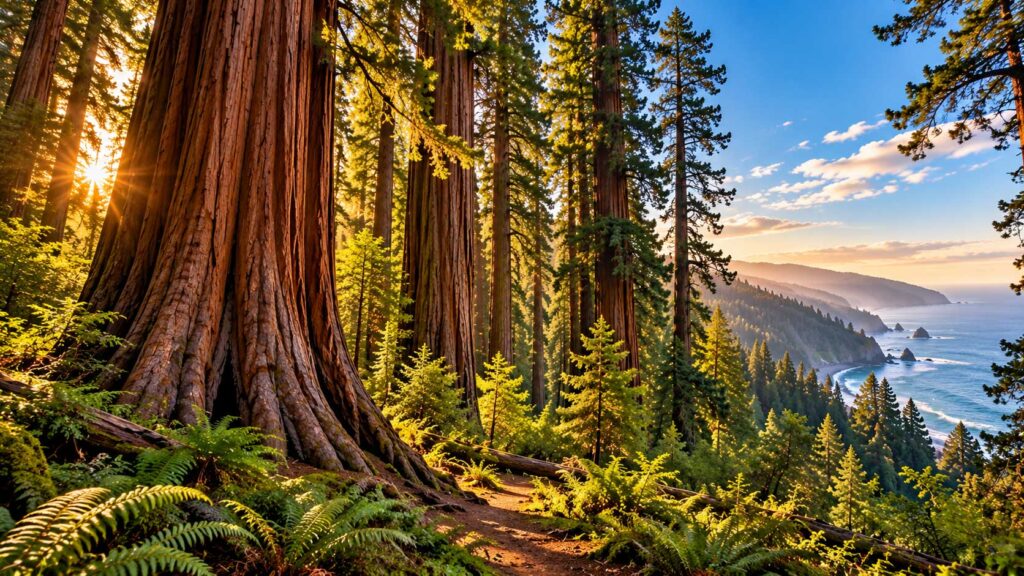
If giant sequoias impress with their enormous trunk volume, coast redwoods stand out for a different reason: they are the tallest trees on Earth. Native to a narrow coastal region of northern California and southern Oregon, these towering evergreens can exceed 350 feet in height and live for well over 1,000 years.
That combination of exceptional height, rapid growth, and longevity allows coast redwoods to accumulate tremendous amounts of woody biomass—and therefore carbon—over their lifetimes.
Why Coast Redwoods Store So Much Carbon
Coast redwoods can grow quickly when conditions are favorable. Unlike trees that grow rapidly but remain relatively small, redwoods combine fast growth with the potential to become enormous.
Their trunks, branches, roots, and surrounding forest soils all contribute to carbon storage. In an old-growth redwood forest, carbon is also held in fallen logs, standing dead trees, forest litter, and other organic material.
That’s why a redwood forest makes more sense as the unit of comparison than a single tree’s annual CO₂ uptake.
The Carbon Value of Old-Growth Redwood Forests
Old-growth coast redwood forests can contain extraordinary amounts of biomass. Some research has identified mature redwood forests among the ecosystems with the highest aboveground biomass measured anywhere in the world.
Redwoods also continue growing after reaching impressive sizes. As their trunks expand and their canopies develop, mature trees can keep adding substantial quantities of wood.
This is an important reminder that old trees are not simply carbon warehouses left over from the past. Large, healthy trees can continue capturing carbon while preserving the huge amount they have already accumulated.
More Than Carbon Storage
Coast redwood forests provide benefits far beyond carbon sequestration. Their complex canopies and forest floors create habitat for wildlife, while the forests help regulate water, protect soils, and maintain cooler local conditions.
Coastal fog is particularly important to this ecosystem. Redwoods can capture moisture from fog through their foliage, providing an additional source of water during California’s relatively dry summers.
Protecting remaining old-growth forests and restoring previously logged redwood landscapes can therefore accomplish several goals at once: preserving existing carbon stocks, creating opportunities for additional carbon storage, and protecting one of the world’s most remarkable forest ecosystems.
3. Douglas Fir (Pseudotsuga menziesii)

The Douglas fir may not have the worldwide fame of giant sequoias or coast redwoods, but it can become an enormous tree in its own right. Native to western North America, it combines rapid growth, impressive mature size, and a long lifespan—three characteristics that can contribute to substantial carbon storage.
In the moist forests of the Pacific Northwest, old Douglas firs can tower above the surrounding canopy. Some individuals exceed 250 feet in height, while exceptionally large trees can grow even taller.
Fast Growth and a Lot of Biomass
One reason Douglas fir is important for carbon storage is its ability to produce large amounts of woody biomass.
Young trees can grow relatively quickly under favorable conditions, removing CO₂ from the atmosphere as they build new trunks, branches, and roots. If those trees remain healthy for centuries, that early growth can eventually become an enormous reservoir of stored carbon.
Douglas fir is also a long-lived species. Individual trees can survive for many centuries, and some old-growth specimens are estimated to be more than 1,000 years old.
That combination separates Douglas fir from trees that grow quickly but have relatively short lifespans.
Old-Growth Douglas Fir Forests
The greatest carbon value doesn’t come from an isolated tree alone. Mature Douglas fir forests contain carbon throughout the ecosystem.
Huge living trees make up a substantial portion of that storage, but carbon is also found in the roots, understory vegetation, forest floor, soils, standing dead trees, and enormous fallen logs characteristic of old-growth forests.
When one of these giants eventually falls, its carbon doesn’t immediately return to the atmosphere. Large logs can remain on the forest floor for decades as they slowly decompose, becoming habitat for fungi, insects, plants, and other organisms along the way.
A Valuable Tree for Reforestation
Douglas fir is also widely used in forestry and reforestation because of its growth rate and valuable timber.
However, simply planting large numbers of Douglas firs isn’t equivalent to restoring an old-growth forest. A plantation containing similarly aged trees has a very different structure from a mature natural forest with multiple tree species, standing dead wood, fallen logs, diverse wildlife, and carbon-rich soils.
Douglas fir combines relatively fast early growth with the potential to become enormous if given enough time.
4. Eucalyptus (Eucalyptus spp.)

Few groups of trees are as strongly associated with rapid growth as eucalyptus. Native primarily to Australia, the genus includes hundreds of species ranging from relatively small trees to enormous forest giants.
Some eucalyptus species can accumulate woody biomass remarkably quickly when growing in favorable conditions. Others, including the towering mountain ash (Eucalyptus regnans), can develop into some of the tallest flowering trees on Earth.
That combination of fast growth and, in some species, exceptional mature size gives eucalyptus considerable potential for carbon storage.
Rapid Growth Can Capture Carbon Quickly
As eucalyptus trees build new wood, they remove CO₂ from the atmosphere and store carbon in their trunks, branches, and roots.
Their rapid growth is one reason eucalyptus species have been planted extensively in commercial forestry and restoration projects around the world. Under suitable conditions, a eucalyptus plantation can accumulate biomass much faster than many slower-growing forests.
But fast growth doesn’t automatically make a tree the best choice for carbon storage.
What happens to the forest over decades matters just as much. If trees are harvested frequently and the stored carbon is quickly returned to the atmosphere, the long-term benefit can be very different from allowing a forest to mature.
Some Eucalyptus Trees Become Giants
It is also misleading to think of eucalyptus only as fast-growing plantation trees.
Mountain ash provides an extraordinary example. Native to southeastern Australia and Tasmania, it can exceed 300 feet (90 meters) under favorable conditions. Mature forests dominated by these huge trees can contain substantial quantities of carbon in living biomass.
Other eucalyptus species vary dramatically in size, growth rate, lifespan, and ecological role. That’s why carbon-storage estimates should be based on the particular species and ecosystem rather than treating every eucalyptus tree as identical.
Eucalyptus Comes With Important Trade-Offs
Planting eucalyptus outside its native range requires careful consideration.
Some species can become invasive in suitable climates, while dense plantations may compete heavily for water and provide less wildlife habitat than diverse native forests. Eucalyptus foliage and bark can also contribute combustible material, making appropriate wildfire management particularly important in fire-prone landscapes.
That doesn’t make eucalyptus a “bad” tree. It simply means location matters.
Replacing a diverse native forest with a eucalyptus monoculture simply because eucalyptus grows quickly can sacrifice biodiversity and other ecosystem benefits. In many restoration projects, protecting existing native vegetation or planting a mixture of locally appropriate species will be the better approach.
A successful carbon-storing forest needs to survive, continue accumulating biomass, maintain healthy soils, and function as an ecosystem over the long term.
In the right environment, eucalyptus can do that exceptionally well. But its greatest climate value comes when rapid carbon uptake is combined with responsible land management and long-term forest protection.
5. Oak (Quercus spp.)

Oak trees take a different approach to carbon storage than fast-growing species such as eucalyptus. They may take longer to reach their full size, but many oaks develop large trunks, dense wood, broad canopies, and remarkably long lifespans.
The genus Quercus includes hundreds of species distributed across the Northern Hemisphere. Depending on the species and growing conditions, an oak can live for several centuries, giving it a long period in which to accumulate carbon.
Built for Long-Term Storage
As an oak grows, carbon captured from atmospheric CO₂ becomes incorporated into its trunk, branches, and extensive root system.
A young oak won’t contain nearly as much carbon as a mature tree. Over decades, however, the trunk becomes thicker, branches expand, and the tree adds increasingly more woody biomass.
This is one reason large old trees are so valuable. A mature oak represents decades or even centuries of accumulated growth that cannot be quickly replaced by planting a seedling.
Dense hardwood also makes oaks useful examples of long-term carbon storage. Carbon can remain locked within living wood for the lifetime of the tree and may remain in dead wood or long-lasting wood products afterward.
The carbon held inside an oak is only part of the picture.
Oak woodlands continually add organic material to the forest floor. Fallen leaves, twigs, dead roots, and decomposing wood contribute to soil organic matter, while living roots transfer carbon below ground.
Over time, a healthy forest can therefore develop substantial carbon stores both above and below the soil surface.
This is another reason protecting an established woodland can offer benefits that simply counting newly planted trees doesn’t capture.
Oaks Are Biodiversity Powerhouses
Carbon isn’t the only reason oaks are valuable.
Native oak species can support an extraordinary variety of wildlife, including insects, birds, mammals, fungi, and other organisms. Their acorns provide food for numerous animals, while cavities in older trees create nesting and shelter sites.
A mature oak can effectively become a small ecosystem of its own, which makes native oaks particularly valuable where carbon storage and biodiversity restoration are both priorities.
If you have enough space and an oak species is native or well adapted to your region, it can be an excellent long-term tree choice.
The important word is space. Many oaks eventually develop enormous crowns and root systems, so they shouldn’t be squeezed into locations where they will later require heavy pruning or removal.
Choose a species suited to your climate and soil, and think decades ahead when selecting the planting location.
An oak may not provide the fastest carbon capture during its first few years, but given enough time, its combination of size, dense wood, longevity, and ecological value can make it an impressive long-term carbon store.
6. Mangrove Trees

Mangroves show why measuring carbon storage only by looking at a tree’s trunk can be misleading. These salt-tolerant trees and shrubs grow along tropical and subtropical coastlines, where they create some of the planet’s most important blue carbon ecosystems.
Mangroves may not reach the extraordinary dimensions of giant sequoias or coast redwoods, but much of their carbon-storage power is hidden below the surface.
Their tangled roots trap sediment and organic material, while waterlogged, oxygen-poor soils can slow decomposition. As a result, carbon can accumulate within mangrove sediments over long periods.
Much of the Carbon Is Underground
In a typical forest, it’s easy to focus on what we can see: trunks, branches, and leaves. Mangrove ecosystems work differently.
Mangroves capture atmospheric CO₂ as they grow, storing carbon in their living biomass just like other trees. Leaves, roots, branches, and other organic material eventually fall into the wet sediment surrounding them.
Because decomposition can be slow in these saturated soils, some of that organic carbon becomes buried rather than rapidly returning to the atmosphere.
Over many years, layers of carbon-rich sediment can accumulate beneath a mangrove forest. This belowground reservoir is a major reason mangroves can hold such large carbon stocks despite the relatively modest size of many individual trees.
What Is Blue Carbon?
Blue carbon is carbon captured and stored by coastal and marine ecosystems, particularly mangroves, seagrass meadows, and tidal marshes.
Blue carbon ecosystems occupy a relatively small area globally, but their waterlogged soils can accumulate substantial stores of organic carbon.
That makes mangrove conservation particularly important. Destroying a mangrove doesn’t only remove the living trees. Disturbing or draining the underlying soil can also expose previously stored organic matter, potentially allowing some of its carbon to return to the atmosphere.
Carbon Storage With Coastal Benefits
The environmental value of mangroves extends well beyond carbon.
Their dense root systems can trap sediment and help stabilize shorelines. Mangrove forests also provide nursery habitat for fish and other marine organisms and create feeding, breeding, and shelter areas for birds and wildlife.
Healthy mangroves can also reduce wave energy, adding a natural layer of protection for some coastal communities during storms.
These combined benefits make mangrove restoration attractive in places where the ecosystem historically occurred and where local conditions can support it.
Planting mangroves has received considerable attention as a climate and coastal-restoration strategy, but successful restoration involves much more than putting seedlings into the mud.
Tidal flows, sediment conditions, salinity, elevation, and the appropriate native species all influence whether a restored mangrove forest will survive.
In some places, removing the cause of degradation and allowing natural regeneration may work better than intensive planting.
Most importantly, conserving established mangrove forests protects both the carbon stored in living vegetation and the much larger carbon reservoir that may have accumulated beneath them.
Mangroves demonstrate one of the central lessons of forest carbon storage: sometimes the most important carbon isn’t visible in the trees at all—it’s stored beneath your feet.
7. Sitka Spruce (Picea sitchensis)

Sitka spruce is a Pacific Coast giant capable of accumulating an impressive amount of carbon. Native to a narrow band stretching from northern California through the Pacific Northwest and into Alaska, it thrives in the cool, moist conditions found near the coast.
With abundant rainfall and favorable soils, Sitka spruce can grow rapidly and reach enormous dimensions. Mature trees commonly tower over surrounding vegetation, while exceptional old-growth specimens can exceed 250 feet (76 meters) in height.
That combination of rapid growth, large size, and a lifespan measured in centuries gives Sitka spruce considerable potential for long-term carbon storage.
Fast Growth and Massive Size
Sitka spruce can grow quickly when young, allowing it to capture atmospheric CO₂ while rapidly building trunks, branches, and roots.
Unlike many fast-growing trees that remain relatively small, however, Sitka spruce can continue developing into a forest giant.
Older trees can produce massive trunks containing decades or centuries of accumulated woody biomass. Some individuals can live for 700 years or longer under favorable conditions.
This makes Sitka spruce a good example of a tree that combines two valuable carbon-storage characteristics: relatively fast growth and the ability to become very large.
A Key Tree in Temperate Rainforests
Sitka spruce is an important component of the extraordinary temperate rainforests found along parts of the Pacific Coast.
These forests can be exceptionally productive because their mild temperatures and abundant moisture create favorable growing conditions. Large trees dominate the canopy, but the ecosystem’s carbon isn’t confined to living trunks.
Carbon is also stored in roots, soils, fallen logs, standing dead trees, mosses, and other organic material scattered across the forest floor.
In old forests, enormous fallen trunks can take decades to decompose completely. During that time, they continue to hold carbon while providing habitat and eventually contributing organic matter to the soil.
More Than a Carbon Reservoir
Sitka spruce forests also provide important wildlife habitat and help protect watersheds and soils.
Along streams and rivers, large trees and fallen wood can influence aquatic habitats, including waterways used by salmon. Dense coastal forests also provide shelter and nesting habitat for numerous birds and mammals.
Carbon is only one part of what makes these forests valuable.
Sitka spruce is commercially valuable, but a managed plantation isn’t the ecological equivalent of an old-growth coastal forest. Mature forests contain trees of different ages, standing and fallen dead wood, developed soils, understory vegetation, and far more complex wildlife habitat.
Protecting the remaining mature forests preserves carbon accumulated over centuries, while restoration gives younger forests the opportunity to develop that complexity over time.
8. Teak (Tectona grandis)
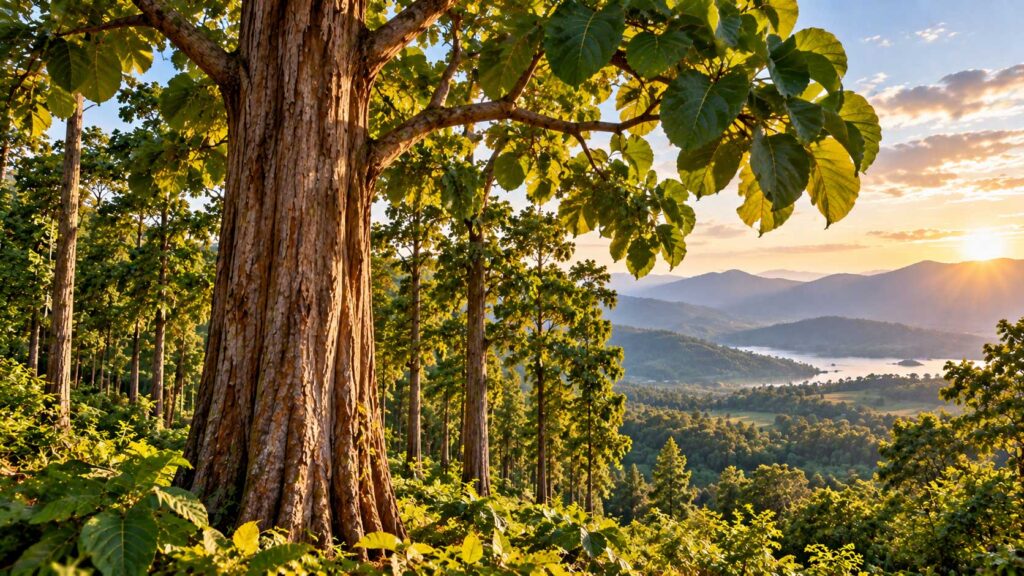
Teak is best known for its strong, durable timber, but those same characteristics also make it interesting from a carbon-storage perspective. Native to parts of South and Southeast Asia, teak can develop into a large tropical hardwood tree with substantial woody biomass.
Unlike the towering redwoods and sequoias earlier in this list, teak’s carbon story isn’t primarily about record-breaking size. Instead, it combines moderately fast growth, dense wood, a relatively long lifespan, and timber that can remain in use for decades.
Dense Wood Can Hold Carbon for Years
As teak grows, it captures atmospheric CO₂ and converts some of that carbon into wood, roots, leaves, and other plant tissue.
Mature teak trees can reach roughly 100 feet (30 meters) or more under favorable conditions and develop substantial trunks.
Teak wood is particularly valued because of its natural durability and resistance to moisture and decay. When responsibly harvested wood is turned into long-lived products such as furniture or building materials, some of the carbon captured during tree growth can remain stored in those products rather than being released immediately through decomposition or burning.
However, wood products don’t store carbon permanently. Their climate impact depends on how long they remain in use, what happens at the end of their life, and how the forest is managed afterward.
Teak is widely grown in plantations, but a plantation and a natural tropical forest are very different ecosystems.
Natural forests typically contain multiple layers of vegetation, trees of different ages and species, dead wood, complex soils, and habitat for far more wildlife. Converting an existing natural forest into a teak plantation can therefore result in major ecological losses and may release substantial amounts of previously stored carbon.
The climate benefits are much stronger when teak is established on appropriate land without clearing carbon-rich natural ecosystems first.
Management Makes the Difference
How frequently trees are harvested, what happens to the timber, whether forests are replanted, and how soils are managed all affect the long-term carbon balance.
Longer rotations can allow trees to develop more biomass before harvest. Maintaining vegetation between trees, protecting waterways, reducing soil disturbance, and preserving areas of native forest can also improve the ecological value of managed landscapes.
Where timber is harvested, using the wood in durable products can retain some of its carbon for considerably longer than using it for short-lived products or fuel.
A growing teak tree removes CO₂ from the atmosphere, but what happens afterward matters. Carbon may remain stored in the standing tree, enter the soil, stay locked in a piece of furniture for decades, or return relatively quickly to the atmosphere.
Teak’s carbon story ultimately depends on where it grows, what was there before it, how long the trees remain standing, and what happens to the wood after harvest.
When those factors are managed responsibly, teak can contribute to long-term carbon storage while supplying one of the world’s most durable hardwoods.
9. European Beech (Fagus sylvatica)

The European beech is one of the defining trees of Europe’s temperate forests. Native across much of the continent, it can develop into a large, long-lived hardwood with a broad canopy, substantial trunk, and extensive root system.
European beech doesn’t compete with eucalyptus for rapid early growth or with redwoods for extreme height. Its strength as a carbon-storing tree comes from something different: steady growth over a long life combined with the ability to form mature forests rich in living biomass, dead wood, and soil carbon.
Centuries of Carbon Storage
European beech trees can live for several centuries under favorable conditions. As they mature, their trunks and branches gradually accumulate more woody biomass—and therefore more carbon.
Some mature trees reach around 100–150 feet (30–45 meters) tall, although size varies considerably with location and growing conditions.
In an undisturbed forest, carbon captured by a beech doesn’t simply disappear when a branch falls or the tree eventually dies. Fallen wood decomposes gradually, transferring some organic matter to the forest floor and providing habitat for fungi, insects, and other organisms.
Over time, carbon moves through living trees, dead wood, leaf litter, and soil, making the whole forest part of the carbon store.
Every autumn, deciduous beech trees drop huge quantities of leaves.
Some of this material decomposes relatively quickly, while some contributes to the organic matter in forest soils. Roots also continually grow, die, and interact with fungi and microorganisms below ground.
Over time, some of the carbon captured by the forest becomes part of the soil.
The exact amount stored varies enormously according to climate, soil type, forest age, management, and local conditions, which is why assigning one carbon-storage number to every European beech forest would be misleading.
Why Ancient Beech Forests Matter
Europe once contained much larger expanses of natural beech forest. Today, surviving old and relatively undisturbed stands provide a glimpse of what these ecosystems can become when allowed to develop over long periods.
Ancient forests contain more than large living trees. They include young trees, veterans, standing dead trees, fallen trunks, cavities, fungi, understory plants, and complex soils.
Some of Europe’s most exceptional ancient and primeval beech forests are protected as part of a UNESCO World Heritage Site, highlighting their ecological importance.
Old beech trees create valuable habitat as they age. Cavities can shelter birds and bats, while dead and decaying wood supports fungi, beetles, and many other organisms.
European beech forests show why restoration is about more than choosing whichever tree grows fastest.
Allowing native forests to mature can simultaneously increase carbon storage, create wildlife habitat, protect soils, and make ecosystems more structurally diverse.
European beech may accumulate carbon more gradually than some trees on this list, but given enough time, a mature beech forest can become an impressive storehouse of both carbon and biodiversity.
10. Baobab (Adansonia spp.)
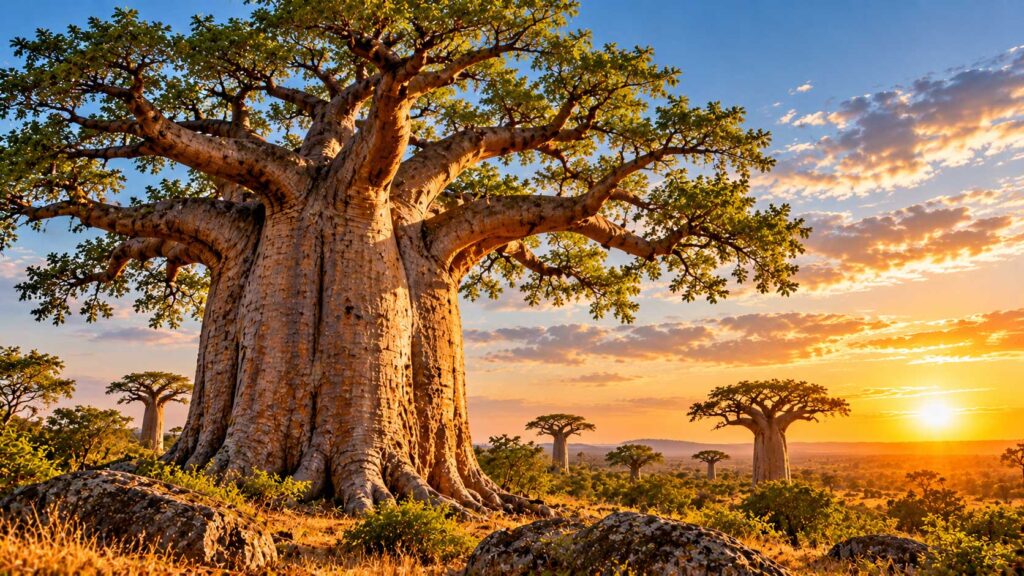
Few trees are as instantly recognizable as the baobab. With its enormous swollen trunk, relatively short branches, and ability to survive in hot, seasonally dry environments, it looks unlike almost any other tree on this list.
Baobabs occur naturally in Africa, Madagascar, and Australia, depending on the species. Some can survive for well over 1,000 years, giving them an extraordinarily long period in which to accumulate woody biomass and store carbon.
They aren’t included here because they necessarily capture more carbon each year than fast-growing trees such as eucalyptus. Instead, baobabs demonstrate another path to carbon storage: grow large, survive for centuries, and persist in landscapes where conditions can be extremely challenging.
Massive Trunks Built for Survival
The most striking feature of a mature baobab is its trunk.
Rather than producing the tall, relatively narrow form of many forest trees, baobabs can develop tremendously thick trunks. Their massive, water-rich trunks are one of several adaptations that help baobabs survive long dry seasons.
Some old individuals develop trunk diameters measured in several meters, giving them an enormous physical presence despite being much shorter than giant sequoias or coast redwoods.
All of that living tissue contains carbon originally captured from atmospheric CO₂ through photosynthesis.
Carbon Storage in Dry Landscapes
Baobabs are especially interesting because they thrive in environments very different from the wet forests occupied by redwoods, Sitka spruce, or Douglas fir.
In dry ecosystems, water availability can strongly limit plant growth. A tree capable of surviving repeated dry seasons and living for centuries can therefore represent a substantial long-term reservoir of biomass within the landscape.
Baobabs remind us that important carbon-storing trees aren’t restricted to lush rainforests and towering conifer forests.
Drylands, savannas, and seasonally dry woodlands also contain carbon that is worth protecting. Restoring these landscapes requires a different approach from restoring a wet forest. Our guide to preventing and reversing desertification explains how vegetation restoration, water management, and better land-use practices can help degraded drylands recover.
More Than a Carbon-Storing Tree
Baobabs have enormous ecological and cultural importance in many of the places where they grow.
Their flowers can provide food for pollinators, while their fruits and seeds are consumed by wildlife and people. Cavities in large old trunks can provide shelter, and the trees often become important landmarks within local landscapes.
People have also used baobab fruit, leaves, bark, and other materials for generations.
Protecting these trees preserves much more than the carbon contained in their trunks.
Their extraordinary age is part of what makes old baobabs so difficult to replace.
A tree that has survived for a thousand years represents an ecological structure that cannot simply be replaced by planting another tree nearby. Even if dozens of seedlings are planted, recreating an ancient giant takes centuries.
Climate change and shifts in rainfall patterns may create additional challenges for some baobab populations, while land-use change can affect regeneration and surrounding habitat.
Protecting old trees while allowing younger generations to establish helps keep these remarkable landscapes intact.
Baobabs are a reminder that a major carbon store doesn’t have to look like a towering rainforest tree. In dry landscapes, longevity and survival can matter just as much as rapid growth.
How the 10 Trees Compare

The trees that store the most carbon don’t all do it in the same way. Giant sequoias and coast redwoods accumulate enormous quantities of woody biomass, while mangrove ecosystems can store a large share of their carbon below ground. Fast-growing eucalyptus captures carbon quickly, while oaks, European beeches, and baobabs can retain carbon over very long lifespans.
Here’s a quick comparison:
| Tree | Native Range | What Makes It Notable for Carbon Storage | Typical Longevity |
|---|---|---|---|
| Giant Sequoia | California, USA | Extraordinary trunk volume and centuries of continued biomass accumulation | 2,000+ years |
| Coast Redwood | California and southern Oregon | Extreme height, rapid growth, massive biomass, and carbon-rich old-growth forests | 1,000+ years |
| Douglas Fir | Western North America | Fast growth combined with huge mature size and long lifespan | Several hundred years; some 1,000+ |
| Eucalyptus | Primarily Australia | Rapid biomass accumulation; some species become exceptionally large | Highly species-dependent |
| Oak | Northern Hemisphere | Dense wood, large mature size, extensive roots, and long lifespan | Often several centuries |
| Mangroves | Tropical and subtropical coastlines | Exceptional belowground carbon storage in waterlogged coastal sediments | Species-dependent |
| Sitka Spruce | Pacific Coast of North America | Fast growth, very large mature size, and productive temperate rainforest habitat | Several hundred years |
| Teak | South and Southeast Asia | Substantial hardwood biomass and durable wood that may remain in long-lived products | Often 100+ years under favorable conditions |
| European Beech | Europe | Long-lived hardwood and mature forests with significant biomass and soil carbon | Several centuries |
| Baobab | Africa, Madagascar and Australia | Massive trunks, extreme longevity, and persistent biomass in dry ecosystems | Some individuals 1,000+ years |
Which Tree Stores the Most Carbon?
When comparing the trees that store the most carbon, there’s no single winner because the answer depends on what you’re measuring.
For individual trees, giants such as sequoias and coast redwoods stand out because they can accumulate tremendous amounts of woody biomass over centuries. For entire ecosystems, the picture changes. Mangrove forests, for example, can store a large share of their carbon underground in waterlogged sediments.
Be cautious with claims that a particular tree absorbs an exact number of pounds or kilograms of CO₂ every year. Actual carbon uptake varies with tree size, age, climate, growing conditions, and the method used to calculate it.
Fast-Growing vs. Long-Lived Trees: Which Is Better?
Neither characteristic automatically wins.
Fast-growing trees can remove CO₂ relatively quickly while building new biomass. This can make them useful in appropriately designed restoration projects where rapid vegetation recovery is needed.
Long-lived trees have a different advantage. They can continue accumulating biomass for decades or centuries while keeping previously captured carbon locked in living wood.
Some of the most impressive trees combine both characteristics. Coast redwoods and Douglas firs, for example, can grow relatively quickly while eventually becoming enormous and living for centuries.
The best choice for restoration usually isn’t simply the species with the fastest growth rate. A tree should also be appropriate for the local climate, soil, water availability, wildlife, and surrounding ecosystem.
In many cases, protecting an existing mature forest provides benefits that planting a new stand of fast-growing trees cannot immediately replace.
Does Planting More Trees Really Help Climate Change?
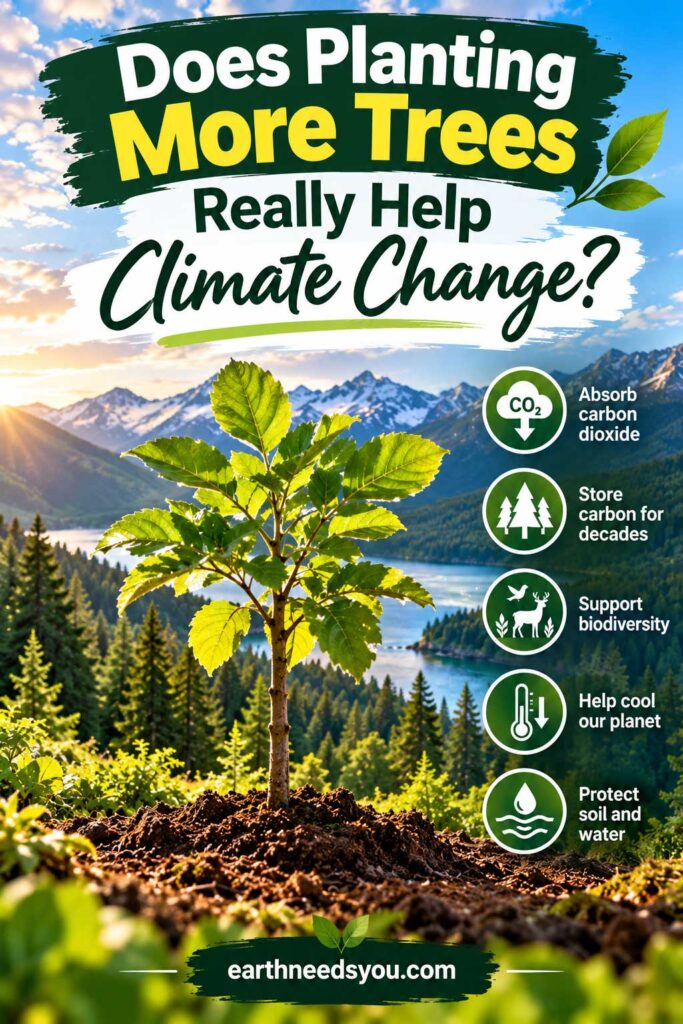
Yes, restoring forests can help address climate change, but planting trees is not a substitute for reducing greenhouse gas emissions.
As trees grow, they remove CO₂ from the atmosphere and store some of that carbon in wood, roots, and soils. Restoring forests can also provide benefits that extend far beyond carbon, including wildlife habitat, cleaner water, healthier soils, cooler local temperatures, and greater protection against erosion.
Protecting Existing Forests Comes First
A newly planted tree starts with very little stored carbon. A mature forest may contain decades or centuries of accumulated carbon in large trees, roots, dead wood, and soils.
If an established forest is cleared and replaced with seedlings, those seedlings may eventually capture significant amounts of CO₂—but rebuilding the carbon stock of the original ecosystem can take many decades or longer.
Preventing unnecessary forest loss therefore protects carbon that is already stored while allowing surviving trees to continue growing.
Plant the Right Trees in the Right Places
Reforestation isn’t about planting as many trees as possible everywhere.
Tree species need to match the local climate, soils, water availability, and ecology. Native species are often valuable because local wildlife and other organisms have evolved alongside them, although the best restoration approach depends on the site.
Diverse forests can also be more ecologically valuable than large monocultures containing only one tree species.
And some landscapes shouldn’t be turned into forests at all. Natural grasslands, peatlands, wetlands, and other non-forest ecosystems can already store substantial carbon and support specialized biodiversity. Planting trees where forests don’t naturally belong can damage those ecosystems rather than restore them.
A Forest Has to Survive to Store Carbon
Planting a seedling is only the beginning.
Drought, wildfire, pests, disease, grazing, poor species selection, and inadequate long-term management can cause restoration projects to fail. If trees die prematurely and their biomass decomposes or burns, some of the carbon they captured can return to the atmosphere.
Successful restoration is about what survives decades from now, not how many seedlings go into the ground today.
In some degraded forests, allowing trees to regenerate naturally after removing the original source of disturbance can be more effective than planting every tree by hand.
Trees Are Part of the Climate Solution
Forests are powerful natural carbon reservoirs, but there is a limit to how much additional CO₂ land ecosystems can absorb.
Tree planting cannot compensate indefinitely for emissions from fossil fuels, industry, transportation, and other sources.
Forests are also only one way of removing or managing carbon. Technologies such as carbon capture and storage are being developed to address emissions from industrial and energy sources.
Trees work best as part of a bigger climate strategy: protect the forests we still have, restore damaged ecosystems, reduce greenhouse gas emissions, and move toward cleaner energy and more sustainable land use.
The extraordinary trees in this article show how much carbon nature can accumulate when forests are given enough time to grow. Protecting that stored carbon—and creating conditions for healthy forests to continue developing—is just as important as planting the next generation of trees.
What Is the Best Tree to Plant for Carbon Storage?
After seeing giant sequoias, redwoods, and other enormous trees on this list, you might wonder which tree you should plant if you want to help store carbon.
The answer usually isn’t the biggest or fastest-growing species in the world. It’s the tree that is well suited to your location and has a good chance of surviving for many decades.
A coast redwood may be an extraordinary carbon-storing tree in its native environment, but it wouldn’t be an appropriate choice for most climates. The same applies to mangroves, eucalyptus, baobabs, and many other trees on this list.
Choose a Tree That Can Thrive Where You Live
Start with your local conditions:
- Climate and winter temperatures
- Annual rainfall and available irrigation
- Soil type and drainage
- Amount of sunlight
- Available space above and below ground
- Mature height and canopy width
- Local pests and diseases
Whenever possible, consider native or regionally appropriate trees that can thrive without excessive irrigation, fertilizer, or maintenance.
A healthy tree that thrives for generations can provide far more long-term value than a fast-growing species that struggles in the wrong climate and dies young.
One of the most overlooked factors in carbon storage is simply allowing a tree to become large.
A tree planted beneath power lines, too close to a building, or in a tiny strip of soil may eventually require aggressive pruning or removal. That prevents it from reaching its full carbon-storage potential.
Before planting, check the tree’s expected mature height, canopy spread, and root requirements.
Think about what the site will look like in 20, 50, or even 100 years—not just how the seedling looks today.
Don’t choose a tree simply because a nursery label says it grows fast.
Beyond growth speed, look for characteristics such as:
- Large mature size
- Long lifespan
- Strong resistance to local pests and diseases
- Suitability for the local climate
- Wildlife value
- Low risk of becoming invasive
- Ability to survive without excessive water or maintenance
In many yards and community landscapes, a long-lived native oak or another locally adapted shade tree may make more sense than trying to plant one of the global giants featured above.
Carbon storage is only one reason to plant trees. The right tree can also shade buildings, cool neighborhoods, reduce erosion, provide food and shelter for wildlife, improve soil, and make outdoor spaces more comfortable.
That’s why tree selection should consider the whole ecosystem, not just CO₂.
Looking for trees that make more sense around homes and landscapes? See our guide to Top 10 Carbon-Storing Trees for options including oak, pine, tulip tree, sweetgum, red mulberry, and dogwood.
The goal isn’t simply to plant the tree that sounds most impressive. It’s to plant the right tree in the right place—and give it the opportunity to grow old.
Frequently Asked Questions About Trees That Store the Most Carbon
Which Tree Stores the Most Carbon?
There isn’t a single tree species that stores the most carbon under every set of conditions. Giant sequoias and coast redwoods stand out because individual trees can become enormous and live for centuries or even thousands of years. When entire ecosystems are considered, mangrove forests are also exceptional because large amounts of carbon can accumulate in their waterlogged soils.
Which Trees Absorb the Most CO₂?
Large, fast-growing trees can absorb substantial amounts of CO₂ as they add new biomass, but the rate varies with species, age, climate, soil, water availability, and overall tree health. Coast redwoods, Douglas firs, eucalyptus species, and other rapidly growing large trees can be highly productive, but there is no universal annual CO₂ figure that applies to every tree.
Do Older Trees Still Absorb Carbon Dioxide?
Yes. Healthy older trees continue photosynthesizing and adding new wood, which means they can continue capturing carbon even after reaching impressive sizes. Large old trees are particularly valuable because they preserve carbon accumulated during previous decades or centuries while continuing to grow.
How Much Carbon Can One Tree Store?
There’s no single number that applies to every tree. Carbon storage varies enormously with species, trunk diameter, height, age, wood density, climate, and growing conditions. Estimates also change depending on whether roots and surrounding soils are included.
A young backyard tree and a 1,000-year-old giant sequoia clearly contain vastly different amounts of carbon. Estimates are therefore most meaningful when they are calculated for a specific tree, forest, or area of land.
Where Is Carbon Stored in a Tree?
Carbon is stored throughout the tree, including its trunk, branches, roots, leaves, and other tissues. In a forest, additional carbon can be found in dead wood, leaf litter, roots, microorganisms, and soil organic matter.
In ecosystems such as mangrove forests, belowground sediments can account for a particularly important portion of total carbon storage.
Is Planting Trees Enough to Stop Climate Change?
No. Forest protection and restoration can contribute to climate mitigation, but trees cannot replace the need to reduce greenhouse gas emissions.
Protecting existing forests, restoring degraded ecosystems, reducing fossil-fuel emissions, improving land management, and expanding cleaner energy all have roles to play.
Final Thoughts: Trees Are Long-Term Carbon Stores
From towering giant sequoias and coast redwoods to ancient baobabs and carbon-rich mangrove forests, the trees that store the most carbon can look remarkably different from one another.
Some species capture CO₂ rapidly because they grow quickly. Others accumulate enormous amounts of woody biomass over centuries. And in ecosystems such as mangroves, much of the carbon isn’t visible in the trees at all—it’s stored underground in roots and sediments.
There isn’t one universally “best” carbon-storing tree. A species that performs exceptionally well in one ecosystem may be completely wrong for another.
The takeaway is simple: carbon storage isn’t a numbers game where planting more trees automatically produces a better result. Protecting mature forests preserves carbon that has already accumulated, while thoughtful restoration can help damaged ecosystems begin storing more carbon again.
And when planting a tree at home or in your community, you don’t need a giant sequoia to make a difference. Choose a species suited to your region, give it enough room to reach maturity, and consider its value for wildlife and the wider ecosystem.
A tree’s greatest climate contribution doesn’t happen on the day it’s planted. It develops over decades—and sometimes centuries—of growth.
Explore More About Forests and Climate Solutions
Want to learn more about how trees, forests, and natural ecosystems can help address environmental challenges? Continue with these EarthNeedsYou guides:
- Top 10 Carbon-Storing Trees — Discover practical tree species that can capture and store carbon, including oak, pine, tulip tree, sweetgum, red mulberry, and eucalyptus.
- How Reforestation Helps Fight Climate Change — Learn how restoring forests can remove CO₂ from the atmosphere while rebuilding wildlife habitat.
- Best Reforestation Projects Around the World — Explore large-scale efforts to restore forests and degraded landscapes.
- How Can We Prevent or Reverse Desertification? — See how vegetation restoration, better land management, and water conservation can help damaged landscapes recover.
- How Carbon Capture Works — Compare natural carbon storage in forests with technologies designed to capture CO₂ from industrial sources or directly from the atmosphere.
- Why Biodiversity Matters — Learn why healthy forests need more than trees and how diverse ecosystems become more resilient over time.



0 Comments