


Finding the best organic diaper bags isn’t as simple as choosing a style you like. Once you start comparing materials, sizes, pockets, straps, and dozens of different designs, there’s a lot more to consider. If sustainability matters to you, there’s another important question: what is the bag actually made from?
Sustainable diaper bags take several different approaches. Some use organic cotton, while others rely on recycled polyester, recycled nylon, or other materials that reduce the need for virgin resources. Some brands also provide certifications or detailed information about recycled content and substances they intentionally avoid.
Of course, an eco-friendly diaper bag still needs to work well. You need enough room for diapers, wipes, bottles, snacks, extra clothes, and all the other things that somehow end up coming along when you leave the house with a baby. Comfortable straps, useful pockets, an easy-to-clean interior, and a bag that can handle years of use matter just as much as the material.
In this guide, we’ve rounded up some of the best organic, eco-friendly, and non-toxic diaper bags to consider in 2026. We’ll look at the materials, storage, everyday features, advantages, drawbacks, and sustainability claims of each option so you can decide which one makes the most sense for your family.
Quick Answer: What Is the Best Organic Diaper Bag?
There isn’t one option that will work for every parent. The best organic diaper bags for your family will depend on the materials you prefer, how much you carry, and which features you actually use. If sustainability is your priority, look for organic or recycled materials, durable construction, and credible certifications or clearly documented material claims. Parents interested in natural-material baby products may also want to compare our best organic diapers.
Then consider how you’ll actually use the bag. A good diaper bag should have enough storage for your daily essentials, comfortable straps, easy-access pockets, and materials that are reasonably easy to clean.
Durability matters, too. A well-made sustainable diaper bag that can later become a travel, work, or everyday backpack may be a better environmental choice than a bag that needs to be replaced after a year or two.
Editor’s Note: We researched these diaper bags based on their materials, sustainability claims, storage and organization, comfort, durability, useful parenting features, and overall value. When a manufacturer makes a specific environmental or material-safety claim, we recommend checking its current product information and certifications before buying.
Quick Comparison: Best Organic Diaper Bags & Eco-Friendly Options (2026)
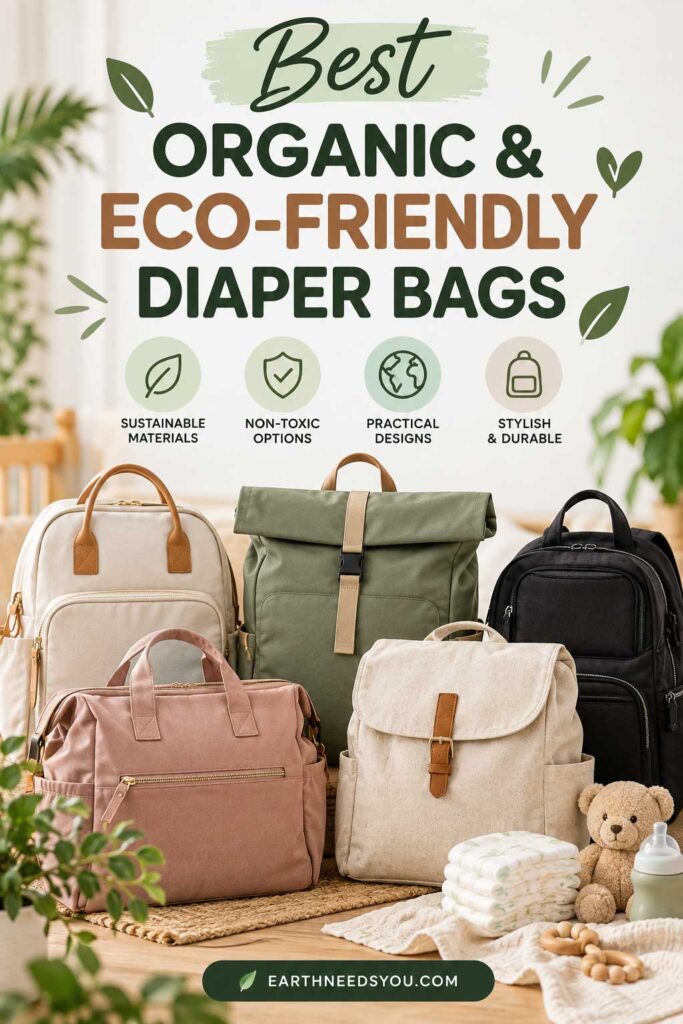
If you don’t want to compare all 11 bags individually, start here. The table highlights what makes each option different and the primary material or sustainability feature to consider.
| Diaper Bag | Best For | Material / Sustainability Feature | Notable Feature |
|---|---|---|---|
| Parker Baby Co. Birch Bag | Best Overall | Check current model specifications | Spacious, organized everyday design |
| LÄSSIG Green Label Rolltop | Best Sustainable Backpack | Recycled material options | Expandable rolltop storage |
| Petunia Pickle Bottom Boxy Backpack | Best Premium | Materials vary by collection | Wide-opening structured design |
| Freshly Picked Classic Diaper Bag | Best Vegan Leather | Vegan leather | Polished, easy-clean design |
| JuJuBe Eco Collection | Best for Recycled Materials | Recycled fabric options | Lightweight with excellent organization |
| Dagne Dover Indi | Best for Modern Parents | Neoprene with recycled-material components | Work-and-travel-friendly design |
| Honest Company City Backpack | Best Simple Everyday Option | Check current model specifications | Compact everyday organization |
| CALPAK Diaper Backpack | Best for Travel | Recycled nylon body and recycled polyester lining | Laptop compartment and luggage sleeve |
| Babymoov Day to Day Diaper Bag | Best Recycled Cotton Option | Recycled cotton | 23L capacity and detachable pouch |
| Bugaboo Diaper Backpack | Best 100% Recycled Fabric Option | 100% certified recycled polyester fabrics | 19L capacity with insulated accessories |
| Terra Thread Earth Backpack | Best Organic Cotton Option | GOTS-certified organic cotton canvas | Natural-fiber everyday backpack alternative |
Product materials, accessories, and specifications can change. Check the manufacturer’s current product information for the exact model and color you’re considering.
How We Chose the Best Organic & Eco-Friendly Diaper Bags
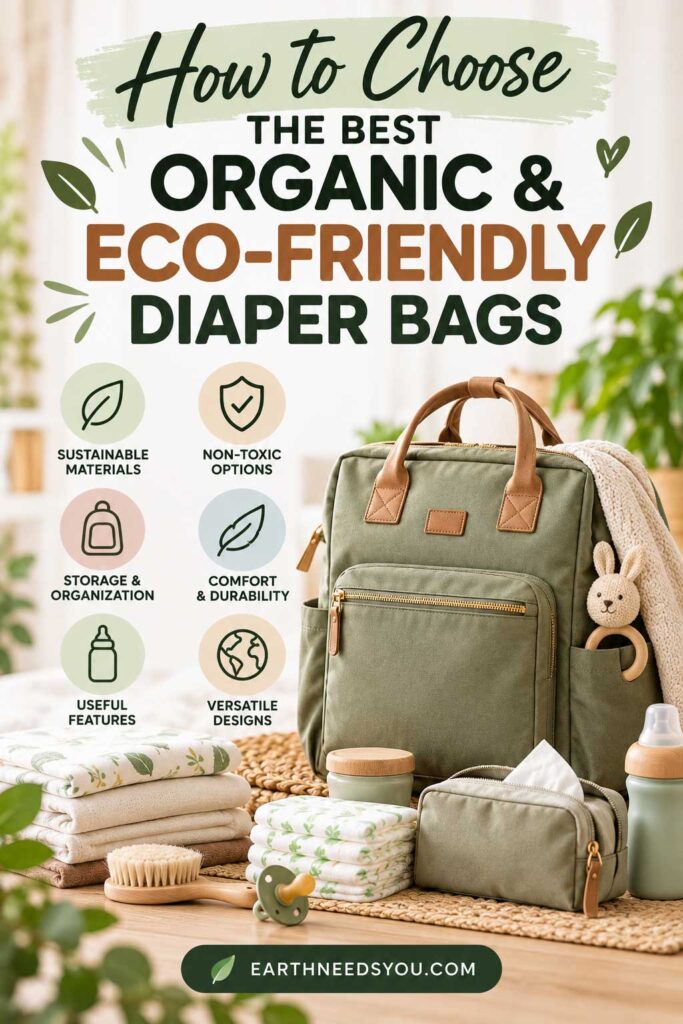
Not every diaper bag described as “green” or “eco-friendly” is sustainable in the same way. One might use recycled polyester, another organic cotton, while another focuses on durability or manufacturing practices. That makes comparing them a little more complicated than simply looking for an eco-friendly label.
For this guide, we researched diaper bags based on several factors that matter both environmentally and in everyday use.
Materials and Sustainability
When researching the best organic diaper bags and sustainable alternatives, we looked closely at what each product is actually made from. We prioritized options using materials such as organic cotton, recycled polyester (rPET), recycled nylon, and other recycled or responsibly sourced materials.
We also looked for specific information from manufacturers about recycled content, certifications, sourcing, and manufacturing practices rather than relying solely on terms such as “green” or “natural.”
Vegan leather requires a little more consideration. Although it avoids animal leather, many types are made partly or entirely from synthetic materials. For that reason, we consider the actual material, durability, and available manufacturer information rather than automatically treating “vegan” as synonymous with “eco-friendly.”
Material Safety
Diaper bags frequently hold bottles, snacks, pacifiers, clothing, and other baby essentials, so material information matters. Where manufacturers provide it, we looked for details about substances such as PVC, BPA, phthalates, and certain chemical treatments, as well as recognized textile certifications.
We don’t assume that a product is “non-toxic” simply because it is marketed as natural or sustainable. Specific safety claims should be supported by information from the manufacturer or an independent certification.
Durability and Everyday Use
Sustainability isn’t only about the material. A bag that remains useful for years can reduce the need for frequent replacements.
We therefore considered construction, zippers, stitching, water resistance, ease of cleaning, and whether the bag could continue to be useful after the diaper years. Bags that can later become travel, work, or everyday backpacks have an obvious advantage here.
Storage, Comfort, and Practical Features
An environmentally friendly diaper bag still has to make life easier for parents. We compared useful features such as insulated bottle pockets, changing pads, easy-access compartments, wet-storage areas, stroller attachments, laptop sleeves, and adjustable or padded straps.
We also considered capacity and organization. A larger bag may make sense for travel or families with multiple young children, while a smaller backpack can be much more convenient for quick everyday trips.
Price and Overall Value
Finally, we considered what each bag offers for its price. A more expensive bag may be worthwhile if it uses better materials and lasts for years, but a high price alone doesn’t make a diaper bag sustainable or better.
Our goal isn’t to find the bag with the longest list of features. It’s to highlight organic and eco-friendly diaper bags that combine more thoughtful materials with durability, useful organization, comfort, and everyday practicality.
A note on our research: We did not personally test every bag in this guide. Our recommendations are based on manufacturer specifications, material and certification information, practical features, and overall versatility. Product specifications can change, so check the current manufacturer’s information before purchasing.
1. Parker Baby Co. Birch Bag Diaper Backpack – Best Overall Eco-Friendly Diaper Bag
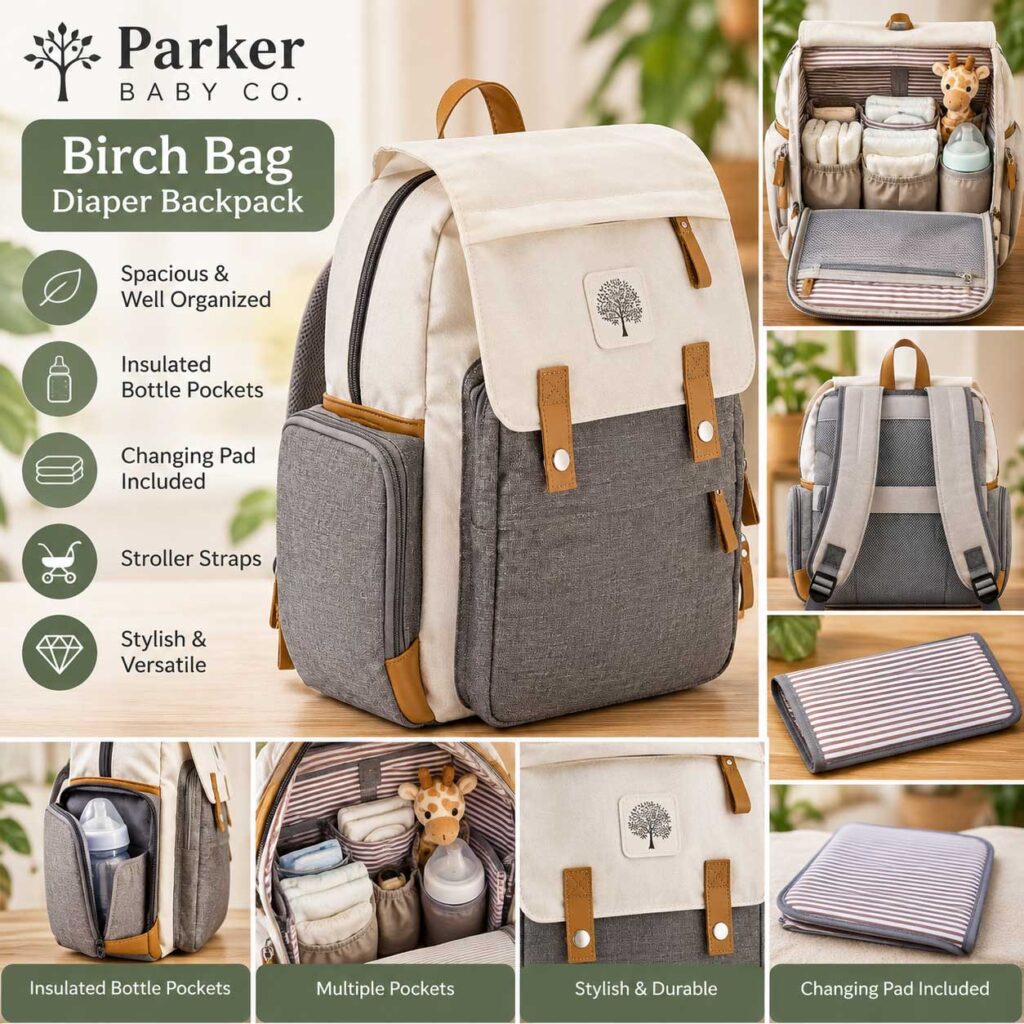
The Parker Baby Co. Birch Bag is a practical choice for parents who want plenty of storage without carrying a diaper bag that looks overly bulky or baby-specific. Its neutral design also makes it easy to continue using as a regular backpack once you no longer need to carry diapers everywhere.
The bag has a roomy main compartment with dedicated spaces for bottles, wipes, clothing, snacks, and smaller essentials that would otherwise disappear at the bottom of the bag. The backpack-style design is especially convenient for longer outings because it keeps both hands free.
The Birch Bag isn’t one of the strongest choices here from a materials standpoint. The current version uses a polyester exterior, nylon interior, and vegan-leather accents. We’re including it primarily because of its durability, organization, and potential to remain useful beyond the diaper years rather than because it uses organic or recycled materials.
Key Features
- Spacious main compartment
- Multiple interior and exterior storage pockets
- Insulated bottle pockets
- Changing pad included
- Padded, adjustable backpack straps
- Stroller straps
- Easy-access exterior pockets
- Neutral, modern design
- Room for diapers, wipes, bottles, clothing, and other everyday essentials
Pros & Cons
| Pros | Cons |
|---|---|
| ✓ Plenty of organized storage for everyday essentials | ✗ More expensive than many basic diaper backpacks |
| ✓ Comfortable backpack design keeps your hands free | ✗ Larger size may be unnecessary for short outings |
| ✓ Insulated pockets make carrying bottles easier | ✗ Does not use organic or recycled main fabrics |
| ✓ Neutral design works well for either parent | |
| ✓ Spacious enough for longer outings and travel | |
| ✓ Can be repurposed as an everyday or travel backpack later |
Why We Recommend It
What makes the Parker Baby Co. Birch Bag appealing is its combination of storage, organization, comfort, and versatility. Rather than packing everything into one large compartment, parents get dedicated spaces for many of the things they regularly need while away from home.
The backpack format is another advantage. Carrying bottles, diapers, snacks, toys, and extra clothes can quickly make a shoulder bag uncomfortable, while two adjustable straps distribute the weight more evenly and leave your hands available for a stroller—or a toddler who suddenly decides walking is over for the day.
We also like that the design doesn’t scream “diaper bag.” Once the diaper years are over, it can potentially continue serving as a travel bag, everyday backpack, or family day bag instead of being pushed into the back of a closet.
For those reasons, the Birch Bag is a strong option for parents who want one versatile diaper backpack that can remain useful for years.
Eco Tip: Don’t judge a diaper bag by its material alone. Durability and how long you’ll actually use it matter too. A well-made bag that serves your family for several years and later becomes a regular backpack can help reduce the need for additional purchases.
2. LÄSSIG Green Label Rolltop Backpack – Best Sustainable Backpack
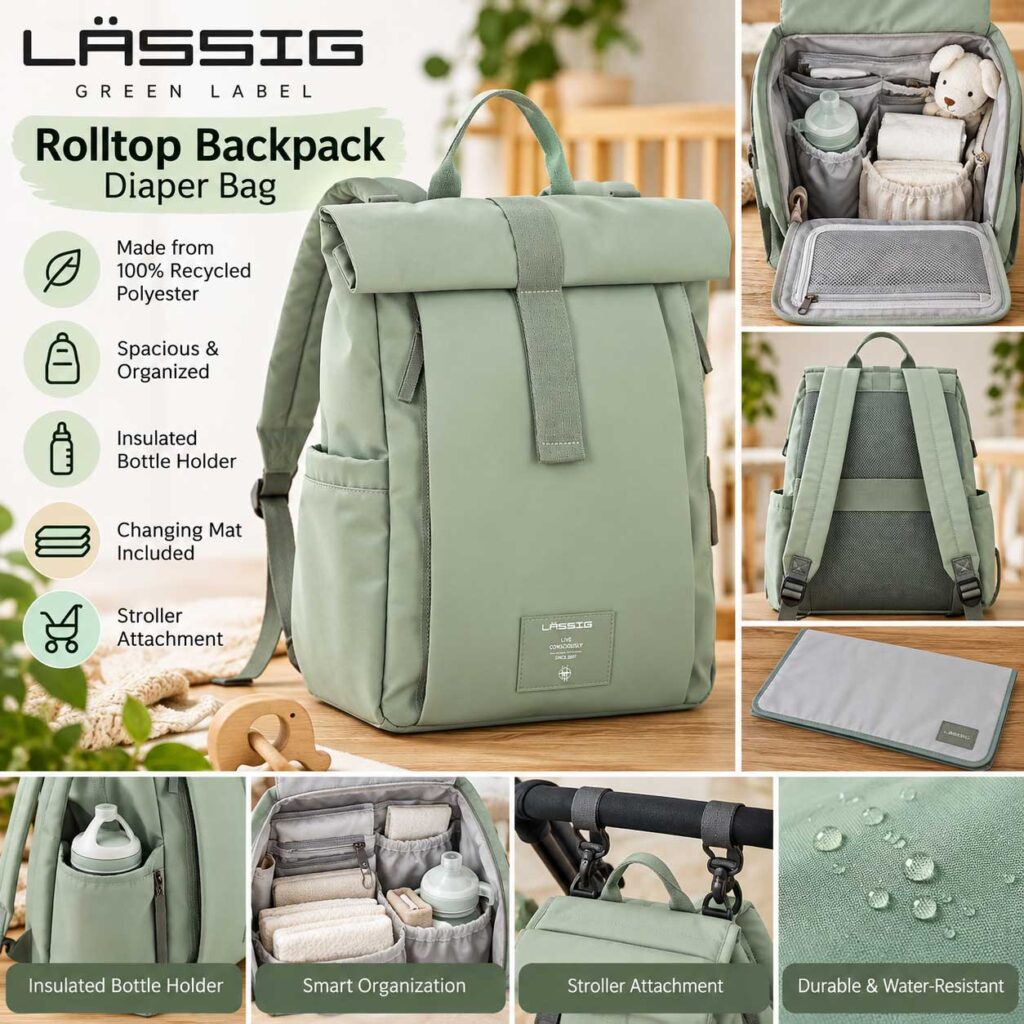
The LÄSSIG Green Label Rolltop Backpack is designed for parents who want a practical diaper bag with a stronger focus on recycled materials. Its clean, minimalist design looks more like a modern everyday backpack than a traditional diaper bag, which also makes it easier to keep using once the diaper years are over.
One of its most useful features is the rolltop opening. The design allows you to adjust the available space depending on how much you’re carrying. Keep it compact for a quick trip to the park, or expand it when you need room for extra clothes, bottles, snacks, toys, and other baby essentials.
The current Rolltop Up uses 100% recycled polyester, giving it one of the clearer recycled-material stories among the dedicated diaper backpacks in this guide.
Key Features
- 100% recycled polyester
- Expandable rolltop design
- Spacious main compartment
- Water-repellent exterior
- Insulated bottle holder
- Changing mat included
- Stroller attachments
- Multiple storage compartments
- Adjustable padded shoulder straps
- Modern, gender-neutral design
Pros & Cons
| Pros | Cons |
|---|---|
| ✓ Made with 100% recycled polyester | ✗ More expensive than many basic diaper backpacks |
| ✓ Expandable rolltop provides flexible storage | ✗ Rolltop design isn’t as quick to open as a standard zipper |
| ✓ Plenty of room for longer outings and travel | ✗ May feel larger than necessary for short trips |
| ✓ Comfortable backpack-style carrying | |
| ✓ Includes useful diaper-changing accessories | |
| ✓ Modern design makes it useful beyond the diaper years |
Why We Recommend It
The biggest advantage of the LÄSSIG Green Label Rolltop is its expandable design. Diaper-bag needs can change considerably from one day to the next, and having the option to increase the bag’s capacity means you don’t necessarily need a separate backpack for longer outings.
The included accessories are another plus. Features such as the bottle holder, changing mat, stroller attachments, and organized storage make it practical for everyday parenting rather than simply being a regular backpack marketed toward parents.
Its understated appearance also gives it a longer useful life. Once you’re no longer carrying diapers and bottles, the Rolltop can still work as a daypack or travel backpack.
For parents looking for a dedicated diaper backpack made from recycled polyester, the LÄSSIG Rolltop Up combines a strong material profile with genuinely useful parenting features.
Sustainability Tip: Recycled polyester gives existing plastic another use and can reduce demand for virgin polyester. But recycled material doesn’t automatically make a product sustainable. Durability, manufacturing, repairability, and how long you keep using the bag also matter.
3. Petunia Pickle Bottom Boxy Backpack – Best Premium Diaper Bag
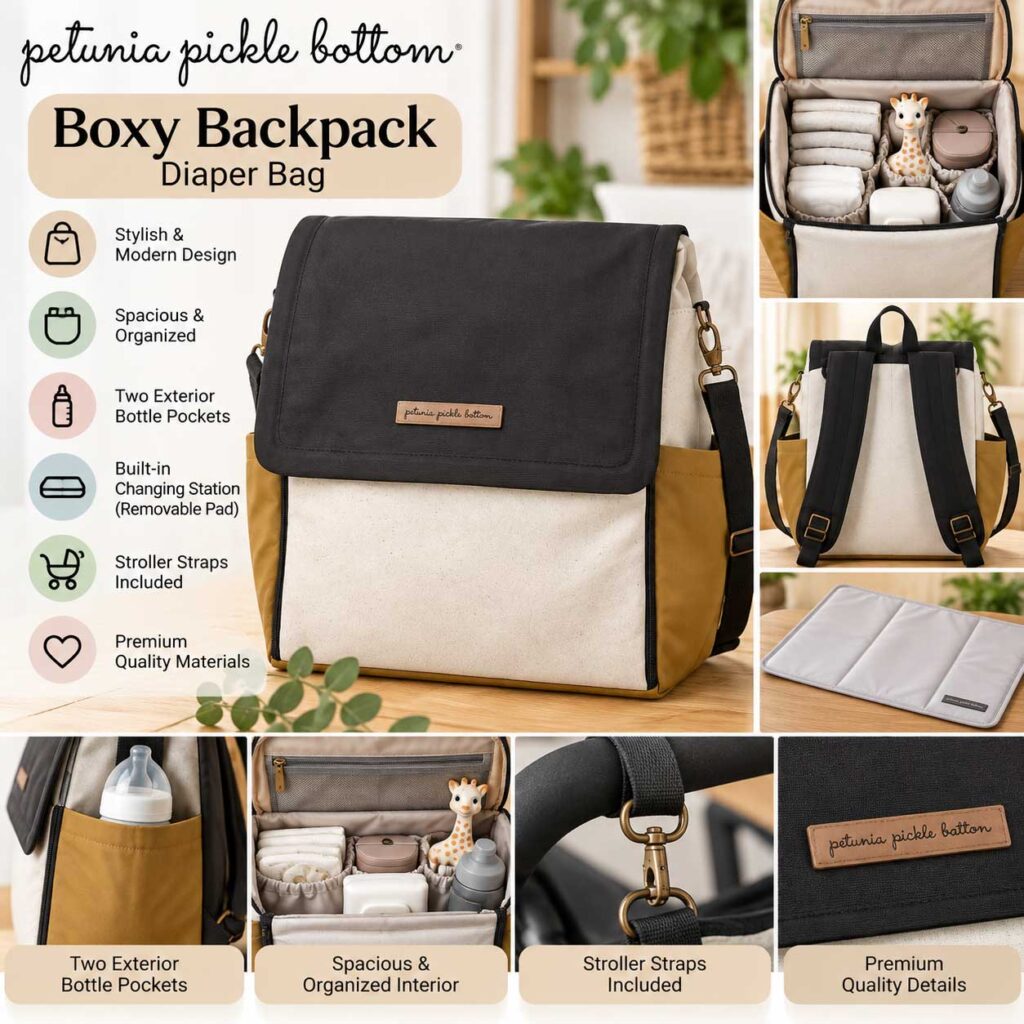
The Petunia Pickle Bottom Boxy Backpack is a premium option for parents who want a diaper bag that combines organization with a more polished, structured design. Instead of looking like a typical baby bag, the Boxy has a distinctive shape and comes in a wide range of colors, prints, and finishes.
The Caramel/Black version featured here uses TPU-coated cotton with leather details and a polyester lining. That makes it more of a premium durability and organization pick than one of the strongest sustainability choices in this guide. Other Boxy collections may use different materials.
One of its biggest advantages is accessibility. The wide-opening main compartment makes it easier to see what’s inside, which is surprisingly important when you’re trying to find wipes, a bottle, or a clean onesie with one hand.
Key Features
- Wide-opening main compartment
- Structured design that helps the bag hold its shape
- Multiple interior and exterior storage pockets
- Dedicated bottle storage
- Changing pad
- Adjustable backpack straps
- Stroller-friendly carrying options
- Easy-access exterior storage
- Available in numerous colors and patterns
- Designed for everyday outings and travel
Pros & Cons
| Pros | Cons |
|---|---|
| ✓ Wide opening makes essentials easier to find | ✗ More expensive than many standard diaper bags |
| ✓ Excellent internal organization | ✗ Materials vary between styles and collections |
| ✓ Structured shape helps prevent everything from becoming jumbled together | ✗ Some designs may be heavier than lightweight fabric backpacks |
| ✓ Multiple carrying options add versatility | ✗ Popular patterns can have limited availability |
| ✓ Large enough for longer outings without being oversized | |
| ✓ Attractive design can remain useful beyond the diaper years |
Why We Recommend It
The Boxy Backpack’s strongest feature is its organization and accessibility. Diaper bags tend to become crowded quickly, and a wide opening makes it much easier to see what you’ve packed instead of digging through layers of clothing, toys, wipes, and snacks.
Its structured construction is also useful for parents who dislike soft backpacks that collapse when they’re partially empty. Everything has a more defined place, making it easier to pack the bag consistently and find what you need.
The trade-off is price. This is firmly in the premium category, so it makes the most sense for parents who value the Boxy’s organization, distinctive styling, and versatility enough to justify spending more.
From a sustainability perspective, we wouldn’t recommend buying it simply because it’s expensive or durable. Instead, look at the specific materials used in the version you’re considering and think about whether you’ll continue using the bag after the diaper stage.
If you want a polished diaper bag with particularly good organization and don’t mind paying more for it, the Petunia Pickle Bottom Boxy Backpack is worth considering.
Buying Tip: When comparing premium diaper bags, look beyond appearance. Check the materials, warranty, cleaning instructions, replacement parts or accessories, and whether the design will still be useful once you no longer need a dedicated diaper bag.
4. Freshly Picked Classic Diaper Bag – Best Vegan Leather Diaper Bag
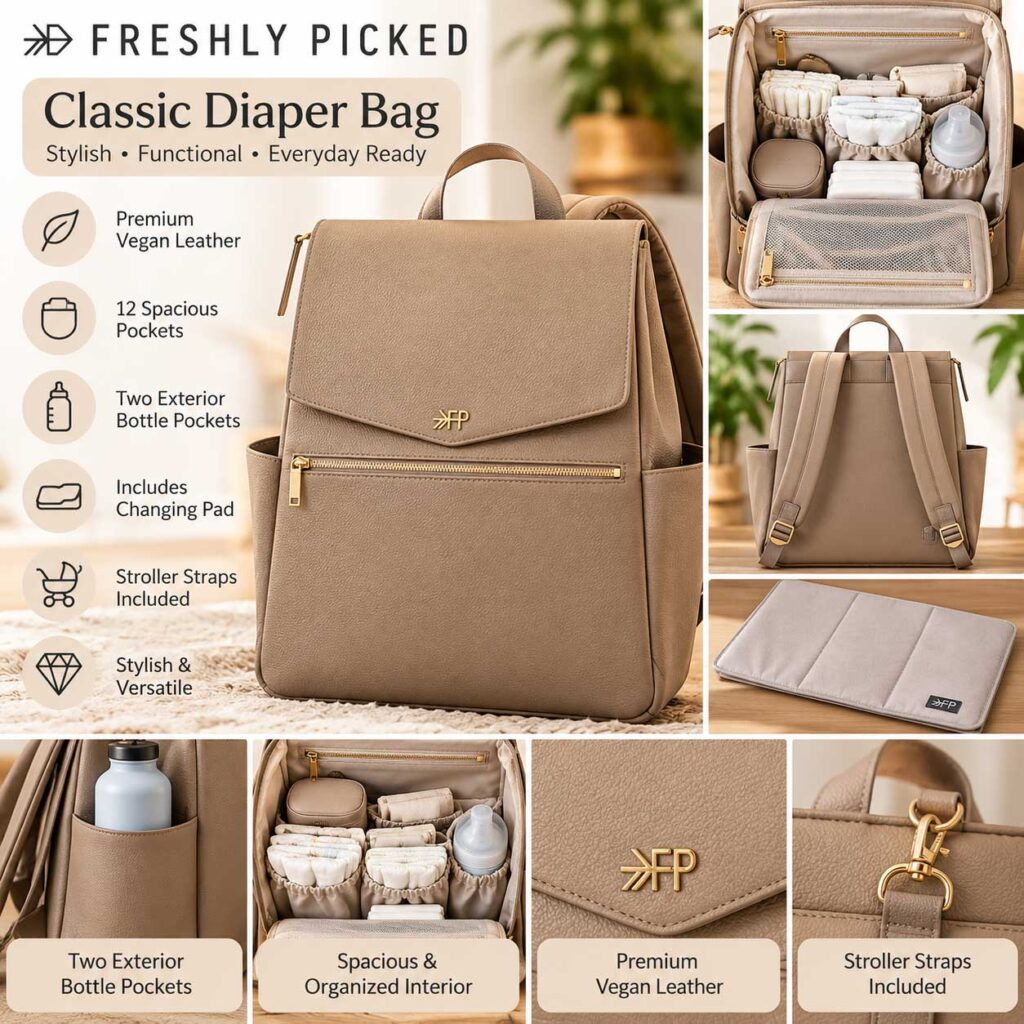
The Freshly Picked Classic Diaper Bag is aimed at parents who prefer the polished look of leather but want an animal-free alternative. Its structured vegan leather exterior gives it more of a handbag or everyday backpack appearance than a traditional diaper bag.
Inside, there’s room for diapers, wipes, bottles, extra clothing, snacks, and personal items, with multiple pockets helping keep smaller essentials from disappearing at the bottom. The structured opening also makes it easier to see and reach what you’ve packed.
It’s important, however, to distinguish vegan from sustainable. Vegan leather doesn’t use animal leather, but many vegan leathers are made from polyurethane (PU) or other synthetic materials. If environmental impact is your main priority, check the material composition of the specific Freshly Picked model you’re considering rather than assuming vegan leather is automatically eco-friendly.
Key Features
- Vegan leather exterior
- Structured main compartment
- Multiple interior storage pockets
- Exterior pocket for frequently used items
- Adjustable backpack straps
- Grab handle for alternative carrying
- Easy-to-wipe surface
- Protective feet on the bottom
- Designed to hold everyday baby essentials
- Available in multiple colors and finishes
Pros & Cons
| Pros | Cons |
|---|---|
| ✓ Polished design doesn’t look like a traditional diaper bag | ✗ Vegan leather is typically synthetic rather than a natural material |
| ✓ Structured interior makes organization easier | ✗ Heavier than some lightweight fabric backpacks |
| ✓ Exterior can be wiped clean after everyday spills | ✗ Premium styling comes with a higher price than basic diaper bags |
| ✓ Backpack design keeps your hands free | ✗ Not the strongest choice if natural or recycled materials are your top priority |
| ✓ Plenty of storage for everyday baby essentials | |
| ✓ Design can transition to other uses after the diaper stage |
Why We Recommend It
The main reason to consider the Freshly Picked Classic is its combination of organization and polished styling. It gives parents the functionality of a diaper backpack without looking particularly baby-specific.
The structured shape is useful, too. Instead of collapsing when you open it, the bag makes it relatively easy to see and organize diapers, wipes, bottles, clothing, and smaller necessities. Its wipeable exterior can also be practical when spills and sticky hands become part of everyday life.
From an environmental perspective, though, this bag needs some context. “Vegan leather” and “eco-friendly” aren’t interchangeable terms. Avoiding animal leather may matter to some shoppers, but conventional synthetic vegan leather has its own environmental considerations.
That’s why we’d recommend this option primarily to parents specifically looking for a vegan diaper bag with a refined appearance and reusable design. If your priority is organic, natural, or recycled materials, one of the fabric bags elsewhere in this guide may be a better match.
Eco Tip: When you see “vegan leather,” check what it’s actually made from. PU, recycled synthetics, and newer plant-based materials have different environmental characteristics, so the material composition tells you more than the vegan label alone.
5. Huhu Diaper Bag Backpack – Best PFAS-Free Recycled Diaper Bag
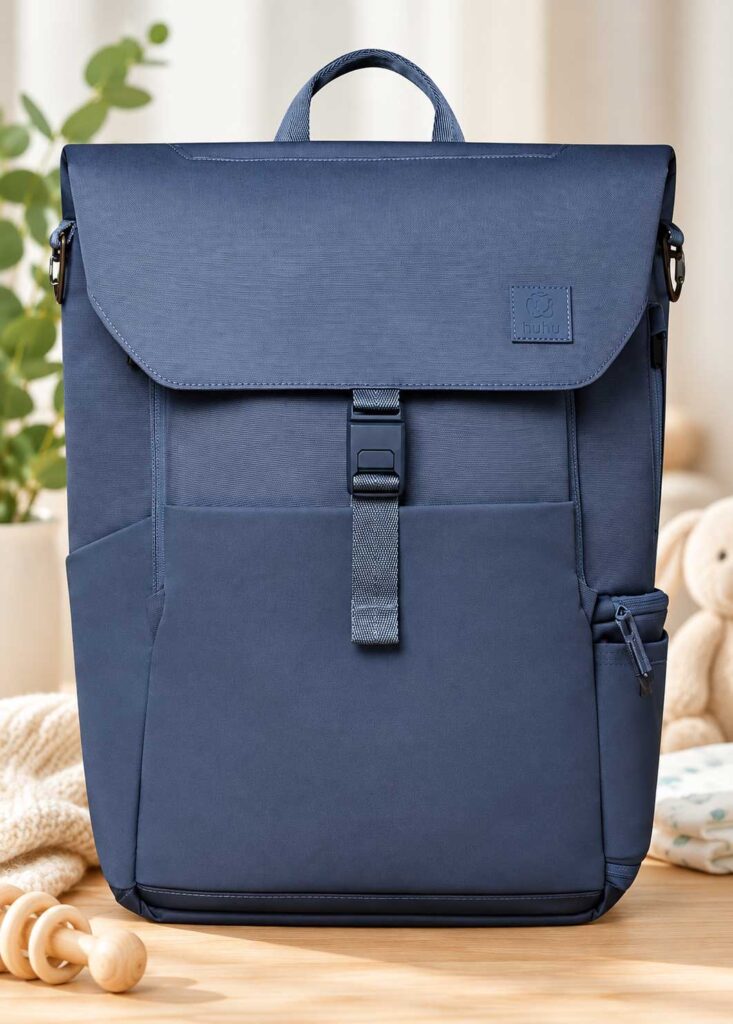
The Huhu Diaper Bag Backpack is one of the more interesting sustainable options in this guide because it combines a modern, minimalist design with recycled polyester fabric that Huhu describes as PFAS-free.
It is designed specifically for parents rather than being a regular backpack adapted for baby gear. The interior provides dedicated space for diapers, wipes, bottles, snacks, spare clothes, and other everyday essentials, while the structured backpack design keeps everything relatively easy to access.
Its understated appearance is another advantage. It doesn’t immediately look like a traditional diaper bag, making it easier to continue using as an everyday or travel backpack after the diaper years.
Key Features
- Recycled polyester construction
- PFAS-free fabric
- Water-resistant exterior
- Approximately 20L capacity
- Multiple interior organizational pockets
- Dedicated bottle storage
- Changing pad included
- Removable organizer pouches
- Laptop compartment
- Luggage pass-through
- Padded backpack straps
- Minimalist, gender-neutral design
Pros & Cons
| Pros | Cons |
|---|---|
| ✓ Made with recycled polyester | ✗ Recycled polyester is still a synthetic material |
| ✓ PFAS-free fabric | ✗ Premium price compared with basic diaper backpacks |
| ✓ Designed specifically for baby essentials | ✗ Minimalist exterior may not appeal to everyone |
| ✓ Includes changing pad and organizers | ✗ Around 20L may be limiting for families packing for multiple children |
| ✓ Laptop and travel-friendly features | |
| ✓ Can be reused beyond the diaper years |
Why We Recommend It
Huhu gets a lot right: useful organization, dedicated baby features, travel-friendly storage, and a design that doesn’t immediately look like a diaper bag. More importantly for this guide, the brand provides specific information about its recycled polyester and PFAS-free fabric rather than relying only on broad “eco-friendly” language.
The laptop compartment and understated design also give it a realistic second life as a work or travel backpack once you no longer need it for diapers.
Eco Tip: “PFAS-free” and “recycled” describe two different environmental considerations. A recycled fabric reduces demand for virgin material, while a PFAS-free claim addresses the use of a particular group of persistent chemicals. Look for specific claims like these rather than relying only on broad terms such as “eco-friendly.”
6. Dagne Dover Indi Diaper Backpack – Best for Modern Parents
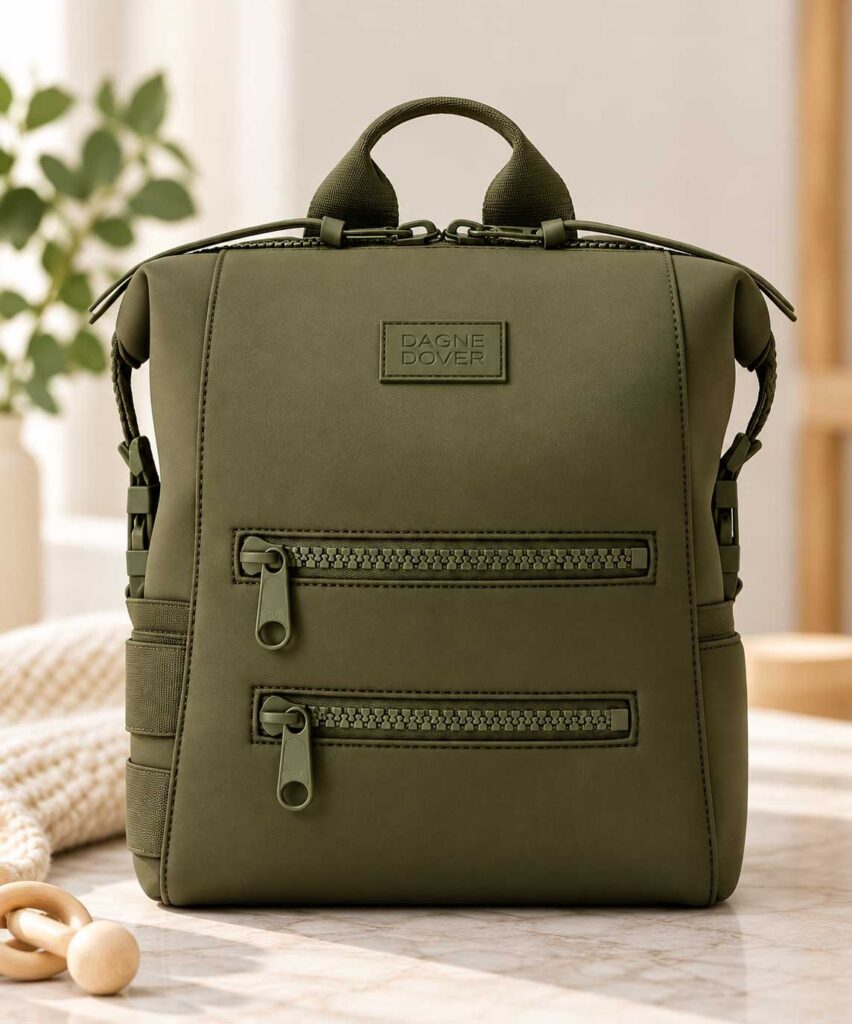
The Dagne Dover Indi Diaper Backpack is a good fit for parents who want a diaper bag that doesn’t really look like one. Its clean, minimalist design works for everyday outings but can also transition into a work, travel, or general-purpose backpack once you no longer need to carry diapers and bottles.
The Indi is known for its neoprene construction and organized interior. There’s space for diapers, wipes, bottles, extra clothing, snacks, and personal belongings, while dedicated compartments help keep smaller items from getting lost. Depending on the size and current version, you’ll also find features intended to make travel and longer days away from home easier.
There is an environmental trade-off here. The Indi’s signature neoprene is a synthetic material, so this isn’t the bag to choose if organic or natural fibers are your priority. Its stronger argument is longevity: the understated design and laptop-friendly organization make it realistic to keep using after the diaper years.
Key Features
- Neoprene construction
- Spacious main compartment
- Multiple interior and exterior pockets
- Dedicated bottle storage
- Changing mat
- Adjustable padded backpack straps
- Luggage sleeve on applicable sizes
- Space for personal items and electronics
- Easy-access storage
- Available in multiple sizes and colors
Pros & Cons
| Pros | Cons |
|---|---|
| ✓ Sleek design doesn’t look like a traditional diaper bag | ✗ Neoprene is a synthetic material |
| ✓ Excellent organization for baby and parent essentials | ✗ Premium price compared with basic diaper backpacks |
| ✓ Multiple sizes make it easier to choose the right capacity | ✗ Not the best choice if organic or natural materials are your priority |
| ✓ Comfortable backpack format keeps your hands free | ✗ Neoprene bags can be heavier than lightweight fabric alternatives |
| ✓ Useful for travel as well as everyday outings | |
| ✓ Can transition into a regular backpack after the diaper stage |
Why We Recommend It
The biggest advantage of the Dagne Dover Indi is versatility. Many diaper bags are designed for a relatively short period of your child’s life, while the Indi looks and functions much more like a regular backpack.
Its organization is another strong point. Instead of one large compartment where everything gets mixed together, the bag provides dedicated storage for many of the small items parents regularly carry. That can make a real difference when you’re trying to find a bottle, pacifier, wipes, or clean clothes quickly.
It’s also a practical option for parents who travel frequently. Depending on the size selected, features such as a luggage sleeve and space for electronics make it easier to use the same backpack for flights, road trips, commuting, and family outings.
From a sustainability standpoint, the Indi’s main limitation is its neoprene construction. Its environmental case rests less on natural or recycled materials and more on longevity and versatility. If you continue using it for work, travel, or everyday errands later, you may get considerably more life from it than from a highly specialized baby bag.
For parents who prioritize modern styling, organization, and a design that can serve several purposes, the Dagne Dover Indi is one of the more versatile options in this guide.
Buying Tip: Think beyond the first year when choosing a diaper bag. If you can realistically see yourself using the same backpack for travel, work, or everyday errands later, you’ll get considerably more use from your purchase.
7. Cloud Island Cargo Diaper Backpack – Best Budget Recycled Diaper Bag
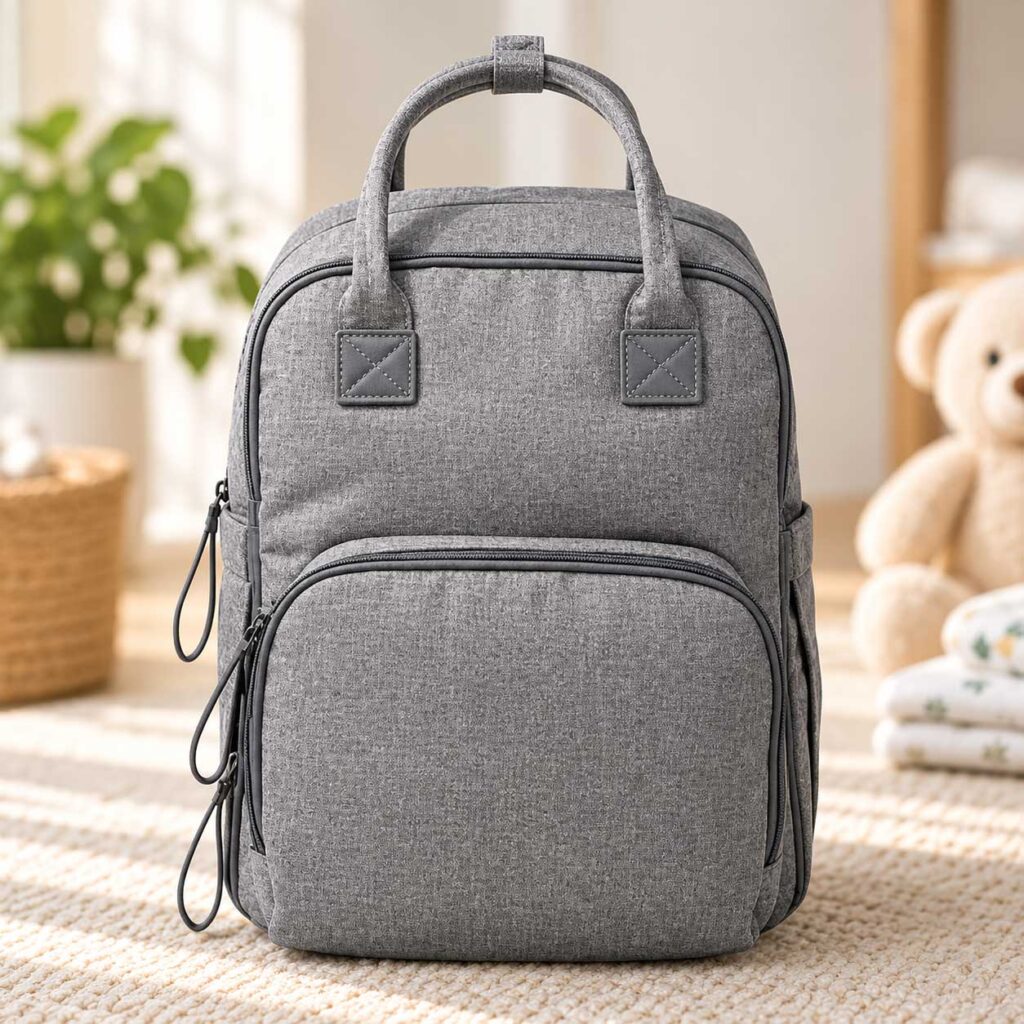
You don’t have to spend $150 or more to find a practical diaper bag made with recycled materials. The Cloud Island Cargo Diaper Backpack is a much more affordable option for parents who want plenty of everyday storage without paying premium-brand prices.
The bag is made with 100% recycled polyester. That doesn’t eliminate the environmental impacts associated with synthetic fabric, but it does reduce reliance on virgin polyester. Its backpack design also keeps your hands free while carrying a baby, pushing a stroller, or juggling everything else that comes along on an outing.
The design is relatively simple, but that’s part of the appeal. There is room for diapers, wipes, bottles, extra clothes, snacks, and other everyday essentials without adding features you may never use.
Key Features
- Made with 100% recycled polyester
- Spacious main compartment
- Multiple organizational pockets
- Exterior pockets for quick-access items
- Adjustable backpack straps
- Top carrying handle
- Designed specifically for baby essentials
- Simple, neutral design
- Budget-friendly price
Pros & Cons
| Pros | Cons |
|---|---|
| ✓ Made with 100% recycled polyester | ✗ Recycled polyester is still a synthetic material |
| ✓ Much more affordable than most bags in this guide | ✗ Fewer premium features than higher-priced diaper bags |
| ✓ Lightweight backpack design | ✗ Less sophisticated organization than some premium models |
| ✓ Plenty of room for everyday baby essentials | ✗ May not be ideal for long trips or families packing for multiple children |
| ✓ Neutral style that’s easy to share between parents | |
| ✓ Good entry-level sustainable option |
Why We Recommend It
The Cloud Island Cargo stands out primarily because it makes recycled materials accessible at a much lower price. Many sustainable diaper bags cost well over $100, which isn’t realistic or necessary for every family.
We also like that it doesn’t try to be overly complicated. If you mainly need an affordable backpack for diapers, wipes, bottles, clothes, and everyday baby gear, its straightforward design may be all you need.
The recycled polyester construction doesn’t make the bag impact-free—it’s still a synthetic material—but using recycled fibers can reduce demand for virgin polyester. For parents shopping on a tighter budget, that makes the Cloud Island Cargo a worthwhile alternative to similarly priced bags made entirely from new synthetic materials.
Budget Tip: Don’t assume a more expensive diaper bag is automatically more sustainable. Check the actual materials and choose a bag you’ll use for years rather than paying extra for features you don’t need.
8. CALPAK Diaper Backpack with Laptop Sleeve – Best Eco-Friendly Diaper Bag for Travel
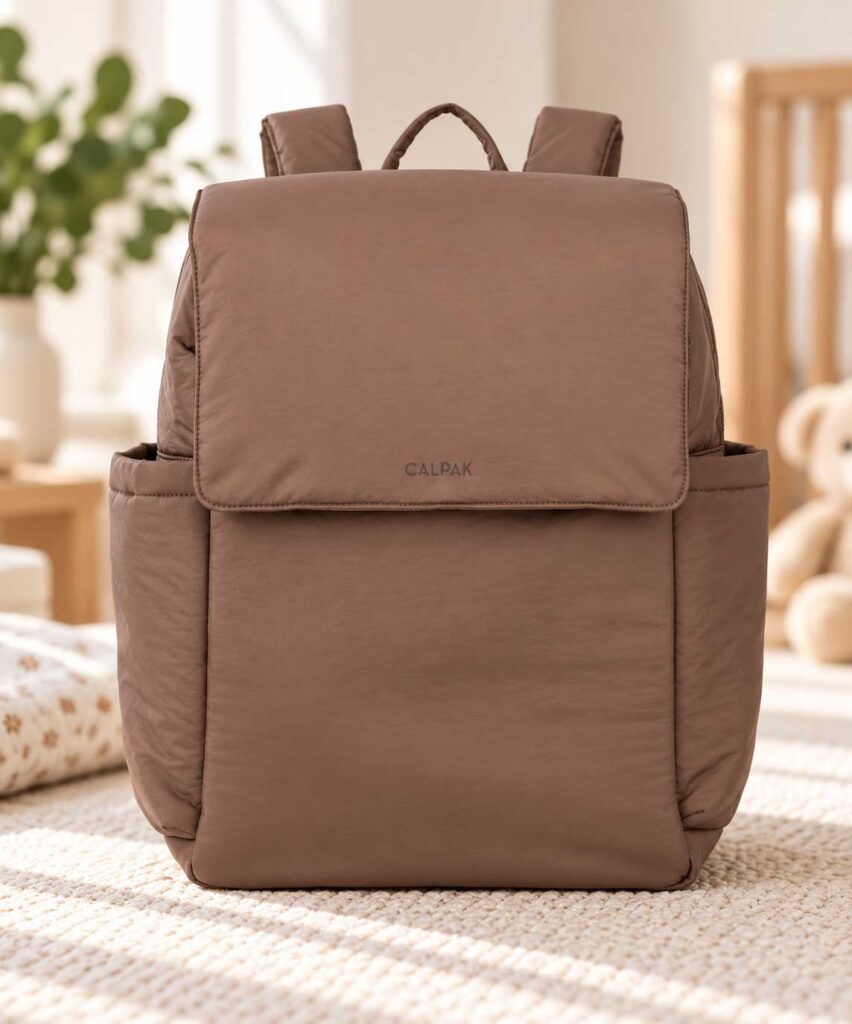
The CALPAK Diaper Backpack with Laptop Sleeve is a strong choice for parents who travel frequently or want one bag that can handle both baby gear and everyday essentials. Unlike many diaper bags that simply use vague sustainability language, CALPAK provides specific material information for this backpack: the body is made from recycled nylon, while the lining uses recycled polyester.
The design is particularly well suited to travel. Along with organized storage for diapers, wipes, bottles, clothing, and personal items, the backpack includes a dedicated laptop compartment and a luggage sleeve that slides over the handle of a suitcase.
At approximately 17.5 liters, it provides useful everyday capacity without becoming an enormous backpack. The water-resistant materials are another practical touch when you’re dealing with bottles, snacks, changing supplies, and the inevitable spills that come with traveling with children.
Key Features
- Recycled nylon exterior
- Recycled polyester lining
- 17.5-liter capacity
- Dedicated laptop sleeve
- Two insulated bottle pockets
- Water-resistant materials
- Luggage sleeve for attaching the bag to a suitcase
- Hidden pocket within the luggage sleeve
- Adjustable shoulder straps
- Top carrying handle
- OEKO-TEX® STANDARD 100 certified materials
Pros & Cons
| Pros | Cons |
|---|---|
| ✓ Body is made from recycled nylon | ✗ Premium price compared with basic diaper backpacks |
| ✓ Recycled polyester lining | ✗ Stroller straps are sold separately |
| ✓ Two insulated bottle pockets | ✗ Synthetic materials may not appeal to parents looking for natural fibers |
| ✓ Laptop compartment makes it useful beyond parenting | ✗ 17.5L capacity may be limiting for parents packing for multiple children |
| ✓ Luggage sleeve is especially useful for air travel | |
| ✓ Water-resistant construction helps with everyday spills |
Why We Recommend It
The CALPAK stands out because it works particularly well as a travel diaper backpack while also giving us clearly documented recycled materials.
The luggage sleeve is one of its most useful features for traveling families. Instead of carrying the backpack through an airport the entire time, you can slide it onto your suitcase handle. There’s even a hidden pocket built into the luggage sleeve for smaller valuables.
The laptop compartment also extends its usefulness beyond parenting. Once you no longer need a dedicated diaper bag, the same backpack can potentially become a work, commuter, or travel bag.
We also like that CALPAK tells shoppers what the main materials actually are. The use of recycled nylon for the body and recycled polyester for the lining gives consumers more meaningful information than simply describing a product as “eco-friendly.”
For frequent travelers, though, the combination of recycled materials, insulated bottle storage, laptop space, water resistance, and suitcase compatibility makes this one of the more practical options on our list.
Eco Tip: Recycled materials are only part of the picture. Durability matters too, especially with a bag designed to transition from parenting to work or travel.
9. Product of the North Elkin Diaper Bag Backpack – Best Recycled Bottle Diaper Bag
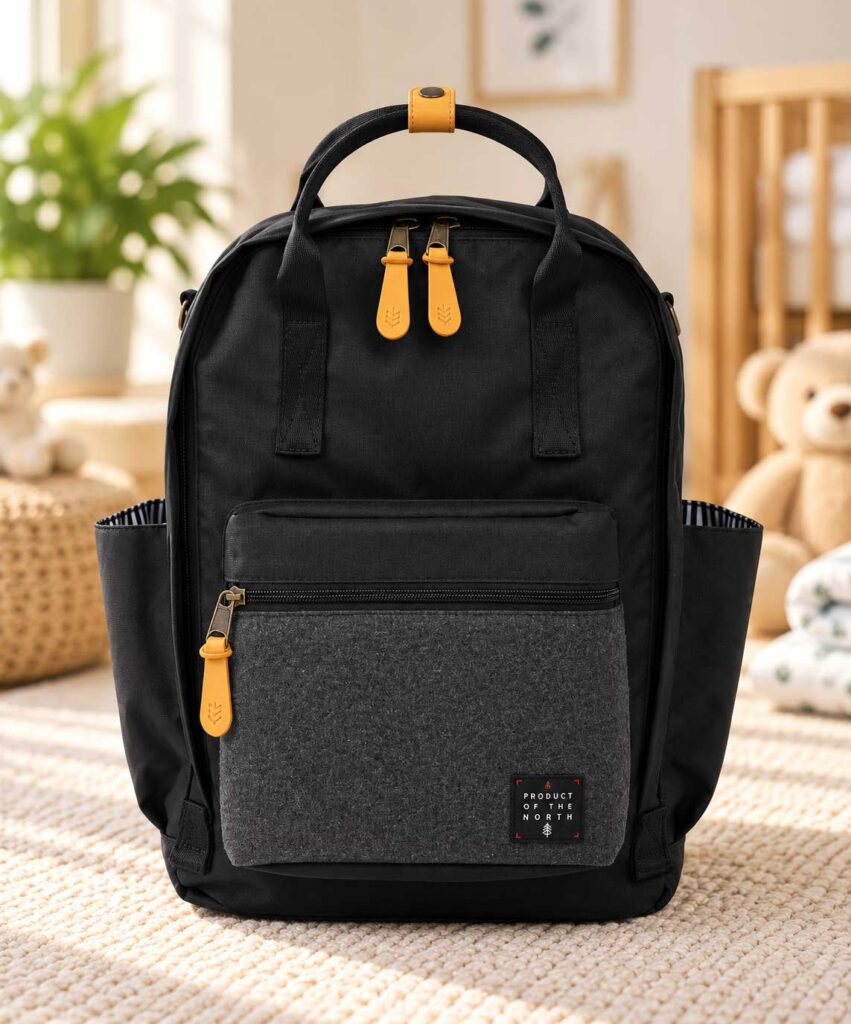
The Product of the North Elkin Diaper Bag Backpack is a strong option for parents who want recycled materials without giving up the features of a traditional diaper bag.
Its exterior uses bluesign®-certified fabric containing material made from recycled plastic bottles, while the lining is made from 100% recycled water bottles. Product of the North also describes the bag as PFAS-free, giving it more specific environmental credentials than many bags marketed simply as “eco-friendly.”
The Elkin is designed for everyday parenting rather than being a standard backpack adapted for diaper duty. It has plenty of organization for bottles, diapers, wipes, clothes, snacks, and personal items, along with several features that make it useful for travel.
Key Features
- Exterior material incorporates recycled plastic-bottle content
- Lining made from 100% recycled water bottles
- bluesign®-certified exterior and interior materials
- PFAS-free materials
- Insulated exterior bottle and snack pocket
- Removable changing pad
- Wide-opening main compartment
- Multiple interior organizational pockets
- Two exterior side pockets
- Padded, adjustable backpack straps
- Laptop sleeve that fits up to a 15-inch laptop
- YKK zippers made with recycled material
Pros & Cons
| Pros | Cons |
|---|---|
| ✓ Uses recycled plastic-bottle materials | ✗ Still relies primarily on synthetic materials |
| ✓ bluesign®-certified materials | ✗ More expensive than basic diaper backpacks |
| ✓ PFAS-free claim | ✗ Less widely available than major diaper-bag brands |
| ✓ Includes a removable changing pad | ✗ Styling is more utilitarian than some premium bags |
| ✓ Insulated bottle/snack storage | |
| ✓ Laptop sleeve makes it useful beyond the baby years |
Why We Recommend It
The Elkin earns its place in this guide because Product of the North provides specific information about its recycled content and material standards rather than relying on vague sustainability language.
We particularly like the combination of recycled materials, bluesign® certification, and a PFAS-free claim. At the same time, it still functions as a proper diaper bag, with an insulated pocket, changing pad, wide opening, and plenty of organization.
The laptop compartment is another advantage. Once you no longer need to carry diapers and bottles, the Elkin can transition into a work, travel, or everyday backpack instead of sitting unused in a closet.
Eco Tip: Products made from recycled plastic bottles still contain synthetic fibers, so they aren’t impact-free. Their main advantage is giving existing plastic another use while reducing some demand for virgin polyester.
10. Bugaboo Diaper Backpack – Best 100% Recycled Fabric Diaper Backpack
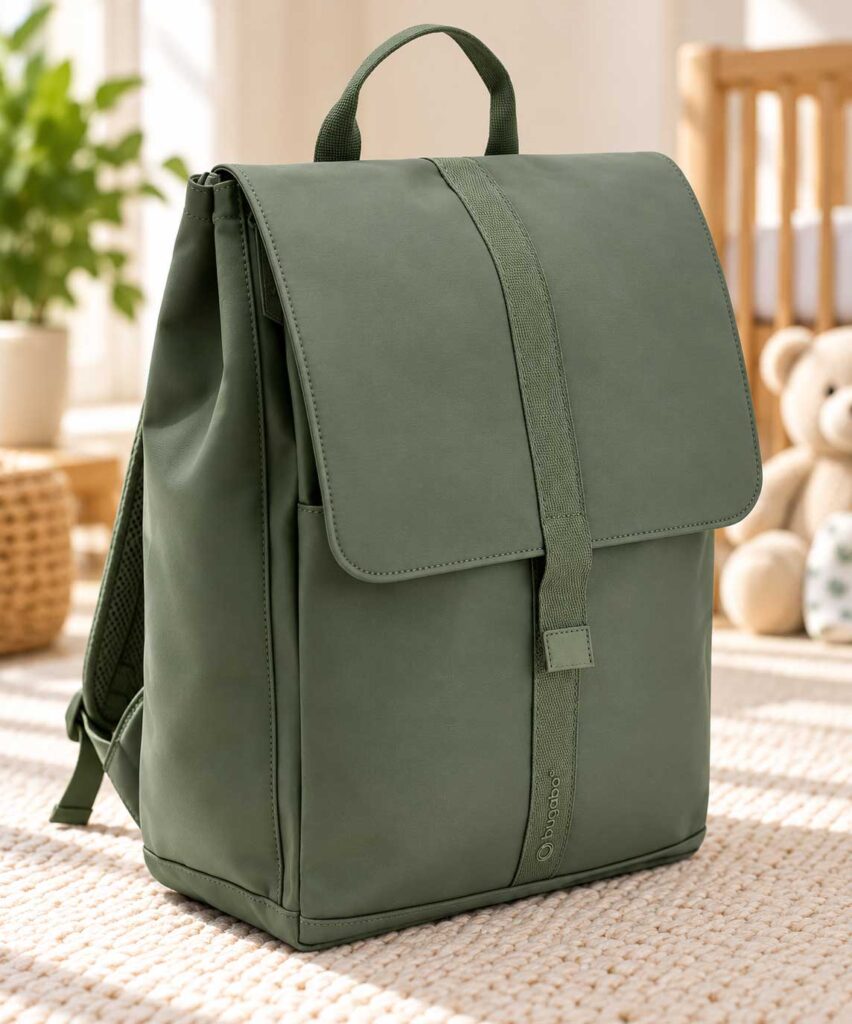
The Bugaboo Diaper Backpack is one of the strongest sustainability-focused options in this guide because the manufacturer provides unusually detailed information about its materials. Bugaboo states that the backpack is made with 100% recycled fabrics, including certified recycled polyester used for the exterior, lining, straps, bindings, mesh, and other textile components.
According to Bugaboo, the recycled material used for each backpack is equivalent to approximately 45 repurposed PET bottles. The fabric is also water-repellent, which is particularly useful for a bag that’s likely to encounter leaking bottles, snacks, wet wipes, and plenty of everyday messes.
The backpack has a 19-liter capacity, giving parents enough room for everyday baby essentials without becoming excessively large. It also includes several accessories that would otherwise need to be purchased separately.
Key Features
- Made from 100% certified recycled polyester fabrics
- 19-liter capacity
- Water-repellent exterior
- PFAS-free water-repellent fabric coating
- Foldable padded changing mat
- Insulated bottle holder
- Insulated food and snack clutch
- Separate mesh accessory pouch
- Multiple organizational pockets
- Padded compartment for laptops up to 17 inches
- Adjustable padded backpack straps
- Attaches to compatible Bugaboo strollers
Pros & Cons
| Pros | Cons |
|---|---|
| ✓ Made with 100% recycled fabrics | ✗ Premium price compared with basic diaper backpacks |
| ✓ Manufacturer provides clear recycled-material information | ✗ Recycled polyester is still a synthetic material |
| ✓ PFAS-free water-repellent fabric coating | ✗ At about 2.95 lb, it’s heavier than some lightweight backpacks |
| ✓ Includes changing mat and insulated accessories | ✗ Stroller compatibility is best within the Bugaboo ecosystem |
| ✓ Large padded laptop compartment | |
| ✓ 19L capacity balances storage and portability |
Why We Recommend It
What makes the Bugaboo Diaper Backpack stand out is transparency about its materials.
Rather than simply describing the backpack as sustainable, Bugaboo specifies that its exterior, lining, straps, bindings, elastics, zippers, and mesh use 100% certified recycled polyester. The company also states that the backpack repurposes the equivalent of about 45 PET bottles.
That’s useful information for shoppers trying to compare recycled diaper bags instead of relying on vague environmental marketing.
The included accessories are another advantage. You get a padded changing mat, insulated bottle holder, insulated food pouch, and separate mesh pouch, helping keep feeding and changing supplies separated inside the bag.
There’s also a padded compartment that accommodates a laptop up to 17 inches. That makes the backpack more useful for parents combining work and childcare and gives it another potential purpose once the diaper years are over.
The main trade-off is that recycled polyester remains a synthetic material. Parents specifically looking for organic cotton, hemp, or another natural fiber should consider a different option.
But if your priority is a diaper backpack with clearly documented recycled content, practical organization, and useful included accessories, the Bugaboo is one of the strongest choices in this guide.
11. Terra Thread Earth Backpack – Best Organic Cotton Diaper Bag Alternative
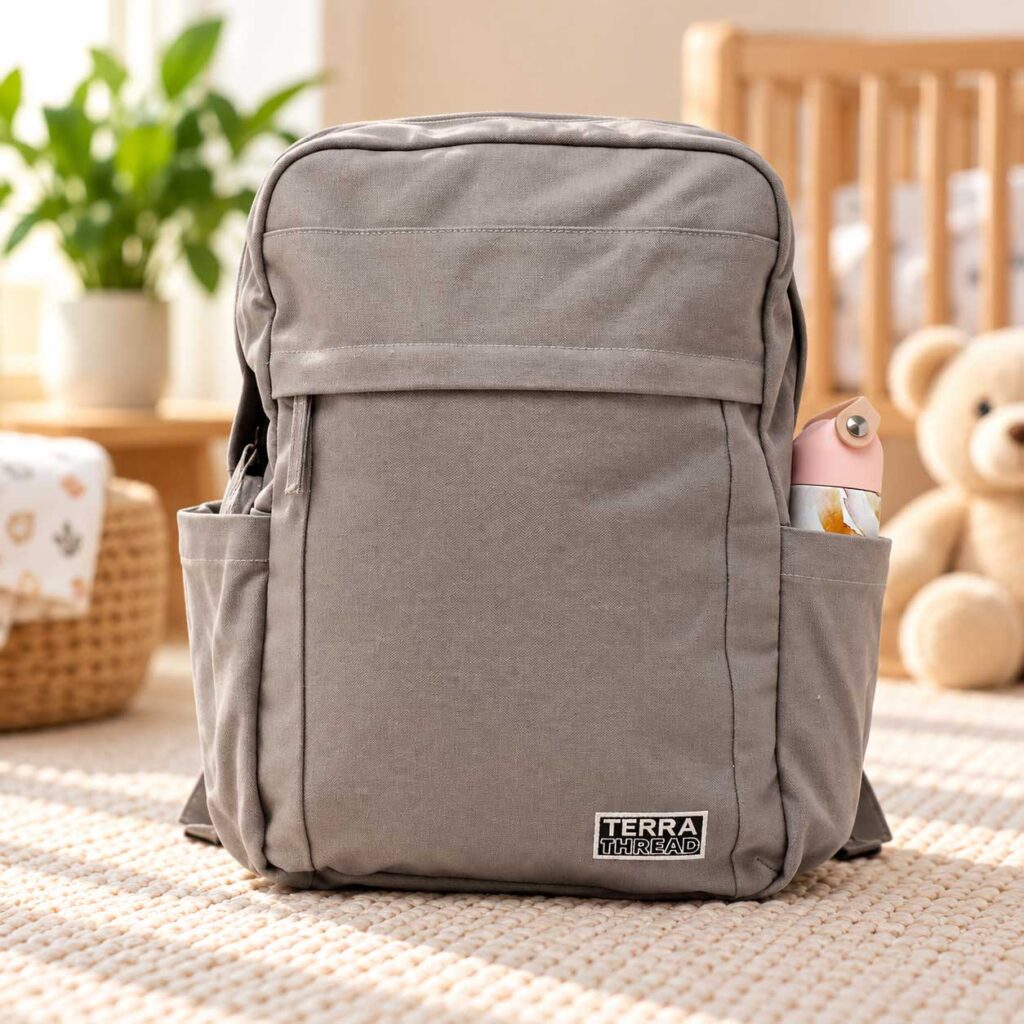
The Terra Thread Earth Backpack is different from most of the other bags in this guide. It isn’t marketed specifically as a diaper bag. Instead, it’s a versatile everyday backpack made from certified organic cotton canvas, making it an interesting alternative for parents who care more about natural materials than built-in diaper-bag accessories.
Terra Thread says the backpack is made from heavy-duty 14-ounce organic cotton canvas and produced in line with the Global Organic Textile Standard (GOTS). It’s also manufactured in a Fair Trade Certified factory. Those are much more specific credentials than the vague “natural” or “eco-friendly” descriptions found on many bags.
With approximately 16 liters of capacity, the Earth Backpack has room for diapers, wipes, spare clothing, snacks, bottles, and other everyday essentials. There are two exterior bottle pockets, a large front zippered compartment, an interior hanging pocket, and a sleeve designed for a 13- to 15-inch laptop.
Key Features
- Heavy-duty 14-oz organic cotton canvas
- GOTS-certified organic material
- Made in a Fair Trade Certified factory
- Approximately 16L capacity
- Two exterior bottle pockets
- Large exterior zippered pocket
- Interior hanging pocket
- Internal sleeve for a 13- to 15-inch laptop
- Metal zippers and fasteners
- Machine washable according to the manufacturer’s care instructions
Pros & Cons
| Pros | Cons |
|---|---|
| ✓ Made primarily from certified organic cotton canvas | ✗ Not specifically designed as a diaper bag |
| ✓ GOTS-certified organic material | ✗ No built-in insulated bottle compartments |
| ✓ Manufactured in a Fair Trade Certified factory | ✗ Changing pad isn’t included |
| ✓ 16L capacity works well for everyday essentials | ✗ Organic cotton isn’t waterproof |
| ✓ Machine washable according to Terra Thread | ✗ Fewer internal compartments than dedicated diaper backpacks |
| ✓ Can easily become an everyday backpack later |
Why We Recommend It
The Terra Thread Earth Backpack fills an important gap in this guide: it’s an option for parents who specifically want organic cotton rather than another synthetic diaper backpack.
Terra Thread provides unusually clear information about the material. The backpack uses heavy-duty certified organic cotton canvas, is produced in line with GOTS, and is made in a Fair Trade Certified factory.
There is a trade-off. Because this is an everyday backpack rather than a purpose-built diaper bag, you don’t get insulated bottle pockets, a changing mat, or a complicated system of baby-specific compartments.
That may actually appeal to some parents. You can add your own reusable pouches for diapers, wipes, snacks, and changing supplies instead of being locked into a particular internal layout.
The two exterior bottle pockets are useful for bottles or reusable water bottles, while the large front pocket provides quick access to frequently used items. The laptop sleeve also gives the backpack an obvious second life as a work, travel, or everyday bag.
Another advantage is cleaning. Terra Thread says the backpack can be machine washed separately in cold water and either line dried or tumble dried on low. That’s particularly useful when you’re repurposing a regular canvas backpack for baby gear.
There are still a few synthetic components. Terra Thread specifically notes that the zipper tape and thread are polyester, so we wouldn’t describe the entire finished backpack as 100% cotton.
For parents whose priority is finding an organic diaper bag alternative with verified organic cotton, however, the Earth Backpack is one of the most compelling options in this guide.
Eco Tip: You don’t necessarily need a product marketed as a “diaper bag.” A durable everyday backpack combined with washable organizers or pouches can carry the same essentials while remaining useful long after your child is out of diapers.
Is a Diaper Bag Really Necessary?
A dedicated diaper bag isn’t absolutely necessary, but having one organized bag for baby essentials can make outings much easier.
Even a short trip can mean packing diapers, wipes, bottles or snacks, spare clothes, a changing pad, pacifiers, toys, and a few things for yourself. Keeping everything together means you aren’t searching through several bags when you suddenly need a clean diaper or bottle.
That doesn’t mean you have to buy something specifically labeled a diaper bag. A regular backpack or tote can work perfectly well if it has enough space and is comfortable to carry.
In fact, parents looking for an organic or eco-friendly diaper bag may find better options by expanding their search beyond traditional baby products. A durable organic cotton or recycled-material backpack paired with a few washable organizer pouches can make an excellent diaper bag—and can remain useful long after the diaper years are over. If you’re putting together more sustainable baby essentials, see our sustainable baby gift ideas for more reusable and lower-waste options.
If you do choose a dedicated diaper bag, features such as insulated bottle pockets, a changing pad, easy-access compartments, and stroller attachments can make everyday outings more convenient.
What to Look for When Buying an Eco-Friendly Diaper Bag
Shopping for an eco-friendly diaper bag can get confusing quickly. Terms such as natural, green, vegan, and sustainable sound reassuring, but they don’t necessarily tell you what a bag is made from or how it was produced.
When comparing the best organic diaper bags, don’t focus on the word “organic” alone. Check which components are actually made from certified organic materials and whether the rest of the bag uses synthetic fabrics, coatings, or hardware.
Instead of relying on the label on the product page, look at a few specific details.
Check the Actual Materials
Start with the fabric composition. Organic cotton, recycled polyester, recycled nylon, hemp, and cork are some of the materials you may encounter in more sustainability-focused diaper bags.
If a bag contains recycled material, see whether the manufacturer states how much. Likewise, if a product is advertised as organic, look for information about certification rather than assuming the entire bag is made from certified organic material.
And remember that vegan doesn’t automatically mean environmentally friendly. Many vegan leathers are synthetic, although recycled and partially plant-based alternatives are becoming more common.
Look for Credible Certifications
Third-party certifications can provide more useful information than vague marketing language. The same principle applies to environmental labels more broadly. Our guide to what recycling symbols mean explains several common labels consumers encounter on products and packaging.
Depending on the material, you may encounter certifications or standards such as GOTS for organic textiles, OEKO-TEX Standard 100 for testing textiles for certain harmful substances, or GRS for products containing certified recycled material.
A bag doesn’t necessarily need one of these certifications to be a reasonable choice, but recognized standards make specific environmental or material claims easier to verify.
Think About What You Actually Carry
A newborn may require diapers, wipes, bottles, burp cloths, spare clothing, changing supplies, and more. Toddlers may need fewer changing supplies but considerably more snacks and entertainment.
Before buying, think about your normal outings rather than choosing the bag with the largest capacity.
Useful features can include insulated bottle storage, a changing pad, a wet compartment, easy-access exterior pockets, stroller attachments, and a laptop sleeve if you’ll also use the bag for work or travel.
Pay Attention to Comfort
A diaper bag that feels fine when empty can become surprisingly heavy once it’s packed.
For backpack designs, look for wide adjustable straps and some padding. If possible, also consider the empty weight of the bag. Structured vegan-leather bags, for example, may weigh noticeably more than lightweight fabric backpacks before you’ve put anything inside.
Make Sure You Can Clean It
This is one feature that’s easy to underestimate.
Milk leaks, snacks crumble, and wipes somehow open inside the bag. Sooner or later, something sticky is going to end up in there.
Check whether the bag is machine washable, hand washable, or intended only for spot cleaning. Removable or wipeable interior linings can make everyday maintenance considerably easier.
Consider What Happens After the Diaper Years
Finally, ask yourself whether you’d use the bag if it weren’t called a diaper bag.
A neutral backpack that can later become a travel bag, work backpack, daypack, or family carry-on may stay useful much longer than a highly specialized baby bag.
That doesn’t automatically make it sustainable, but extending the useful life of something you already own can reduce the need to purchase a replacement.
The best eco-friendly diaper bag ultimately depends on what matters most to you. If materials are the priority, concentrate on organic or verified recycled fabrics. If longevity matters most, focus on construction and versatility. And if you’ll carry the bag every day, don’t underestimate comfort, organization, and ease of cleaning.
Frequently Asked Questions About Eco-Friendly Diaper Bags
What Is an Organic Diaper Bag?
The best organic diaper bags typically use organically grown materials, most commonly organic cotton, for a significant portion of the bag. However, the word “organic” in a product description doesn’t necessarily mean every component is organic.
If organic materials are important to you, check the fiber composition and look for recognized certifications such as the Global Organic Textile Standard (GOTS) rather than relying on the product name alone.
What Is the Most Eco-Friendly Material for a Diaper Bag?
There isn’t one perfect material. Organic cotton, hemp, recycled polyester, recycled nylon, and cork can all offer advantages depending on how they’re sourced, manufactured, and used.
Recycled fabrics reduce demand for virgin materials, while organic natural fibers can reduce reliance on some conventional agricultural inputs. Durability matters as well. A bag that stays useful for many years may be preferable to one that needs frequent replacement.
Are Vegan Leather Diaper Bags Eco-Friendly?
Not necessarily. Vegan leather simply means the material doesn’t use animal leather. Many conventional vegan leathers are made from polyurethane (PU) or other synthetic materials derived partly from fossil fuels.
Some manufacturers now use recycled or partially plant-based alternatives, but the environmental impact varies considerably. Check the actual material composition instead of assuming that “vegan” also means sustainable.
What Does Non-Toxic Diaper Bag Mean?
“Non-toxic” is a broad marketing term and doesn’t tell you exactly which substances have been tested or excluded.
Instead, look for specific information. A manufacturer may state that a product is made without PVC, BPA, phthalates, or certain chemical treatments. Independent textile certifications can provide additional information about substances that have been tested.
This is particularly useful when you’re comparing non-toxic diaper bags for carrying bottles, snacks, pacifiers, and other baby essentials.
Are Recycled Polyester Diaper Bags Sustainable?
Recycled polyester can reduce the demand for virgin polyester and gives existing plastic another use. It is commonly produced using recycled PET plastic, including material derived from plastic bottles. Of course, recycling is only part of the solution. Our guide to ways to reduce plastic waste covers practical ways to reduce plastic consumption in the first place.
However, recycled polyester remains a synthetic fiber and can still shed microfibers. It’s better viewed as one sustainability consideration rather than proof that an entire product is environmentally friendly.
If you’re curious about the numbers found on plastic packaging, see our guide to the 7 recycling symbols on plastics.
Are BPA-Free Diaper Bags Important?
BPA is better known for its use in certain plastics and food-contact materials than as a primary concern with the main textile portion of a diaper bag.
If you’re specifically looking for BPA-free diaper bags, check the manufacturer’s material disclosures for components such as linings, insulated bottle pockets, coatings, and plastic accessories. A specific manufacturer statement is more useful than assuming a fabric bag is BPA-free.
Is a Diaper Backpack Better Than a Tote?
It depends on how you plan to use it.
A backpack distributes weight across both shoulders and leaves your hands free, which can be particularly convenient when pushing a stroller or carrying a child. A tote usually provides faster access to the main compartment and may be easier for shorter outings.
Convertible bags can provide both options if you don’t want to choose between the two.
What Size Diaper Bag Do I Need?
For everyday outings with one child, a medium-sized backpack is usually enough for diapers, wipes, bottles or snacks, spare clothes, and a few personal items.
You may want something larger if you’re packing for twins, multiple young children, full-day outings, or frequent travel. Bigger isn’t automatically better, though—a large bag becomes heavy surprisingly quickly once it’s full.
How Long Can You Use a Diaper Bag?
There’s no reason to stop using a diaper bag once your child is out of diapers. Many modern designs work perfectly well as travel backpacks, work bags, daypacks, or carry-on bags.
If you’re deciding between two options, choosing the one you’d genuinely use later can extend the life of the product and give you better value from your purchase.
How Do You Know if a Diaper Bag Is Really Sustainable?
Look beyond words such as green, natural, and eco-friendly. Check the actual materials, recycled-content percentages, certifications, manufacturing information, durability, repair or warranty policies, and the manufacturer’s explanation of its environmental claims.
No diaper bag has zero environmental impact. The goal is to find a product with more responsible materials and a design you’ll actually use for a long time, rather than choosing based on a sustainability label alone.
Final Thoughts: Choosing the Best Eco-Friendly Diaper Bag
There isn’t one material or diaper bag that’s right for every family. The best organic diaper bags may appeal to parents who prefer natural fibers, while bags made with recycled polyester or nylon offer another way to reduce reliance on virgin synthetic materials.
More importantly, look beyond words such as green, natural, and non-toxic. Check what the bag is actually made from, whether environmental claims are backed by specific percentages or certifications, and whether the design fits the way you’ll really use it.
A diaper bag also has to survive everyday life. Comfortable straps, useful pockets, enough room for bottles and spare clothes, and an interior you can clean easily may matter more in the long run than an impressive list of features.
Choose a bag you’ll genuinely use—and ideally one useful enough to stick around long after you stop carrying diapers.
For more ideas, explore our guides to organic diapers and sustainable baby gifts.
More Eco-Friendly Baby & Family Guides
- 7 Recycling Symbols on Plastics Explained — Understand plastic resin codes and what they can tell you about different types of plastic.
- 15 Sustainable Baby Gift Ideas — Eco-friendly baby gifts including reusable, organic, and lower-waste essentials.
- 10 Ways to Reduce Plastic Waste — Simple changes that can help your family cut down on everyday plastic waste.
- What Do Recycling Symbols Mean? — Learn what common recycling labels and symbols actually mean before throwing packaging away.



0 Comments